Media: The Hungarian could deal a blow to Vučić and indirectly influence the democratization of the Regulatory Authority for Electronic Media (REM).
The change of government in Hungary could also affect the balance of power in the Regulatory Authority for Electronic Media (REM) Council in Serbia, writes the Hungarian newspaper Nepszava, stating that the election of the ninth member of this body could weaken the previous influence of the government-aligned bloc and open up space for more independent decision-making by the regulators.
The composition of the Regulatory Body for Electronic Media (REM) has long been one of the important issues in Serbia. The European Commission has previously demanded that Serbian authorities ensure the functioning of REM, and Belgrade had to demonstrate that this body was established to advance negotiations for European Union accession, writes this Hungarian newspaper.
However, as they point out, the Serbian authorities have not shown interest in ensuring its smooth operation. On the contrary, pro-government propaganda has openly attacked independent candidates for the Council members. After a deadlock occurred in the body due to conflicts between members close to the authorities and independent candidates, several of them resigned, it is stated.
Now, however, the independent candidates who previously resigned have decided to take their seats in the new composition of the REM Council. Dubravka Valić Nedeljković, Ira Prodanov Krajišnik, Mileva Malešić, and Rodoljub Šabić made this decision because they concluded that the authorities had deliberately tried to portray them as saboteurs of the entire process.
The question arises as to how they can return to the body after resigning. According to legal interpretation, this is possible because their resignations represent a political statement that has no legal effect, given that, according to the authorities' position, their mandate has formally not even begun.
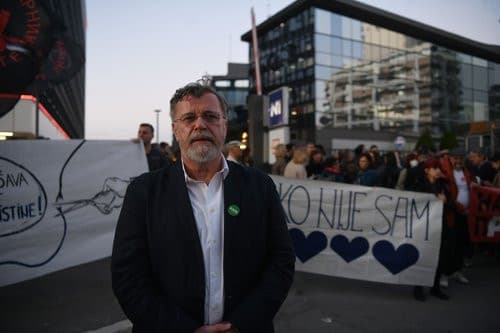
Rodoljub Šabić, a lawyer and former minister, assessed the situation, stating that the state of the media market in Serbia is catastrophic and that a significant portion of the media has been reduced to platforms for brutal political and personal confrontations.
The Board of Directors of Radio-Television of Serbia (RTS), the public media service, is not functioning, while one of the domestic journalists' associations has questioned the validity of the diploma of the newly appointed General Director of the public service, Maja Grčić, notes the Hungarian newspaper.
Behind the events in Vojvodina and Belgrade lies a Hungarian internal political dimension, which, as Nepsava emphasizes, is directly linked to Viktor Orbán's politics, who has, it adds, pressured the institutions of the Hungarian community in Vojvodina.
How could Peter Mađar deal a new blow to Vučić?
Saša Mirković, a representative of the Association of Independent Electronic Media (ANEM), pointed out, as he stated, the significant fact that it was the previous resolute resistance of independent members that prevented the election of a person who would directly represent Viktor Orbán's political and ideological line within the Serbian regulatory body.
This refers to Ištván Bodžoni, the former director of the Vojvodina television Panon RTV, whose appointment to the ninth, decisive position in the REM Council was strongly supported by circles of the then government in Budapest.
The upcoming election of the ninth member of the REM Council will be crucial for the functioning of this regulatory body.
If the Hungarian National Council, managed by the Alliance of Vojvodina Hungarians, continues to play a decisive role in the election process, this time the function could be assumed by a person who would represent the political doctrine and media concept of Peter Mađar.
This could lead to significant changes and contribute to the democratization of media conditions in Serbia.
The close alliance between the authorities in Budapest and Belgrade has become evident in the media sector in recent years, with elements of a centralized model of information, established according to the Hungarian example, systematically appearing in media management in Serbia.
For the authorities in Budapest, it is of particular importance to maintain complete political control over media in the Hungarian language in Vojvodina.
The editorial offices of Panon RTV and the newspaper Mađar So largely depend on the support provided by the State Secretary for National Policy in the Cabinet of the Prime Minister of Hungary, both financially and ideologically.
The candidacy of Ištván Bodžoni for membership in the Serbian regulatory body for electronic media represented a clear attempt to expand that influence to the level of the entire Serbia, thereby granting allies of the Hungarian government direct influence over the allocation of radio frequencies and television licenses.
Under the current circumstances, the REM Council is deeply divided: four independent experts face off against four members previously delegated by the authorities.
This structure allows the Council to make decisions on issues that do not require a two-thirds majority. For example, complaints from citizens regarding media performance, which the regulatory body has not addressed for twenty months due to institutional blockage, could be reconsidered.
Although experts believe that systemic problems and intentional disruption of the media space will not disappear overnight, the beginning of consistent and professional work without political compromises is considered essential for the international community and the domestic civil sector to clearly see how the regulatory body functions.
The Bureau for Social Research (BIRODI) has also officially supported the independent members who ultimately accepted their mandates.
They are expected to, in addition to aligning regulations, publish and make available databases on media monitoring digitally, as well as adopt strict rules that would effectively prevent covert pre-election activities of politicians from the ruling party in the public media service.
The Role of the Hungarian National Council (MNS)
The Hungarian National Council (MNS) represents the official body of personal autonomy and self-governance of the Hungarian national community in Vojvodina, Serbia. The law grants it competencies in the areas of education, culture, official language use, and public information.
Over the past decade, this institution has come under the complete political control of the Alliance of Vojvodina Hungarians (SVM), which has maintained a close strategic partnership with the Fidesz government in Hungary.
As a result, the media in Vojvodina that the MNS establishes or financially supports operate under strict party supervision, while the institution itself serves as a direct channel for transmitting and implementing the models of memory politics and media policy from Budapest to Serbia.
Source: N1