Misogyny and Aggression of the Accused "Bouncer Ćacilenda" for the Attack on the Insider Journalist
Written by Veran Matić, President of ANEM
Dozens of attacks on journalists in the enclosed, illegal, and unhygienic, parapolice camp in Pioneer Park, on the plateau in front of the National Assembly, have not had a judicial outcome. One of the few indictments was raised in the case of preventing journalist and editor of Insider TV, Nataša Mijušković, from performing her journalistic duties while she was subjected to coercion by the accused aggressor from the so-called Ćaciland.
In this case, there would be no epilogue for the violent behavior and coercion had it not been for journalistic solidarity and investigative work. Namely, since the establishment of the so-called Ćacilend, the police have obstructed all cases of attacks by self-proclaimed enforcers, i.e., aggressors. Although the police were often present in front of the National Assembly, they protected the aggressors more than the attacked journalists, activists, or citizens. The KRIK editorial team created a database of the so-called enforcers and those who frequently appear in the area of the so-called Ćacilend. This database included Jelenko Pijevac from Priboj, a “known entity to law enforcement” whom journalist Nataša Mijušković identified as a person against whom the public prosecutor had filed charges, while today, on September 28, the main hearing was held.
In short, the prosecution states in the indictment that on November 2, 2025, in front of the National Assembly, Jelenko Pijevac, along with several others, demanded that the journalist who had taken a recording and several photographs “Take your phone out of your pocket, or we will break all your bones,” while he was squeezing her around the left arm and while other members of this group were preventing her movement. He also added the following threat: “Take out that phone; you don’t know what might happen.” Due to the very uncomfortable situation, squeezed between several violent men, threats, and hand squeezing, Nataša Mijušković took out her mobile phone and deleted the recordings she had made, after which she was allowed to leave the area. In his testimony at the main hearing, Pijevac stated that either Miloš or Novak took her phone, deleted the photographs, and returned her mobile device, while many were not returned, the accused said, suggesting, it can be assumed, that he emphasized the nobility of the act.
Judge Ristić intervened by citing a statement from Pijevac that he had made in the prosecutor's office, stating that the journalist was holding her mobile phone in her hand and that then Miloš or Novak were deleting the content. The accused replied that this was indeed how he testified before the prosecutor.
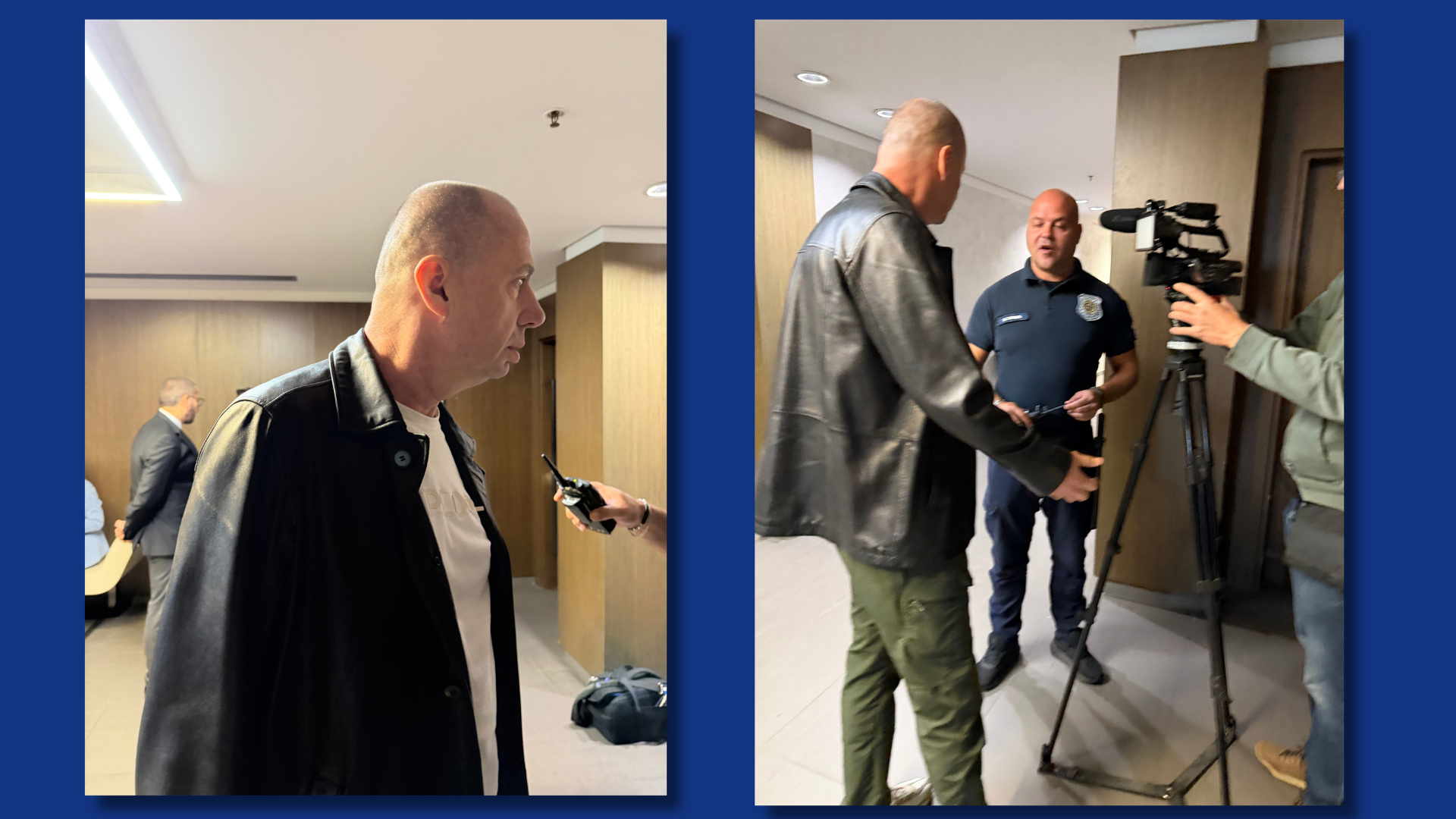
Before the start of the main hearing in the hallway of the First Basic Court in Belgrade, an accredited journalistic team was filming the gathering of those summoned to the main hearing. At one point, the accused Jelenko Pijevac aggressively approached the cameraman from Insajder TV, asking, “Do you have the right to film me here?” Immediately, a representative of the court security intervened, explaining to him that the team has the right to report and film. The accused repeated the same pattern of behavior in the First Basic Court as in Ćacilend and its surroundings. After the intervention of the court security, the accused withdrew.
During the main hearing, after introducing himself as an enforcer, the public prosecutor asked the accused, “Who hired you?”
Jelenko Pijevac replied, “We patriots came on our own.”
According to the KRIK editorial database, these self-organized “patriots” have committed dozens of criminal offenses and have dozens, if not hundreds, of years of accumulated prison sentences.
Jelenko Pijevac himself records court rulings in his biography, which show he has been punished from 1986 to 2023, in Priboj, Bijelo Polje, Užice, and Prijepolje. He also has two convictions in Germany for theft with the use of a weapon and for grand theft in complicity from 2023.
It has also been documented that Pijevac threatened a student in front of the Faculty of Law in Belgrade and threatened a journalist who reported on the illegal disposal of waste.
At the court hearing, Pijevac stated that he has a daughter and a wife and that he would never attack women, although “the journalist was so rude that he had never seen or heard anything like it, and had he been 100 percent a man, he would have reacted differently. As it is, according to him, he held back.” The accused repeatedly emphasized the gender of the journalist and her alleged rudeness.
He stated that he thought the journalist had planted an explosive device and that this was why he approached her. When asked whether he reported this suspicion to the police, which was nearby, he replied: “No, we didn’t trust them.” The defense argues that Pijevac changed his testimony during the interrogation immediately after his arrest at the end of December 2025, and that he did not mention explosives at that time.
He testified that there is a gate in the area of the so-called Ćacilend, although it did not exist on the day of the attack on Mijušković, as it was installed about ten days later.
He also stated that “the scum from N1 and Nova Television could not enter,” later adding that group to include Insajder TV. After a warning from the judge to be polite in his expressions, he stopped using such qualifications but maintained the same tone.
He did not admit to the crime for which he was accused and emphasized the unfair treatment by the public prosecutor. He refused to answer questions from the attorney for the injured journalist. He admitted to saying a lot of things, and that other enforcers told the journalist that she was a traitor and a terrorist.
The main hearing will continue at the end of November.
The expansion of the territory of the so-called Ćacilend to the First Basic Court was unsuccessful.
Journalistic work, especially investigative journalism, has proven to be very important: KRIK's database also helped in identifying the perpetrators of the attack on the N1 team, and the network of contact points between journalistic associations and prosecutor's offices facilitated this case reaching trial.
Therefore, it is important to report every threat, incident, or attack on journalists and media workers to the associations and to the toll-free number 0800 100 115.
Journalistic solidarity is the only real power we can rely on.
Association of Independent Electronic Media (ANEM)
The project “Improvement of the system mechanism for prevention and response in cases of threats to the safety and lives of female and male journalists in Serbia” is implemented by ANEM in partnership with Insajder TV and the Center for the Development of Local Media, with the support of the European Union.
The OSCE Mission in Serbia supported ANEM’s project “24/7 SOS hotline for journalists and other endangered media workers,” within the EU-funded project “Strengthening Freedom of Expression and Media Freedom in Serbia.”
Related Articles

SRG: Information and phone numbers for support for journalists and media on election day, October 25th.

ANEM ALARM: Urgent action required due to horrifying threats against Radar journalists Vuk Cvijić and Milan Radonjić.