

Deliblato Sandstone is burning – the prosecution is threatening: What reporting under the threat of penalties looked like.
Regarding the reporting of the fire in the Deliblatska Sandstone, Veran Matić assessed for Cenzolovka that the announcement from the Higher Public Prosecutor's Office about prosecuting individuals for allegedly spreading "fake news" constituted a concealed, but also an open threat to the critical public. Matić warns that such a message has already created a sense of insecurity among journalists who were professionally reporting on the fire and questioning the actions of institutions, pointing to a broader pattern of intimidation and shifting responsibility from institutions to the critical public.
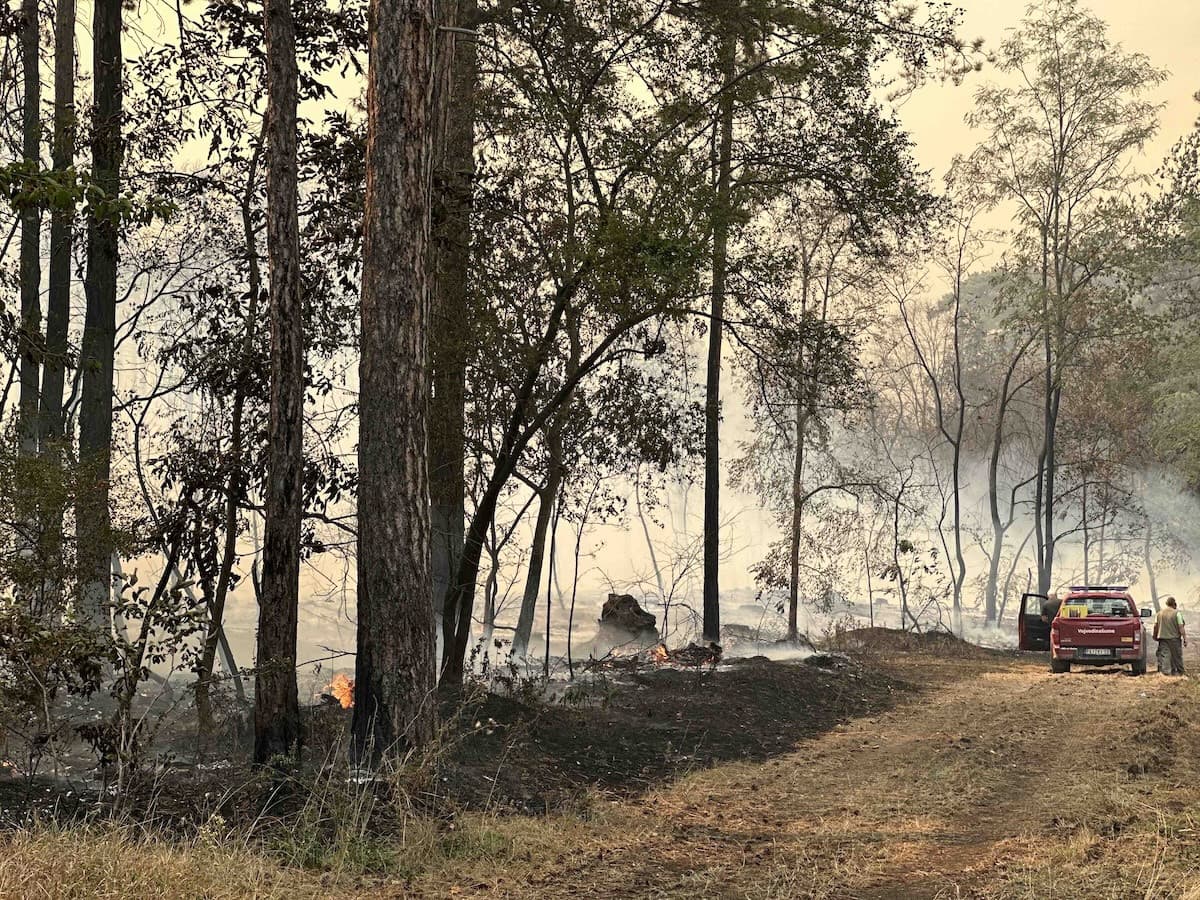
While journalists reported for days from the Deliblatska Sand, in difficult, stressful, and sometimes dangerous conditions, the Belgrade Higher Public Prosecutor's Office announced the prosecution of those spreading "fake news" and "causing panic" – without any explanation of what this announcement entails. So vague, it could also be interpreted as an intimidation of all those who criticize the state's response to the fires. Some journalists ignored it, but others found it quite uncomfortable.
On Wednesday, August 5, shortly after noon, a fire broke out in the Central Zone of the unique sand dune in Europe – Deliblatska. On that day alone, the fire spread to nearly 700 hectares.
Today, at the end of August, it is significantly calmer, but the fire is still active. According to estimates from the Klima 101 portal, around 11,000 hectares of forest and low vegetation have been burned. The damage to biodiversity, animal species, and land cannot be assessed until the fire is completely extinguished, but it is clear that it is enormous.
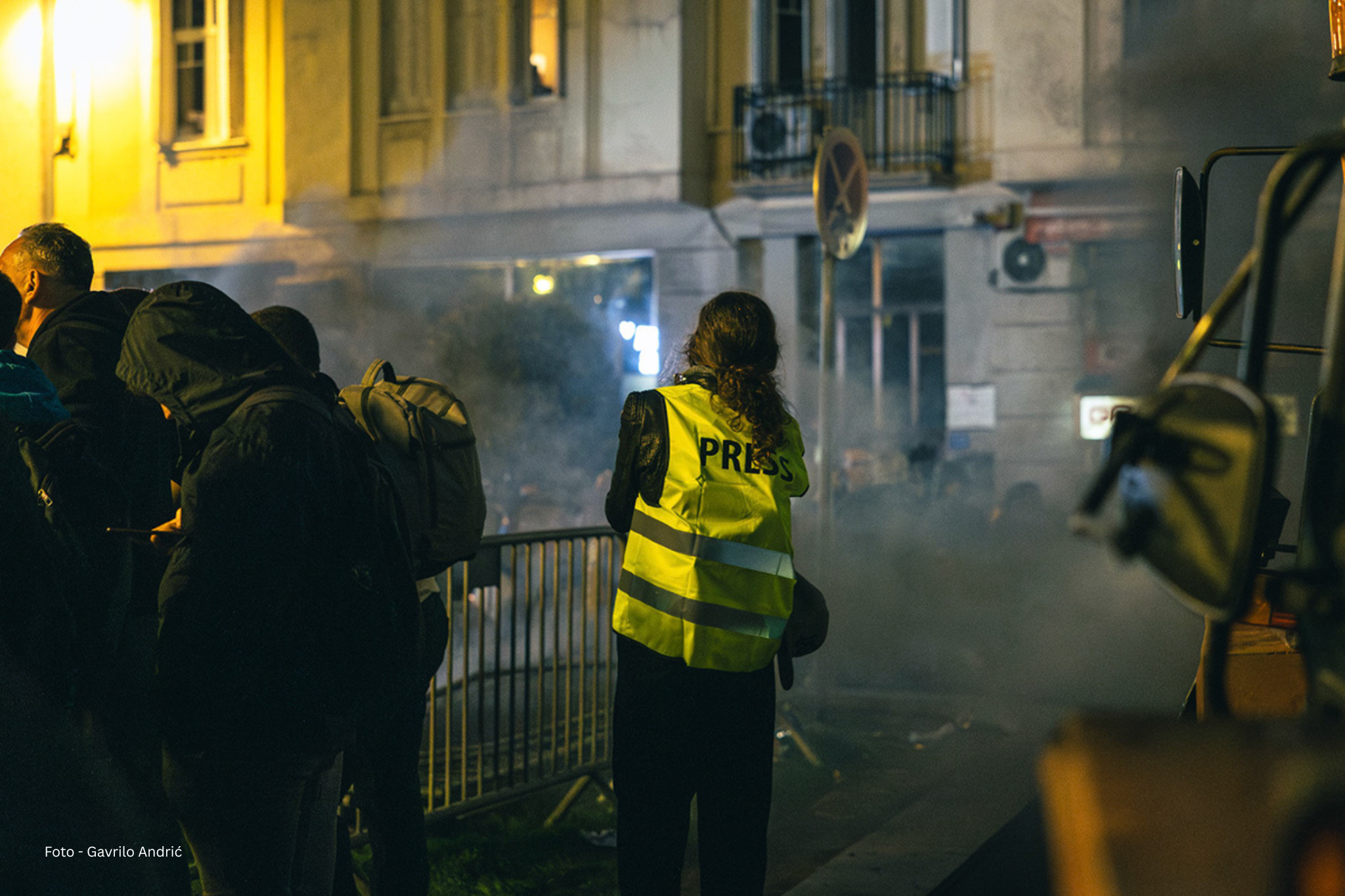
Numerous journalists reported from the field, going to villages and settlements affected by the fires, relaying testimonies from people who live there and who fought the flames. They performed their jobs under extremely stressful and dangerous circumstances.
Miloš Zekić, a reporter for N1, is one of the journalists who spent several days in the affected area. He describes to Cenzolovka that the situation changed hour by hour, and that he experienced some of the most challenging live reports he remembers while working there. Primarily due to the wind that carried ash and sand, making breathing and speaking during reports much more difficult.
“The safety of the team was paramount, and we maintained a reasonable and safe distance. But while we waited for the live report, and even when we were on air, the fire, due to the strong wind, came within just a few dozen meters of us, and there were no firefighters nearby. We had to retreat toward the vehicle during the report,” he says.
He also mentions that he often felt that “words barely came out” after a few hours, but despite that, he continued to work, primarily due to the awareness that he might be the only journalist on site and had a responsibility to convey information in a timely manner.
Darija Stjepić, a journalist for Mašina, describes the same uncertainty.
“I went to the sand dune several times, and each time I fundamentally did not know where I would be able to stay, how much I could follow, or whether I would be close to the fire at all. Information was changing minute by minute. We were constantly in contact with them to hear where it was most critical and which routes we could take,” says Stjepić.
Alongside this stress of reporting under circumstances where they did not know what was happening or where, after about fifteen days of constant fires and ongoing work, another factor emerged – the Belgrade Higher Public Prosecutor's Office.
In a statement released on August 22, they announced that their Special Department for the Fight Against High-Tech Crime would request the police to identify and prosecute individuals spreading false news about the fire in Deliblatska Sand on social media.
The announcement did not provide any explanations or examples of what constitutes false news, nor did it indicate whether this announcement could also apply to the media. So vague, it could also be interpreted as intimidation of all those who criticize the state's response to the fires.
A Constant Atmosphere of Fear
This very uncertainty, say Cenzolovka's sources, is the problem.
At Mašina, Stjepić says they wondered whether the announcement applied to them.
“We did not perceive it as a warning, but we definitely thought about whether it applied to us, since it was not clear whether it referred to the media or individuals on social media, especially since Mašina operates through field reporting on networks,” she says.
However, she adds, there was no self-censorship.
“We continued to work as we had before, as we had always strived to report accurately and truthfully,” says Stjepić.
Zekić states that he did not have any reactions to the announcement.
“I know that I reported professionally and faithfully conveyed the situation on the ground, as did my colleagues in the newsroom who adhered to the Journalists' Code of Serbia. There is no question of spreading panic. That news, in a colloquial sense, went in one ear and out the other,” he says.
The atmosphere of fear, he adds, is not new.
“It is continuously created, aimed at colleagues who strive to perform their jobs honorably. Such announcements contribute to that. But it must not affect the way we report. Our work protects us,” says Zekić.
MATIĆ: CREATED A SENSE OF INSECURITY AMONG JOURNALISTS REPORTING
Veran Matić, president of the Board of ANEM and member of the Permanent Working Group for the Safety of Journalists, believes that this announcement from the prosecutor's office is a clear part of the pattern of how the government operates in Serbia.
“This is a covert, but also an overt threat of persecution against journalists, media, activists, and citizens active on social media – a critical public, those whom the government labels for persecution at any given moment,” Matić tells Cenzolovka.
The mechanism is, he emphasizes, always the same – institutions fail to do their jobs, allowing problems to escalate, and then all their failures are “covered up by the government with a new topic and by shifting blame onto the critical public.”
That the effect has already been achieved, Matić states he knows – firsthand.
“This news reached me from several journalists from different media outlets, asking what can be expected and how to protect themselves. A sense of insecurity has been created among those who reported and raised issues regarding the behavior of institutions, even though they worked professionally,” emphasizes Veran Matić.
The accusation of “causing panic,” according to him, has been systematically used by the authorities since the floods in Obrenovac in 2014.
“This is a strategy of thesis substitution and inciting witch hunts, in order to divert attention from the essence to political confrontations. Since then, the spiral of intimidation has accelerated and become part of how institutions function,” Matić adds.
In response to such announcements from the Higher Public Prosecutor's Office, Veran Matić says the response must be collective.
“It is important to provide all journalists and media with free and strong legal assistance, to expose the manipulations of the prosecutor's office, and to engage the international public. Solidarity is essential for the survival of all of us,” he says.
Inconveniences Experienced by Female Journalists
Some journalists describe that they did not always receive a complete picture or a clear path to the affected areas from the authorities. Stjepić says that she experienced having her access restricted by officials and noticed different treatment of the media.
The police were closing access to the most endangered areas, and there were stories circulating that confirmation from the municipality of Kovin or the emergency management headquarters was needed.
“I asked the police officers securing the entrances how I could obtain that confirmation, but they could not explain it to me. I saw that some media were getting in, so I asked how it was possible to obtain approval. They told me they didn’t know,” Stjepić says.
The crew quickly gave up and accessed the affected locations through locals.
Zekić has a more positive experience from those same police checkpoints.
“Our work was limited for safety reasons. But when we requested permission from the Ministry of Interior a day in advance for filming from a closer angle, we would receive it,” he says.
Female journalists faced another type of problem.
“It is more difficult for female journalists to obtain information because they are often objectified,” says Stjepić.
She adds that when she and her colleague asked for contacts from some locals, they received comments in the form of “jokes.”
“They joked about who would dare to give us a phone number because someone’s wife would be jealous or how a woman could ask a man for a phone number. It was uncomfortable and inappropriate for us because we were doing our job,” says Stjepić.
Related Articles

Journalistic associations provided support to the editorial team of Nova.rs: Ongoing communication and updates with international stakeholders agreed upon.

Coalition for Media Freedom: Stop Attacks and Harassment of Journalists During the Election Campaign


.png&w=3840&q=75)