
"The State is Against Us": How the Space for Independent Journalism is Shrinking in Serbia (VIDEO)
Seventy-one open cases of attacks on journalists in the first six months of the year and only one finalized case, according to data provided by ANEM, indicate almost complete impunity. At the same time, journalists are facing physical attacks, targeting, threats, financial pressures, and attempts to exclude professional media from the public space. "The state is against us," comments Veran Matić, President of the Board of ANEM and member of the Permanent Working Group for the Safety of Journalists, for Mašina.
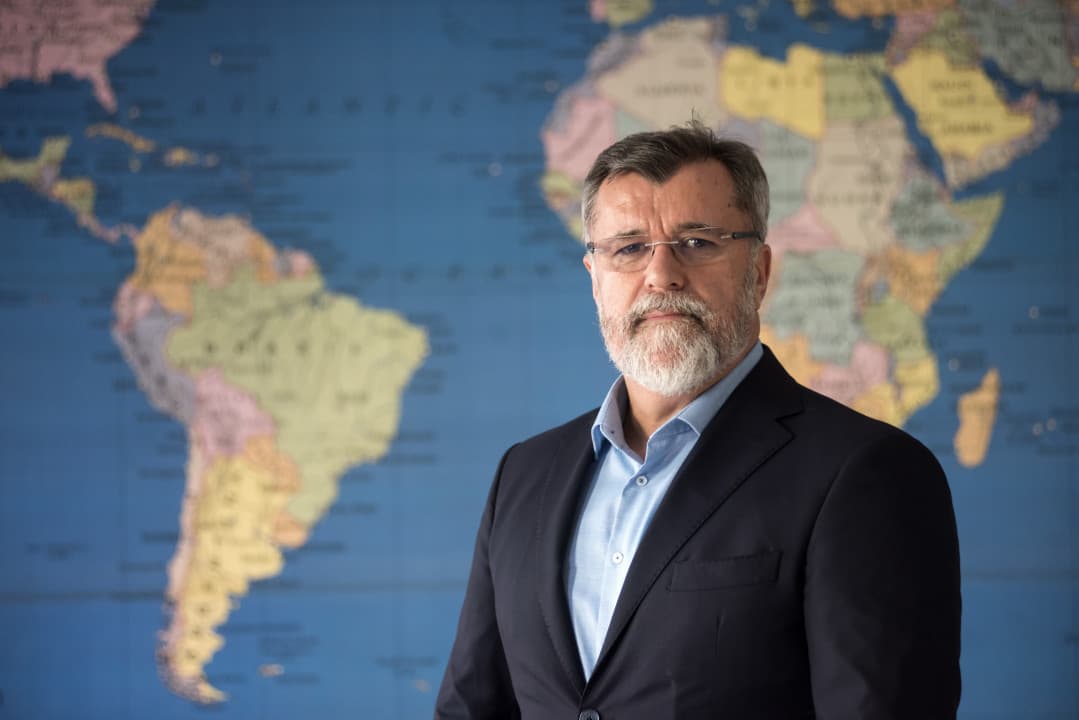
According to the data presented by Matić while discussing the June report by ANEM, in the first six months of the year, 71 cases of attacks on journalists were opened in the prosecutor's offices in Serbia. Only one case has been legally concluded, while all others remain open.
“In the first six months, we have 71 open cases in the prosecutor's offices in Serbia, and of those, only one is legally concluded. All others remain open, which reflects a trend over the past two years of almost complete impunity regarding attacks on journalists,” says Matić.
According to him, in addition to physical attacks and threats, a new form of institutional pressure has emerged in June, through the actions of the Higher Public Prosecutor's Office related to alleged attacks on the constitutional order.
“In June, we have a completely new situation where indictments from the Higher Public Prosecutor's Office for undermining the constitutional order and attacks on the constitutional order have appeared, which are very serious, with very severe penalties, and which intimidate, among others, female and male journalists, all those who had any connection to or mentioned the term ‘sound cannon.’ The Higher Public Prosecutor's Office has initiated a witch hunt without any evidence and for no reason,” Matić assesses.
He cites the departure of journalists from the country as one of the consequences of such an environment. According to him, Aleksandar Radić is the sixth journalist to leave Serbia in the past two years.
“The number of not only attacks but also horrifying threats and attempts to practically force journalists into either internal or external exile is increasing. This indicates an impending dictatorship in Serbia because when you have journalists in exile, when you have students and activists in exile as we have in the past two years, then it is truly a terrifying situation,” says Matić.
Journalists Targeted at Public Events
Matić points out that attacks continue at public events, where journalists should be able to report without obstruction.
As an example, he mentions the case of N1 journalist Gordana Bjeletić, who was attacked during the Pride caravan in Pirot, where the reporting of the journalist from the portal Mašina and the journalist from Tampon zone was obstructed.
“Once again, we have attacks on journalists at public events. This time, it is a completely paradoxical situation in Pirot where Pride was not allowed and participants of that protest were not permitted to arrive, as the city center was occupied by perpetrators and right-wingers surrounded by the police, who were practically protecting them, not those who were supposed to hold the protest. Our colleague Gordana Bjeletić, a correspondent for N1, was attacked, pelted with eggs, and paradoxically, the police were protecting the perpetrators from a journalist who was there reporting and simply doing her journalistic job,” says Matić.
According to him, local media reporting on events of immediate public significance are particularly endangered.
“A large number of local media and local journalists have also been targeted, primarily in reporting on events of public significance. For example, there were fires at a landfill in the vicinity of Prijepolje where two practically editorial offices were attacked, TV Forum and A1, as well as Rec Media from Užice,” Matić notes.
He believes that in Serbia, it is not simply a matter of polarization between different media camps, but rather the discrimination of professional journalism.
“I wouldn’t call it polarization because there is no polarization. You have journalism and you have propaganda. The other media are engaged solely in propaganda and cannot be called journalists because they permanently violate the code and should simply not be considered journalists. Professional media and professional journalists who report according to journalistic codes, respecting them and complying with the laws of this country, are discriminated against. Those who work in the public interest are discriminated against precisely because the state undermines the public interest and has turned everything into a private interest,” Matić assesses.
Control of Information and “Darkening of Serbia”
Matić sees the attitude towards journalists reporting from fires and other crisis events as part of a broader policy of information control. In his assessment, institutions are trying to limit what the public can see and learn.
“They are looking at damage control. They are looking at how to protect themselves regarding the fire that occurred because certainly, there is a certain responsibility for institutions that do not take adequate care of protection, including against fires, and do not adequately consider capacities for firefighting. I believe this is a desire to simply hide what is happening because they are aware that what is happening in society is negative and very, very bad,” says Matić.
He cites the case of Stevan Filipović as particularly concerning, who, according to him, had his phone confiscated after filming a violent event.
“As a responsible citizen, he filmed a violent act against a building protected by the state, which is evidently perpetrated by government officials from the ruling party in the very center of Belgrade. His phone was seized. He was indeed beaten. He has severe, severe injuries. And now we see where that phone has traveled. It was first with the police. It’s evident that among the team that attacked him was someone from the police,” Matić notes.
In such events, he believes that the goal is not only to remove individual recordings but to broadly limit the public from seeing what is happening.
“They want to darken Serbia, to ensure that nothing is visible in Serbia, that only Informer is seen. We also see this, among other things, in what happened in January and February when Instagram accounts and social media accounts of media and Radar and yours and some other media were darkened,” says Matić.
He believes that the earlier restrictions on accounts may have been a sort of rehearsal for even broader information control.
“I think that was a general rehearsal for darkening Serbia at some point when the authorities determine that on that day they need to do it, and I assume that is the day when elections are held, and when the results start coming in at eight o'clock in the evening, that a comprehensive darkening of those media that will strive to inform professionally will be applied, including about the electoral theft that will certainly occur,” Matić asserts.
Financial Exhaustion of Independent Media
According to Matić, pressure on independent media is not limited to violence and threats. One of the key ways to weaken them is financial exhaustion.
“Media are completely isolated from any financial inflow. Whether it concerns advertisers or project co-financing, etc. Professional media are completely cut off from funding sources. Only donations remain, which are very small,” says Matić.
He also warns about the announcements of laws on “foreign agents,” which, according to his interpretation, could further endanger media and civil society organizations that receive international support.
“Now we have this new trend where through the appearances of an obscure figure, Vukuša Dragojević, the making of a foreign agents law is being emphasized, where practically everyone who applies for and receives any international donation, including those from the European Commission, will be defined as foreign agents. This is a Russian model.”
Matić believes that such a law may be withdrawn under international pressure, but that damage will already have been done.
“It is evident that a decision has been made to create a harmful law that will later be retracted under the pressure of the international community, the Venice Commission, etc., but it will cause great damage as it will intimidate, among other things, civil society organizations and media from applying or withdrawing from that work and will intimidate donors as well,” he evaluates.
Experience of the Nineties: When Institutions Do Not Protect
For Matić, the experience of independent media in the nineties shows how alternative support networks can be created under conditions of institutional repression.
“I led Radio B92 for ten years in the nineties, with four bans. Complete bans. Twice everything was taken from us, and we had to start over. This speaks to the fact that what I am now saying about solidarity and rallying the ranks is actually — we created a parallel society in the nineties.”
As he explains, they did not rely on institutions at that time.
“We lived; we created our parallel society, established our cultural centers, created an alternative music scene, publishing, and so on. And this was something related to mutual solidarity because we could not rely on the authorities at all back then.”
Matić believes that the question of how to organize in a situation where institutions do not provide protection is once again being raised today.
“Until now, we have always expected, okay, rule of law, institutions, and so on. There is none of that because practically the state is against us, and those institutions that should protect us are attacking us, and we must protect ourselves even from those institutions. This is a completely new situation.”
Pressure Descends to the Local Level
Matić warns that the targeting model that has been characteristic of the national level for years is now increasingly being transferred to local communities.
“The targeting that we constantly experience, for example, from Informer, is now shifting to the local level, and we have small Informers in Valjevo, Šabac, Čačak, where everyone that they cannot reach from here is targeted, local activists, those who have survived severe violence, and all those who document and publish everything, to ensure that they are completely isolated in that local community, to be discredited in the local environment,” says Matić.
The problem is, he believes, particularly pronounced in smaller communities where people are often not willing to expose themselves to public targeting.
“Very often the situation is such that someone who lives locally is not really ready to expose themselves, to target their neighbors, and so on. That is why pogrom teams from the Belgrade editorial office of Informer go to Valjevo, Čačak, and Šabac and other cities to target local activists, local intellectuals, representatives of opposition parties, and so on.”
The consequence, according to Matić, is the exhaustion of already weakened local editorial offices.
“It is certain that this year many will give in. I believe that the media are already exhausted; the vast majority of media at the local level are exhausted.”
He cites Radio Sloboda from Kraljevo as an example, for which money is currently being raised to ensure its survival.
“We are now conducting a campaign for Radio Sloboda from Kraljevo, raising funds; we need about ten thousand euros for the editorial office to survive in the next few months, so it does not shut down. It is one of the few radio stations in Serbia.”
“We Are All That Is Left”
Matić believes that, in such a situation, mutual solidarity has become the last line of defense for independent journalism.
“We are all that is left, and our mutual solidarity on the ground, to protect each other in those situations and when reporting from such areas where elemental, horrifying disasters and fires occur, to those times when reporting from protests where perpetrators come from and where police attacks come from, and so on.”
That solidarity, he adds, must also be financial.
“When it comes to existence, we must help each other, at least by publishing the truth about what is happening and calling on citizens to show solidarity.”
For Matić, citizens play a crucial role in preserving independent media because the struggle is not only for journalists but for the public’s right to know what is happening.
“We are not doing this solely for ourselves, among other reasons. Of course, we are doing it for ourselves. But we are doing it for the public, for the public interest, and for the fact that we want the best for this country, for all citizens to be equal, and for this to be a rule of law, for institutions to function, and for everyone to be adequately protected.”
Therefore, Matić concludes, the survival of independent media is simultaneously a question of the survival of the public interest.
“If citizens want such a country, it is very important to help the media survive. There are very few of them, and they are, of course, becoming fewer, and that is why this warning is very, how should I say, dramatic and the red lights are already flashing.”
Source: Mašina
Related Articles
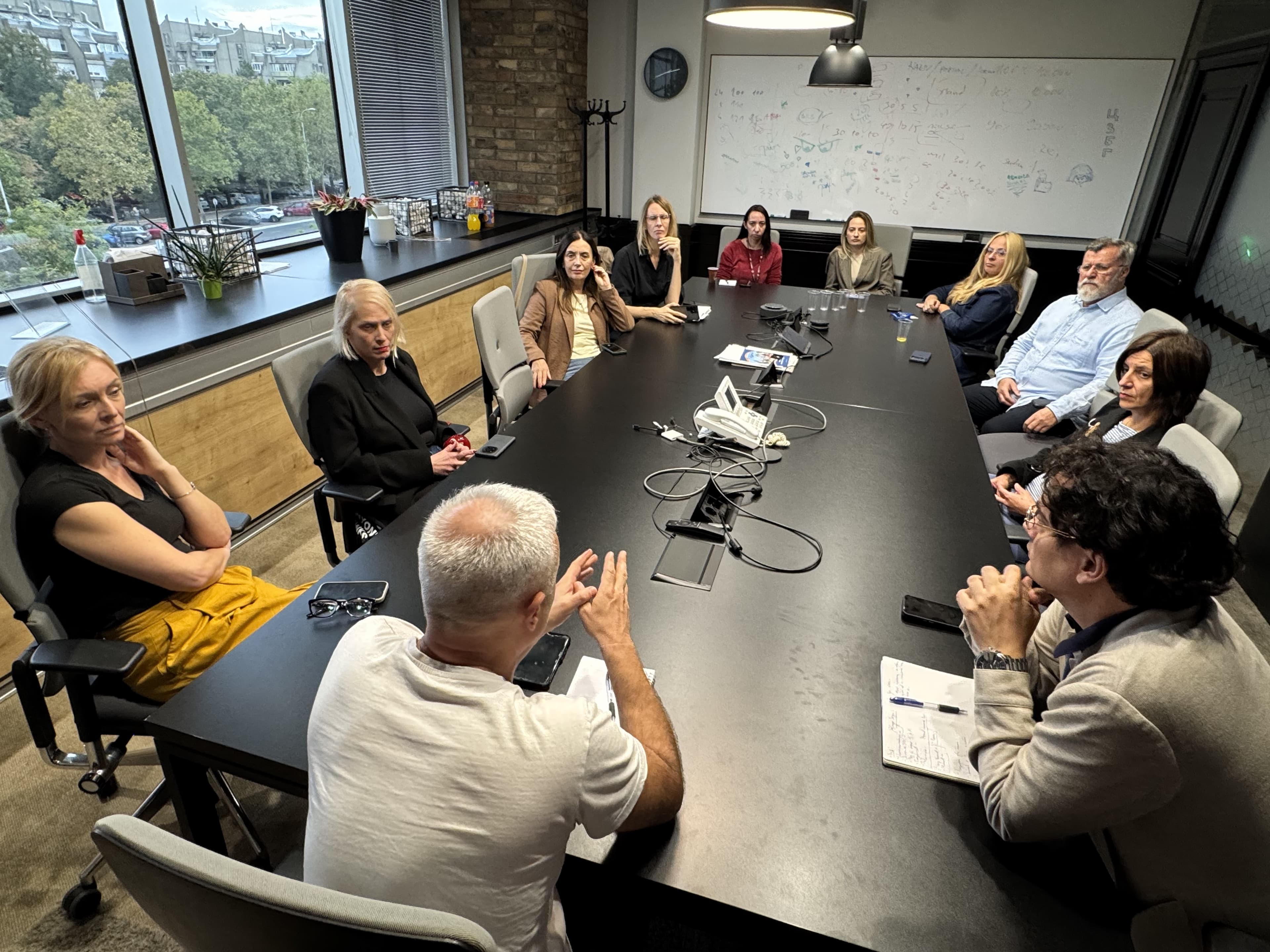
Journalistic associations provided support to the editorial team of Nova.rs: Ongoing communication and updates with international stakeholders agreed upon.

Coalition for Media Freedom: Stop Attacks and Harassment of Journalists During the Election Campaign


.png&w=3840&q=75)