
IFJBlog: Nearly 40 years after defending journalism, Veran Matić is once again the target of attacks.
In Serbia, the systematic destruction of a journalist's reputation has surpassed even an authoritarian scenario. In version 2.0, the assault on his character is a dangerous, acrobatic scenario at the gates of the European Union, while Brussels looks the other way. The Independent Association of Journalists of Serbia (NUNS) and the Association of Journalists of Serbia (UNS), members of the International Federation of Journalists (IFJ), have repeatedly expressed concern over threats to journalist Veran Matić and demanded that his safety be guaranteed.
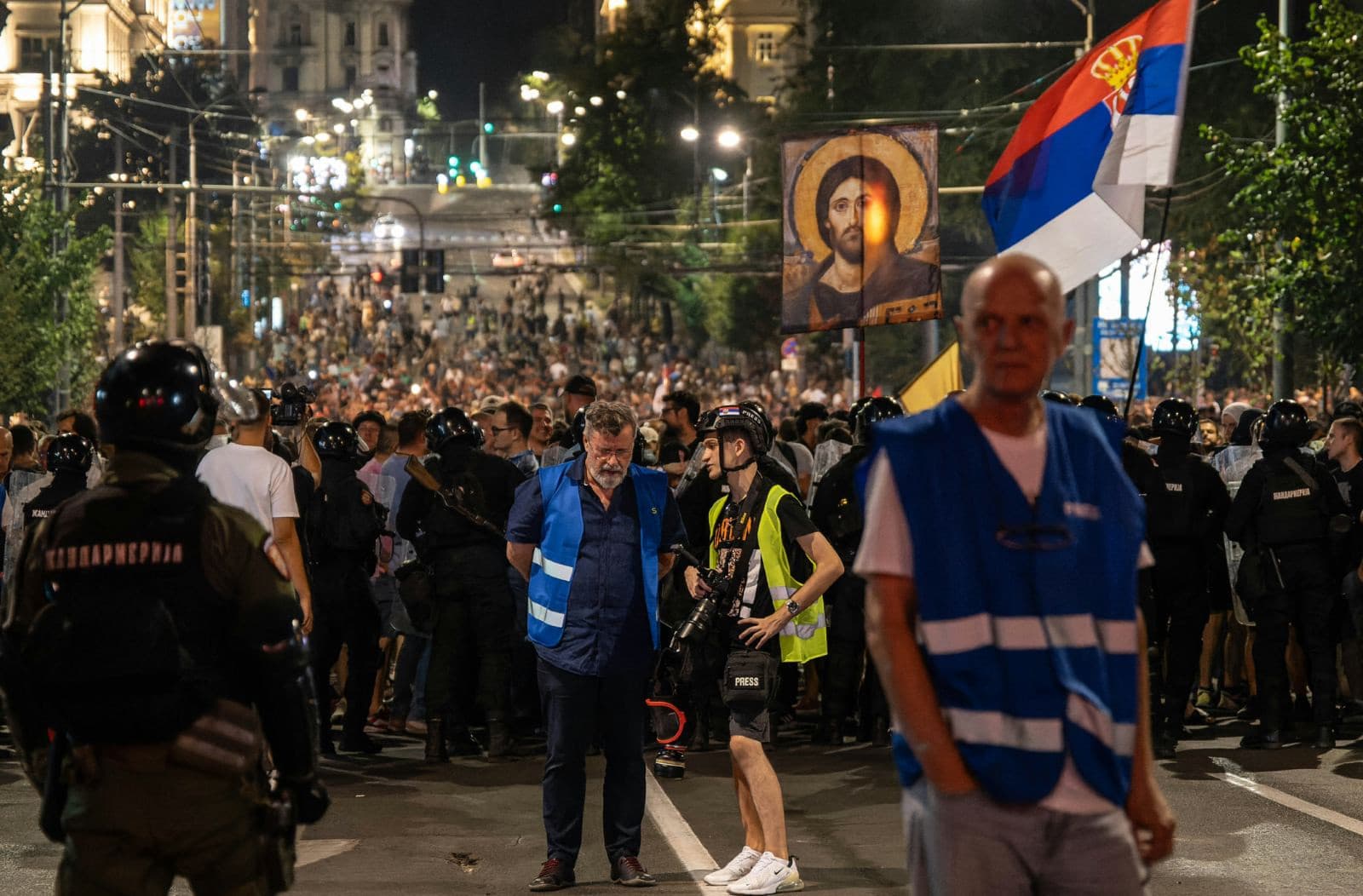
On June 17, Veran Matić — the founder of Radio and TV B92, a global hero of press freedom according to the International Press Institute (IPI), and a person to whom Serbian journalists have turned for decades when under attack — was filming a public gathering in front of the National Assembly of the Republic of Serbia when someone knocked the phone out of his hand.
It didn’t help that Matić identified himself as a journalist. His phone was returned only after Đorđe Prelić — a former leader of the notorious fan group Alkatraz and one of those convicted for the murder of French football fan Brice Taton in 2009 — ordered that the phone be returned. Prelić then told Matić that his show “Insajder” on B92 “ruined his life.” (This program exposed the criminal activities of football fan groups.)
In an atmosphere of complete impunity for crimes against journalists, where daily threats and suppression of free speech are commonplace, and the media are under threat, Veran Matić perceived Prelić’s words as any professional journalist would: he interpreted them as a threat from which potentially dangerous actions could arise. Words as a warning and a prelude to an attack.
Escalation of threats against journalist Veran Matić
For months, Matić has been subjected to ongoing campaigns of targeting and discrediting on pro-government television networks and through more than 30 websites, as well as on various social media platforms such as Facebook, Instagram, and X. Insults and threats are left in the comments under posts mentioning his name.
The security of the National Assembly reportedly did not witness the incident. That is, until Matić reported the attack. Only then did pro-government media tabloids: Informer, Alo, and Novosti, release footage from the assembly’s security camera, claiming it was evidence that Matić was the aggressor.
After a series of smear campaigns in pro-government media, beneath Matić’s photo on X, it read “Let’s cut off the head of the hydra.” A new wave of messages soon followed, calling for him to be hanged, publicly sacrificed, along with inquiries about where he lives.
Since the beginning of the year, Matić and his family members have received dozens of death threats. He has been subjected to hundreds of insults and lies on social media. He has been insulted and threatened on the street, and he was pushed aside in an alleged “accident.”
The president of the Independent Association of Journalists of Serbia (NUNS) became a target of harassment after President Aleksandar Vučić suggested in a tabloid TV show that all those convicted due to Matić’s involvement in the Permanent Working Group on the Safety of Journalists should have their records cleared and that Matić should apologize, and perhaps even buy a nice bottle of wine.
The culmination of the campaign was a propaganda film from the Center for Social Stability, which labeled Matić as a foreign agent who “sold” Kosovo — Kosovo declared independence in 2008, which Serbia does not recognize. The film aired on two national pro-government broadcasters and was promoted by more than 25 pro-government portals.
The state’s response to this shameless aggression was that a court in Novi Sad refused to issue an injunction against the airing of the film.
Even when the Center for Social Stability posted on X and Instagram: “If any of you see Veran Matić in the next month or two, tell him he is not the only (pseudo) journalist who has grown a beard and that he should be a little more patient — continuation soon...,” the clear message in the Serbian context was that Matić would meet the same fate as the assassinated Serbian Prime Minister Zoran Đinđić and journalists Slavko Ćuruvija and Milan Pantić, with the rule of law remaining absent.
Anyone who lived in Serbia at the end of the last century would understand the implications of this message. It is a brutally direct death threat.
Journalists forced to relocate
The responses from the Ministry of Internal Affairs to Matić’s criminal complaints have been rude. Particularly considering that Serbia has witnessed a widespread and systematic pattern of attacks and smear campaigns against journalists over an extended period.
In July 2026, the Independent Association of Journalists of Serbia recorded 19 cases of attacks and threats against journalists. The Slavko Ćuruvija Foundation, a non-governmental organization that works to advance media freedom in Serbia and is named after the murdered journalist, documented 106 verbal attacks from state officials. According to the official records of the Supreme Public Prosecutor’s Office, in the last two and a half years, only twelve of the 271 recorded threats and attacks against journalists resulted in final court judgments.
Among other things, many female journalists in various Serbian cities have received death threats, threats of sexual violence, and have been the subject of online misogynistic campaigns from pro-government media due to their reporting.
Moreover, in the past two years, six journalists have been forced to leave the country. Matić has assisted each of them.
In 1989, Matić and his colleagues, founding Radio B92, referred to the Universal Declaration of Human Rights as their founding document. In 1991, police raided the B92 newsroom, and five years later, the station circumvented censorship by broadcasting its signal via the BBC with satellite support. During the NATO bombing in 1999, Matić was arrested, and the media were forced to operate from “secret” locations. He responded by relocating the signal to Romania and Bosnia. The secret location in Belgrade was involved when the ruthless Serbian ruler Slobodan Milošević fell.
Due to his incredible contribution to investigative journalism through the launch of the show “Insajder” which aired on B92, Matić was under 24-hour police protection from 2011 to 2016.
In 2013, he initiated the Commission for the Investigation of Journalist Murders, demanding that the murders of journalists be investigated and prosecuted.
Many international and regional organizations defending media freedom have reacted to the attacks on Veran Matić — the IFJ and EFJ sent a warning to the Council of Europe Platform, SafeJournalists are calling for criminal prosecution, and IPI, RSF, and MFRR have concluded that further escalation is dangerously likely after their mission in Belgrade in March.
The OSCE Representative on Freedom of the Media, Jan Bratu, called the film from the Center a direct death threat. The office of the EU Commissioner for Enlargement, Olivér Várhelyi, stated that it is very concerning that Matić is exposed to attacks because of his work. The European Parliament condemned the violence in October 2025.
Despite these reactions, nothing has changed.
Impunity in Serbia is not a judicial “backlog.” It is state policy, and every unpunished threat is a call for the next criminal attack.
Veran Matić has spent thirty-seven years ensuring that someone reacts when a journalist is attacked in the country. When attacks on Matić come from the sharp claws of the regime and its followers, who will ensure his safety?
Author: Jelena L. Petković
Source: IFJ
Related Articles

Journalistic associations provided support to the editorial team of Nova.rs: Ongoing communication and updates with international stakeholders agreed upon.

Coalition for Media Freedom: Stop Attacks and Harassment of Journalists During the Election Campaign

.png&w=3840&q=75)