
Coalition for Media Freedom: Serbia welcomes May 3rd as a country where practicing journalism is becoming increasingly dangerous, while institutions are growing more passive.
On May 3rd, World Press Freedom Day, the Coalition for Media Freedom warns that Serbia is facing a serious crisis regarding media freedoms, the safety of journalists, and labor rights in the media sector. Therefore, we call on all journalists and media outlets to join the international symbolic action of FIVE MINUTES OF DEAFENING SILENCE by turning off their sound, darkening their screens, and silently participating at TWELVE TO TWELVE, in order to remind the authorities and the wider public once again of the consequences of the continuous jeopardization of media freedoms, which are already evident in all areas, from the political system to the rights and freedoms of all citizens.

The latest data shows that Serbia is experiencing the most dramatic deterioration in journalist safety in the region. According to the Journalist and Media Worker Safety Index for the Western Balkans, Serbia ranks last on the overall list for 2025, behind Bosnia and Herzegovina, Kosovo, Albania, Montenegro, Croatia, and North Macedonia. The drop from 2.70 to 2.24 indicates a serious regression compared to the previous year.
At the regional conference of the SafeJournalists network, Serbia was presented in 2025 as the most problematic case in the region: formal protection mechanisms exist, but in practice they are collapsing, while the number of threats, physical attacks, police violence, and institutional inaction is recording a dramatic increase.
The worst area for Serbia is the actual safety of journalists. The SafeJournalists network recorded 317 incidents against journalists and media workers during 2025, of which 116 were in the form of physical attacks.
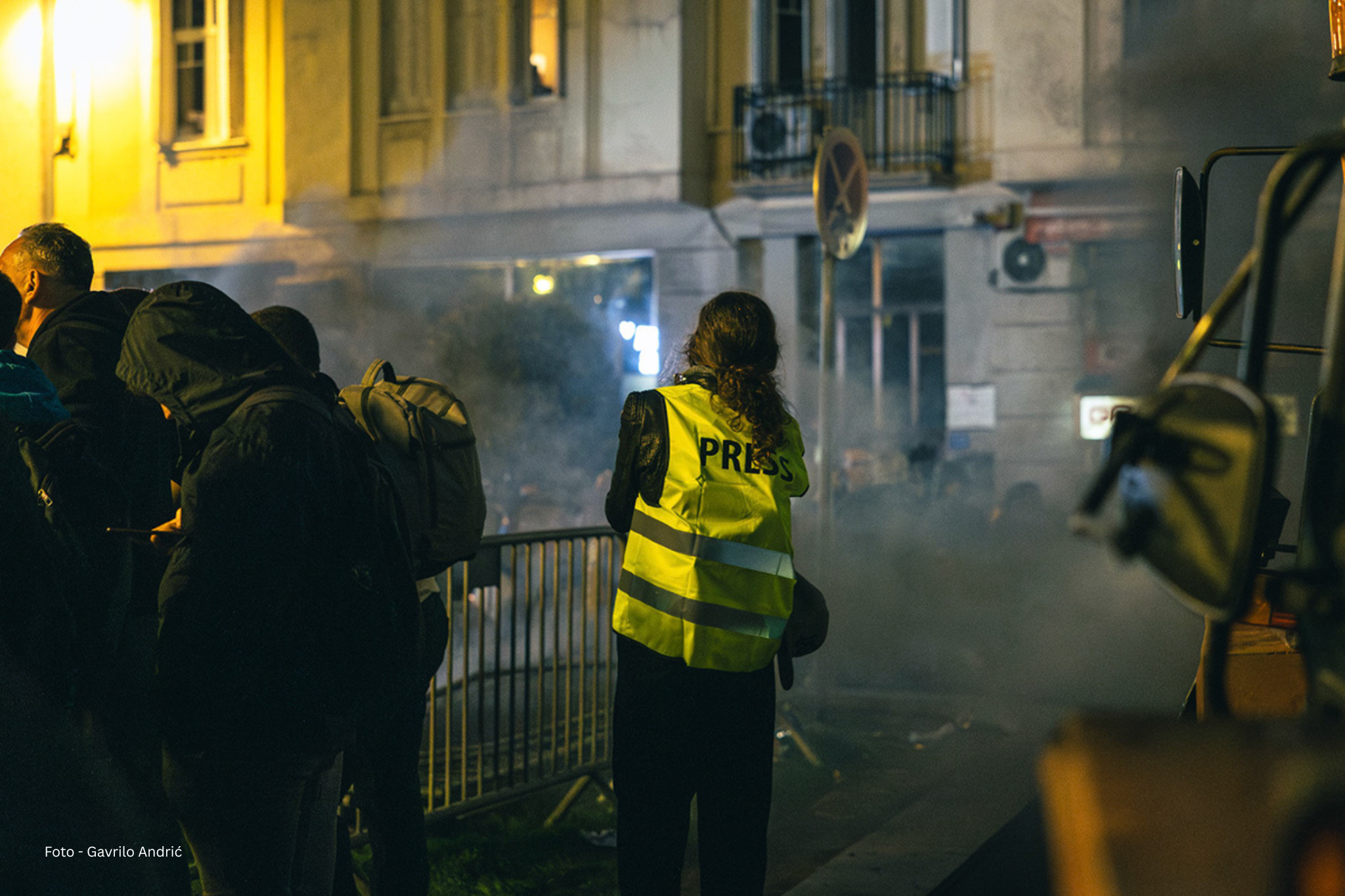
Particularly concerning is the attitude of the police towards journalists. From March to the end of December 2025, NUNS recorded 77 cases of attacks by the police, unlawful detentions, and identification of journalists, as well as police inaction when present at the scene. Of this number, 26 cases involved female journalists. More than 30 physical attacks involved actions by police officers.
Serbia has one of the most developed formal mechanisms for quickly reporting attacks on journalists, but during protests, journalists reported that the police refused to register complaints and provide assistance. This indicates that mechanisms exist on paper, but their implementation depends on the political and institutional context, rather than on the law and the state’s obligation to protect journalists.
The Coalition for Media Freedom warns that hostile rhetoric, targeting of journalists, pressures on the prosecution and police, as well as the lack of public and unequivocal condemnation of attacks, have directly contributed to an atmosphere where threats and violence against journalists have become almost a daily occurrence. The problem of impunity, lack of transparency, and ineffective actions by relevant institutions remains one of the key reasons why attacks are repeated.
Verbal attacks by high-ranking state officials and members of the ruling party on journalists and media create a lynch atmosphere and encourage violence through narratives that criminalize them. According to data collected and published by the Slavko Ćuruvija Foundation, from August 1, 2025, to March 31, 2026, at least 1,191 verbal attacks by high-ranking state officials were directed against critical journalists and media in Serbia.
Additional concerns arise from reports of surveillance and the use of spyware tools against journalists, which poses a serious threat not only to their safety but also to the protection of sources, investigative journalism, and citizens' right to be informed.
The worsening state of media freedom in Serbia is confirmed by the latest Media Freedom Index by Reporters Without Borders. Serbia is ranked 104th out of 180 countries for 2026, a drop from 96th place last year, and is in a group of countries where the situation is classified as "difficult." According to RSF, Serbia is the lowest-ranked country in the region and among the worst in Europe.
In addition to threats and attacks, journalists and media workers face extremely unfavorable working conditions. The position of local journalists is particularly difficult. Low salaries, lack of compensation for overtime work, disregard for working hours, insecure contracts, and constant uncertainty regarding the survival of media outlets lead to the exhaustion of the profession and an increasing number of people leaving journalism.
Young journalists are particularly exposed to insecure engagements, pressures, and economic blackmail, which seriously affects their mental health. In local environments, many are forced to leave the profession or take on additional jobs to survive.
Unions are virtually nonexistent in private media, while some employers actively discourage unionization. Only a small number of media outlets have collective agreements that protect workers' rights, and systemic protection for journalists and media workers is almost non-existent.
The Coalition for Media Freedom emphasizes that media freedom cannot exist where journalists are physically endangered, economically exhausted, institutionally unprotected, and constantly subjected to pressures. Attacks on journalists are not only attacks on individuals and editorial offices but also attacks on the citizens' right to know.
Therefore, the Coalition for Media Freedom demands that relevant institutions urgently and effectively investigate all attacks, threats, and pressures on journalists and media workers; ensure accountability for police officers who have attacked, detained, identified, or failed to protect journalists on duty; cease the practice of targeting critical media and journalists; provide transparent action by prosecutors and courts in cases of attacks; and urgently adopt and implement measures to improve the economic status of journalists, protect labor rights, and strengthen local media.
Without safe journalists, free editorial offices, and dignified working conditions, there can be no free media. And without free media, there is no democratic society.
The Coalition for Media Freedom consists of the Media Association, the Online Media Association (AOM), the Independent Journalists’ Association of Vojvodina (NDNV), the Independent Association of Journalists of Serbia (NUNS), the Business Association of Local and Independent Media "Local Press," the Slavko Ćuruvija Foundation, and the Trade Union of Culture, Arts, and Media "Independence."
Related Articles

Journalistic associations provided support to the editorial team of Nova.rs: Ongoing communication and updates with international stakeholders agreed upon.

Coalition for Media Freedom: Stop Attacks and Harassment of Journalists During the Election Campaign

.png&w=3840&q=75)