
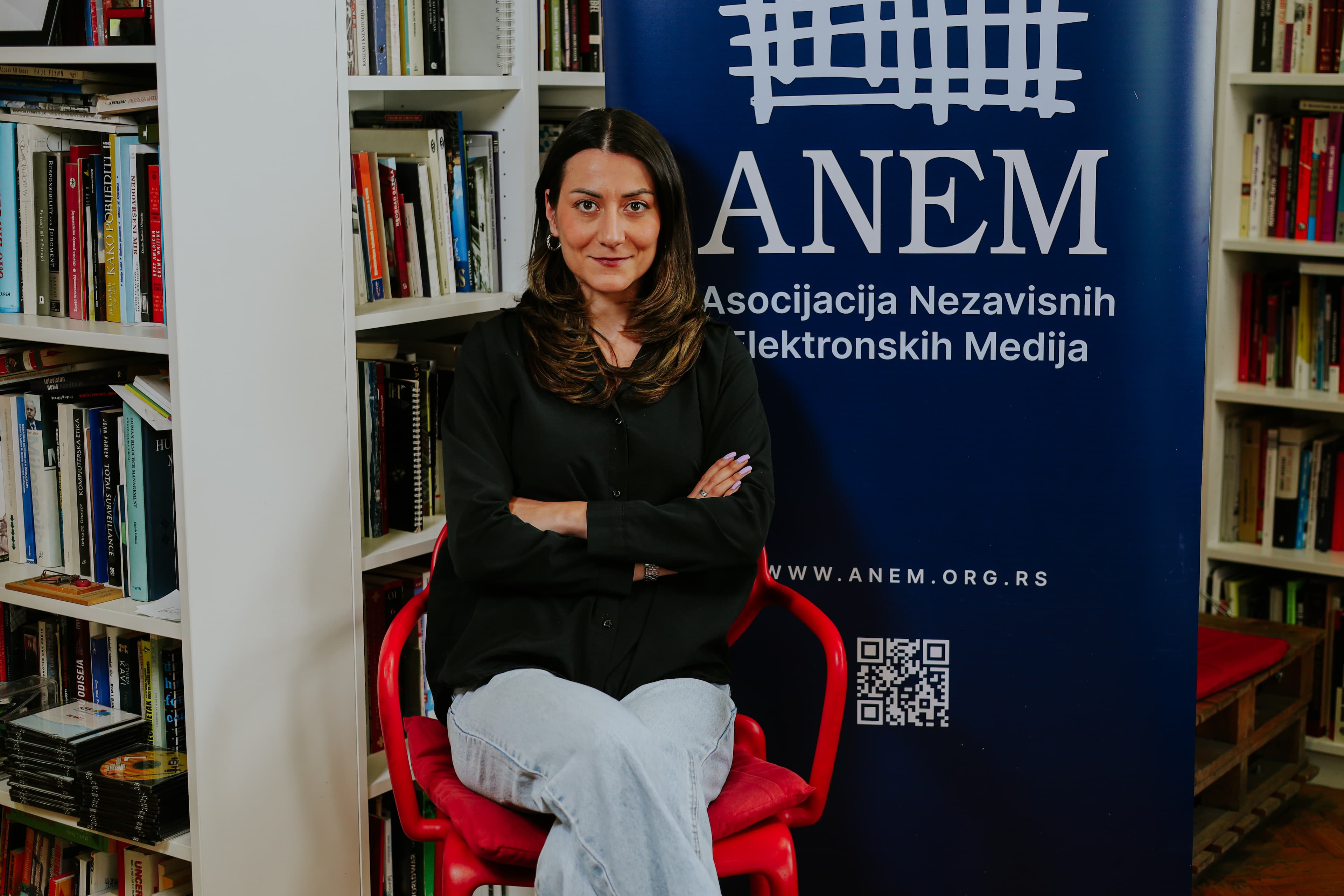
"Journalists in Serbia either complain or criticize," says Sanja Petrov, editor of the portal "Slobodna reč" from Vranje.
In the world of local journalism, where media workers often face the choice between silencing the truth and existential uncertainty, Sanja Petrov and her team launched the portal "Slobodna reč" in Vranje in 2020. Established in response to the "gap" in information and the need to dig "behind the news," this media outlet has set itself the mission of restoring integrity to the profession in an environment where many media capacities are under regime control. For Sanja, the editor of the "Slobodna reč" portal, being an independent journalist at the local level means balancing the mission of informing citizens with the harsh reality in which journalists, according to her, are often either "pitied or spat upon," while the financial survival of the newsroom depends solely on donors who support media freedom.
Here’s the translation of the provided text:
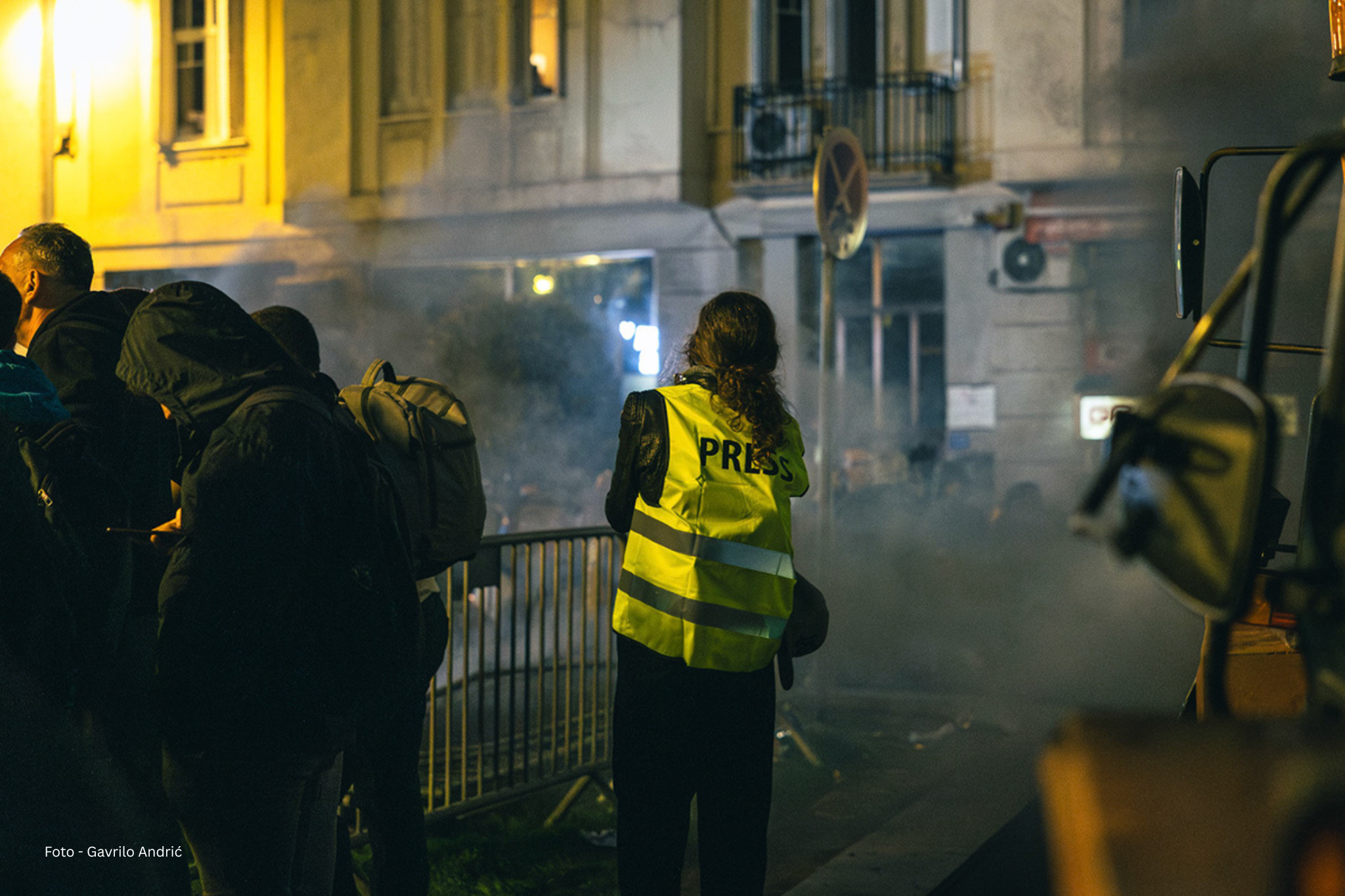
The path to that freedom is paved with serious risks – from direct threats of physical violence to absurd labels from foreign intelligence services regarding the alleged organization of a "Maidan" in Serbia. Sanja Petrov has become a symbol of resistance after she appeared at a protest in front of the Presidency with a banner bearing a striking message – "a helmet doesn't go with my outfit." With this act, she expressed her firm refusal to accept a helmet as a normal and necessary part of journalistic equipment in 2026, fighting against the normalization of fear and violence in society.
How did the portal "Free Word" come about? It was founded in 2020, and last year you celebrated five years of existence…
At that time, we were a group of young people who recognized a void in the media landscape in Vranje. For several years, the media image in Vranje had been such that people mostly dealt with everyday political and informational topics, and no one delved deeper into the problems of citizens. Nobody went beyond the news, as the saying goes. Those who had the capacity to do so were already well under the regime's control, and now they are definitely under regime control. Those who did not have the capacity to do so did not pursue this for that very reason.
So, we were a team of younger people who wanted to go beyond the news in Vranje and remind the people of Vranje that they live in a city with a serious legacy when it comes to media. We wanted to restore integrity to this profession, to journalists and the media, and to remind people of the importance of local media that are not under anyone's control.
You have a very specific logo, as well as the name of the portal. What is the background behind that?
From the very beginning, we paid a lot of attention to our visual identity. We wanted to create a brand for our media, for our portal. As for the logo, it features a raven. You can assume the connection to the name of the city of Vranje, even though there is no official link.
Regarding the name, there used to be a media outlet in Vranje called Free Word. It was published after the liberation following World War II. It was exceptionally high quality. Then, for a while, it was published under the name Vranjske novine.
So, we decided to pay homage to quality journalism in Vranje by naming our portal after the former media outlet Free Word. We immediately attracted attention due to the design, the visual identity, and the quality of the texts because, for a long time in Vranje, after the closure of Nedeljnik Vranjske, there had not been such texts that went beyond the news.
Since 2020, you have been the editor of Free Word, and prior to that, you were at Nedeljnik Vranjske, in sales, marketing, and the civil sector. How has that diverse path influenced how you lead the editorial team today, and what was the moment you decided to return to journalism through Free Word?
I didn’t step back from Vranjske; I fled. Not because the editorial team was bad, but because I reached an age where I had to make a living, and Vranjske had serious problems surviving and paying fees to employees at that time. Unfortunately, I had to leave, and it was at the moment when the current regime toppled the SPS in Vranje after several decades. I was a witness to that change and everything that was happening for a short time. Even then, I knew what was coming, so due to financial reasons and the overall atmosphere in the city, I decided to withdraw because it simply wasn't sustainable.
I spent a few years in the civil sector working as a coordinator for the SOS Corner for girls in Vranje. I was also on a volunteer exchange in Malta where I worked with children who have autism. By profession, I am actually an educator; I didn’t study journalism, so I was searching for a better life.
In the midst of the coronavirus pandemic in 2020, at the urging of friends who helped me establish this portal, I returned to journalism, albeit reluctantly. I didn’t want to come back, but you cannot escape fate. It has been functioning for six years now with ups and downs, but we are still recognized as a media outlet with the capacity to expand and provide quality content.
Regardless of the fact that today anyone with a phone, ring light, and Instagram account can publish something and create an illusion of media content, not everyone can accurately report what has truly happened. Not everyone has enough experience; not everyone respects the code of ethics, nor has everyone gone through an editorial team. I believe our mission as journalists and media is to restore integrity, our role in storytelling, and testifying to what has actually happened. If anyone should be doing this, it is us.
What is the state of media in Vranje and the overall media landscape? Dejan Dimić, the editor of Vranje News, described in an article that, at the local level, funding goes to one party television station and another that only reports on the Serbian Progressive Party. Where does Free Word position itself in that context?
We position ourselves by depending on donors who have no ties to the current authorities, that is, on foundations that support freedom of speech and free journalism. That is our position.
It is easy to say you are independent, but when the moment comes to pay fees and salaries to journalists, you cannot click "I am independent" on that banking app; you have to click "deposit." Our dependence on donors does not mean they control our content, as it would be paradoxical for them to support media freedom while exerting control.
One of the greatest compliments we receive is that local politicians say they still cannot "figure out" whose we are. Here, it is normal to be someone's, and if they cannot assess whose you are, then they think there is something wrong with you. That position has led us to be excluded from conferences and events, to have our inquiries ignored and not receive timely responses about issues that could jeopardize local officials or public enterprises.
As for finances, we only sent one project to a local media co-financing competition and were rejected with the explanation that nothing was good. Since then, we no longer send projects because we know that the commissions consist of people who already know in advance to whom they will allocate funds. Money from all citizens goes to two television stations, while we inform citizens who do not actually finance us.
I often joke that we are funded by taxpayers from European Union countries.
In an interview for Vranje News, you stated that "Vranje lacks both a standard and a market that would allow editorial teams to live off marketing." How does finding advertisers look in practice? Do people openly avoid you, or are they afraid they will "bring the inspection down on them" if they advertise with you?
It is a combination of everything. First, the market and standards are not developed enough for people to even consider advertising small or larger businesses, especially since today anyone can shoot a reel for Instagram or use artificial intelligence for design.
As for public institutions and enterprises, their management probably just receives orders from above about where to advertise that month. On the other hand, Vranje no longer has large foreign companies that had social responsibility towards the area in which they operate. There is control, fear, and a weak market.
I must admit that we have not seriously dealt with marketing and monetizing content because we are non-profit.
What does Free Word actually live on, and how does project financing complicate operations, considering that such projects often come with specific conditions and themes?
Everything depends on the foundation and the donors. Some are institutional and fund what you normally do, while others require content on specific topics or workshops.
If I did not have experience in project management and good collaborators who help me with finances, this would not be possible. These are voids in many local media; no matter how good of a journalist you are, if you do not have someone experienced in managing finances, you will find yourself in a precarious situation. Thanks to that experience, we are still surviving, but currently, we do not have any active projects, and we are in the process of sending new projects to donors.
In a comment below the article in which you announced the Pride in Vranje, a user openly threatened the editorial team with physical violence. Who first noticed the threat, and what is happening with the case before the Prosecutor's Office for High-Tech Crime?
These are not the first insults we receive, but this one was explicit: "You will get beaten, I promise you that." We reported the case to the Independent Journalists' Association of Serbia (NUNS), which forwarded it to the Prosecutor's Office for High-Tech Crime.
We stated that we feel threatened because this is the first time someone has directly promised us violence. We suspect a person who has some influence in organizing various gatherings, and the feedback from the prosecutor's office is that the case has been reported.
The Russian Foreign Intelligence Service (SVR) mentioned you as one of the "organizers of the Maidan" in Serbia. How did you find out about this, and how do you cope with such an accusation?
I often joke that the SVR probably doesn’t even know where Vranje is. It was in all the media, and it lingered on Informer for several days.
We know how much Russia meddles in these areas and how easily they can actually gain support. It was unsettling for us; this would encourage some people who had previously left comments labeling us as foreign mercenaries and similar, insulting us… It was unsettling, but on the other hand, we clearly took the stance that with that statement, they are not inventing any new truth. It is not a secret that we are funded through projects thanks to some foreign foundations, endowments, and donors. That is not a secret at all.
It is also no secret that we report on issues concerning an individual’s freedom in a country whose strategic goal is membership in the European Union. So, that is no secret. It is not hidden propaganda. And that is not a problem, but that labeling is a problem; the fact that someone on national television brands you as a traitor, a foreign mercenary, a domestic enemy. That is not trivial at all. Especially when you live in a small community that is in a media blackout, which is isolated. Here, people only watch television stations that have a national frequency and are completely controlled.
So, it is not trivial when my mother asks me, "What does this mean, why are they bothering you?" Because I know she cannot really understand and process why her child's image is somewhere.
On the other hand, it is also funny because – how can some portal that at that moment has barely 4,000 followers on Instagram and 5,000 followers on Facebook wash the brains of Serbian youth and organize protests, I don’t even know what kind. It’s just funny.
We took a clear stance: it is no secret that we are funded through projects from foreign donors, just as it is no secret that we report on individual freedom in a country whose strategic goal is EU membership. The problem is that national television portrays us as traitors and domestic enemies, which is dangerous when you live in a small and isolated environment that is in a media blackout. It is funny that a portal with barely 4,000 followers on Instagram can organize protests and wash the brains of young people.
Have you considered that such information published by the FSB potentially poses a security risk to you and your editorial team? Have you been afraid, considering that, as you say, you live in a small community that is in a media blackout, someone might think to harm you because you are allegedly an organizer of the "Maidan"?
Of course, I have such thoughts, but they remain just thoughts. I have ways to process those thoughts. However, I am not sure how much my family and those close to me have the capacity to process those thoughts related to me.
So far, no one has specifically physically threatened us because of this, but I am sure it can undermine our integrity in the community. I am sure that maybe someone will not give us a statement because of that or that someone will not answer our calls, further encouraging officials who are already discrediting us in every possible way.
You recounted in an interview for Vranje News that you told two journalists that you could not guarantee their safety at an event that was "formally state-run, yet party-affiliated," and that one of them was then chased by a group of "hat-wearers" while filming buses being brought in. How do you make that decision – when do you assess that the risk to a journalist outweighs the value of the story, and who ultimately has the final say, you as the editor or the journalist themselves?
There isn’t much philosophy in whether they are safe or not. The entire logistics under the regime's control was used to organize that event in Vranje. It was expected that journalists who wanted to report on the buses being brought in and the whole spectacle would be endangered because we have been witnessing this actively for two years, and intermittently for over ten years.
I told our journalists, "Regarding this event, I really cannot guarantee your safety; as far as I am concerned, we don't have to cover it, we can take it from other media."
They are people who think for themselves; if they decide to do something, they have never received an answer from me saying, "You can't do that." So, when they decided to go and cover the event, I simply said, "Good luck."
What happened in the end?
In the Češ neighborhood, which is close to the center, some buses were parked that were bringing people in. A colleague started filming that. Several men who matched the description of "hat-wearers" chased him. Luckily, he is young and fast, so he escaped and returned to the crowd.
He informed me about it; I asked him if he thought we should report it, if he remembered any details, if it was just that they chased him, and so on. He told me that there was no need to report anything and that he did not feel threatened.
Do you feel that journalists in Serbia have normalized the fact that during fieldwork, it is often "a matter of life and death"?
Of course.
I’ll give you an example – I have a friend who once worked in sales. She had a case where a customer came in and started insulting her. Among other things, he told her she was illiterate. She decided to sue that person and won in court.
I always think about that case, how some other people who do not work in media have a lower tolerance threshold for such things, how they stand up for themselves, and how willing they are to react immediately.
On the other hand, journalists are always in the mode of "Oh come on, we always get this, everyone tells us this, journalists are always spat on, so just let it go." I always thought, "God, if all journalists did what she (note: friend) did, at a time when this tolerance threshold hadn’t been raised so high, maybe we wouldn’t have lost our integrity."
What is the position of journalists in society today? I often repeat this to friends and people I talk to. Generally, journalists across Serbia are either pitied or spat upon. That is not a position from which you can be proud of your work, from which you can think that your job has any meaning. It’s a position from which you feel some internal value. So, there is no middle ground.
There is no more of that “Oh, she’s a journalist.” No, it’s more like “Oh, a journalist, what a shame.” Our profession has lost its integrity, and it largely contributes to the overall societal crisis that has been ongoing for much longer than these past two or three years.
It also has to do with concessions and some compromises that colleagues and peers have made. I do not want to comment on individual cases, but there always comes a moment in journalism when you either flee or make a compromise.
In the mentioned interview for Vranje News, you described an experience when you were subtly asked through acquaintances to withdraw a complaint against an unknown person, about which the police and prosecutor's office had never officially informed you. What was the complaint about?
There were threats and insults in the comments below our article about a large mural in the yard of an elementary school. It was one of those murals "when the army returns to Kosovo." In those comments, there were knife emojis, comments about slaughtering, insults, and on a national basis since my last name is Petrov, people feel free to insult me because of my surname.
We reported that to the relevant authorities. There was no official feedback. One day, after two or three years, a friend called me to say that a priest contacted her, asking her to reach out to me because another priest had to go to the police and give a statement due to his comment on Facebook.
So, you have a paradox to the paradox. One priest leaves such comments… Soon after that, on Twitter, on some right-wing pages, a campaign started against me and the portal, claiming that we were attacking some poor priest and so on.
As if we had taken his hands and put them on the keyboard and said, "Write what you wrote."
At the protest in front of the Presidency building in Belgrade, a few days after the violence against journalists on the day of local elections on March 29 this year, your photograph was taken with a blue helmet on your head and a banner reading, "a helmet doesn’t go with my outfit." Do you really think a helmet doesn’t go with your outfit, so you don't wear it during fieldwork?
I refuse to wear a helmet. I refuse to believe that I live in a country where, as a journalist, I have to wear a helmet. None of this seems normal to me, and nothing should be like that. Of course, I would wear it if I assessed it was necessary.
There are layers to the message on the banner I had at that protest. On one hand, when you open Instagram or TikTok, there are stories about outfits, seasonal trends, summer and winter vacations, and some new collections from influencers, and so on. On the other hand, you have tension, war, attacks, insults… It’s as if these are two parallel realities existing in the same country.
I made an effort to connect those two parallel realities and say, "Excuse me, a helmet really doesn’t go with my outfit."
I really do not think it is normal in 2026, in a country that is geographically located where it is and whose strategic goal is membership in the European Union, which has so much potential for nurturing the rule of law and improvement in all areas, I firmly refuse to accept that it is normal to wear a helmet, and I think the police need to seriously consider that if there is anyone normal left there.
What is your message to young female journalists who want to start their careers locally?
It is very rare for young people to start a journalistic career locally. Because these are mostly highly educated individuals, already in some other larger cities. My message would be: don’t.
Really?
Joking aside. If someone really wants to, I would say go regularly to therapy, not to take anything personally, and to keep in mind that you will not have working hours in this job. No matter how much you try to fit your obligations into a working schedule, keep in mind that you will not have working hours, but you will be able to somehow organize your time yourself.
Keep in mind that you will never be paid enough for the work you do. Still, from time to time, if you work well, meet deadlines, and improve yourself, you can be part of a larger team where you will earn a bit more and work a bit better.
I don’t know what else to say. I go back to the position of journalists – what can you say to someone who wants to pursue a profession where people either pity you or spit on you? What can you say to someone?
Source: ZOOMER
Related Articles
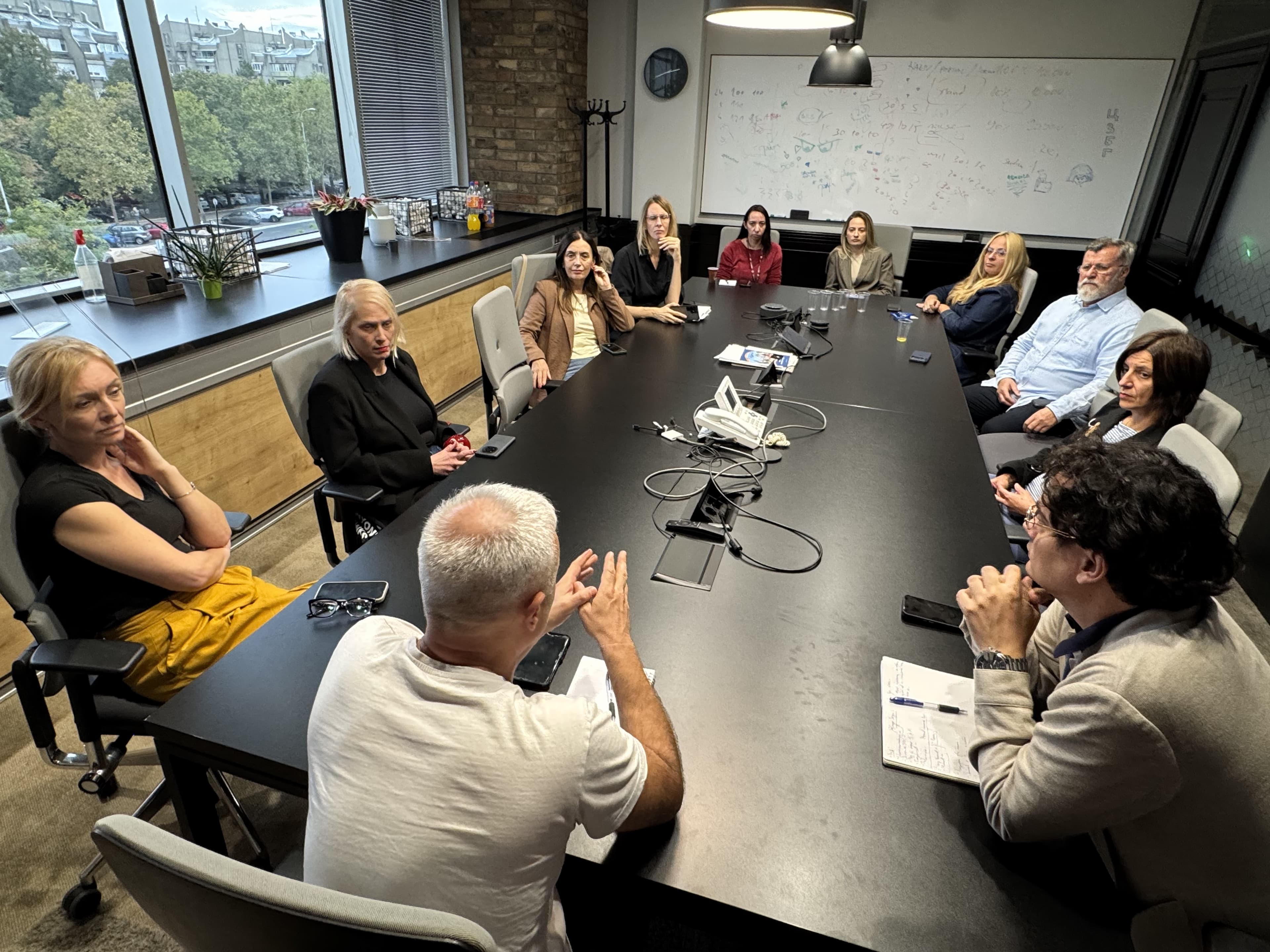
Journalistic associations provided support to the editorial team of Nova.rs: Ongoing communication and updates with international stakeholders agreed upon.

Coalition for Media Freedom: Stop Attacks and Harassment of Journalists During the Election Campaign

.png&w=3840&q=75)