
What the search for a photograph of Veran Matić revealed about the Center for Social Stability and the film "Evil Age 2."
The viewer cannot easily recognize that the photograph of Veran Matić pinned to the bulletin board in the film "Evil Era 2 – The Creation of Propaganda" was taken at the site of the murder of Slavko Ćuruvija on Svetogorska Street in Belgrade.
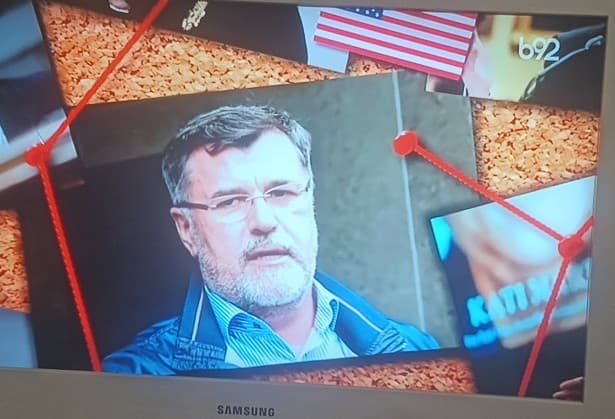
The author or authors of the film utilized a corkboard to depict the faces of the culprits, much like in detective films. The central figure that weaves the narrative belongs to the former head of RTV B92. Behind his head, the board featuring the crime scene of Slavko Ćuruvija can be seen.
The photograph first appears at the end of the fifth minute. An unknown narrator states, “At the beginning of the last decade of the last century, Matić was building contacts with confirmed enemies of the Serbian people... if you think this is the pinnacle of the autochthonous self-hatred of this foreign agent, you are mistaken.”
When entered into a simple internet search, the photograph from the television screen leads us to the original published on the Insajder TV website.
“That is my photograph taken in 2016 on the anniversary of Slavko Ćuruvija's murder. I did not give them permission to use it, and they did not credit me,” says photojournalist Srđan Ilić to the UNS website.
He mentions that those who took the photograph did not ask for his permission, and he watched the film after we contacted him with questions about whether he was the author and where the photograph was taken.
“I value my mental hygiene and do not watch political propaganda of this kind,” Ilić tells us.
That year, at the entrance to the stairwell, where Ćuruvija's body lay in a pool of blood after being shot in 1999, Matić represented the Government Commission for the Investigation of Journalist Murders. This was four years after the establishment of the Commission, which was formed at the behest of the authorities, specifically Prime Minister Aleksandar Vučić.
Today we know that no one is guilty for that murder, although the search for evidence yielded results, and an indictment against members of the State Security Service was raised. They were convicted twice, only to be acquitted by the Appeals Court in 2024.
Why does the film emphasize the photograph that connects Matić, Ćuruvija, the site of the unpunished murder, and the same pretext—betrayal of Serbian interests, collaboration with foreigners, and money, and why do pro-government media publish this both then and now?
The credits of “Evil Era 2” do not indicate who the author of the film is, nor who reads the text, or whose photographs and recordings were used. It only states that it was produced by the Center for Social Stability in January of this year.
In the Agency for Business Registers, we find one phone number that is a link to this organization. It is presumed to be the number of its representative Ognjen Karanović, who is listed on the Center's website as employed at Matica Srpska as a research associate and archivist in the Manuscript Department. However, although it is not mentioned, we also find him on the website of the provincial government where he serves as an assistant secretary for regional development, interregional cooperation, and local self-government.
We call the number. The person who answers says he is not Ognjen Karanović, but that he knows whom we are looking for. He states that he is the founder of the Center for Social Stability and that those who took over the organization have not changed the phone number for ten years, and he does not know why.
“My name is Lazar Slepčev. I haven't been connected to that organization for about ten years. I am a founder, but I have stepped away from that story,” he tells us.
He says that since he is no longer an authorized person, he cannot remove his phone number and that he receives about ten calls a week. Some of those calling attack him.
“I live with that. What can I do? You can emphasize that the founder has no peace from calls because someone among those who took over the organization does not find it appropriate to register their number with the APR. So, I am already fed up,” the man tells us.
Although he is the founder, he explains that he is no longer a member of that organization and that he has “stepped away from that story.” When asked how he views the organization today and the content it produces, he replies:
“I don't know your affinities, but to me, it does not resemble anything. I am happy that I am no longer a part of it.”
We receive Ognjen Karanović's phone number from colleagues working in pro-government media who tell us that they internally refer to this organization as the “center for opinion.”
On the first call, Karanović answered and said that by Friday, fifteen days after the film aired, when the conversation took place, he had not watched “Evil Era 2.”
At the end of January, the film was broadcast by national frequency television stations Prva and B92, the cable television channel of the tabloid Informer, and then numerous other pro-government media.
“Personally, I have not watched it yet,” was his response.
When asked if he was familiar with the materials that were used, he answered that the Center for Social Stability would issue a statement regarding the film in due time.
“First of all, I have to watch it myself,” Karanović reiterated.
When we asked if he could say who the author of the film is, as it was announced as a documentary and that film authors care about not being anonymous, Karanović's response was that it is the Center for Social Stability.
“I have complete confidence in the production team of the Center for Social Stability and that they did it responsibly and thoroughly,” he says and directs us to send questions via email.
Considering the conversation with the person whose phone is registered with the APR, we ask Karanović how long he has been with the Center for Social Stability.
“Me personally? Since 2017.”
He kindly directs us once again to send questions via email.
When asked if this is because he is not familiar with the content that the organization, of which he is an authorized person, broadcasts, he answers that this is not the case.
“Of course, I am familiar with the content. I just say that I have not watched this last film yet; I will watch it today.”
When we suggested that we could continue the conversation after he watches the film, he again requested that it be done via email.
“Any questions you have regarding the film, production, please send them via email and we will respond in a timely manner.”
Just as the connection had not been disconnected and this conversation was coming to a close, Karanović mentioned that he would like to ask and comment on the series “Heroes of the Evil Era,” which was broadcast by N1 television.
“Did you then contact the N1 production considering that episodes in that series were assessed by some civic associations, especially those from the media sphere, as targeting, since that series also spoke about journalists?”
When asked if he wants to say that these are identical series, Karanović answered no.
“In the case of the Center for Social Stability, based on the previous work and production of previous documentary films, this is not about targeting. It is not at all about that.”
When asked about his experience in film production, documentary filmmaking, and whether he has ever been an author, Karanović says he does not have such experience.
-“Me personally?”
-Yes, you personally?
-“No.”
At the end of the conversation, Karanović reiterated his thoughts on the series “Heroes of the Evil Era” and wanted to emphasize that he does not believe these two series are identical.
“For this one, I believe it is absolutely objective and professional, while for ‘Heroes of the Evil Era,’ I do not think so. I think the opposite.”
By email, UNS thanked for the phone responses on Friday evening and suggested continuing the conversation when the representative of the Center for Social Stability watches the film. As of the publication of this text today, that has not happened.
Source: UNS.org
Related Articles

Journalistic associations provided support to the editorial team of Nova.rs: Ongoing communication and updates with international stakeholders agreed upon.

Coalition for Media Freedom: Stop Attacks and Harassment of Journalists During the Election Campaign

.png&w=3840&q=75)