
The Permanent Working Group for the Safety of Journalists is calling for a review of certain cases from the past.
On the occasion of the International Day to End Impunity for Crimes Against Journalists, members of the media section of the Permanent Working Group on the Safety of Journalists (SRG) are raising awareness about the large number of unresolved cases of attacks and threats against journalists in Serbia. Media associations are calling for a reexamination of unresolved cases, accountability of police and judicial authorities, and more effective action from institutions, with the message that journalists must not be subjected to violence, threats, and intimidation for performing their work.

On the occasion of the International Day to End Impunity for Crimes Against Journalists, which is observed today worldwide, journalist associations and media organizations that are members of the Permanent Working Group for the Safety of Journalists (SRG) highlight the alarmingly high number of unresolved cases of attacks and threats against journalists and other media workers in Serbia.
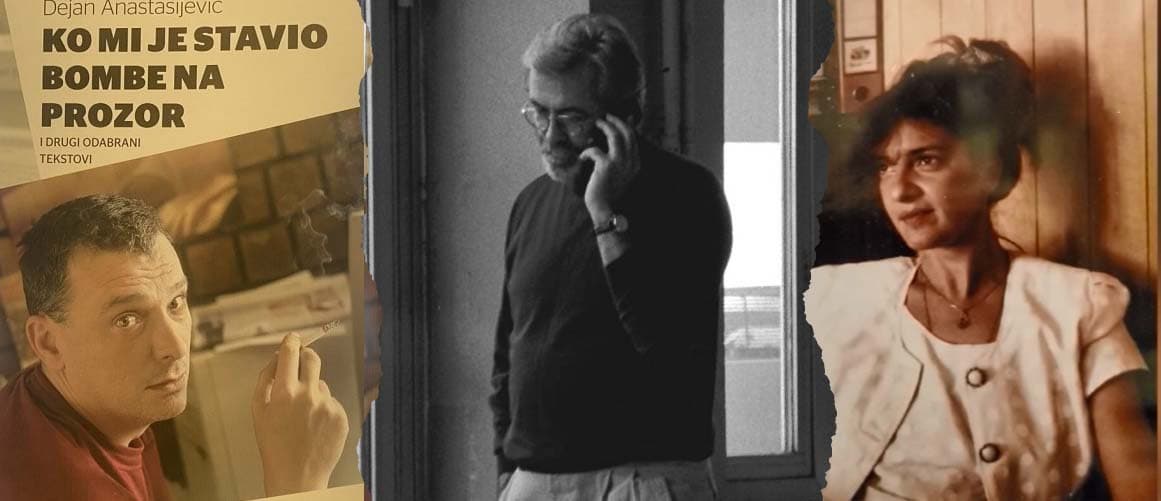
The media section of the SRG primarily demands that the prosecution and police reconsider certain cases from the past. This particularly, but not exclusively, pertains to the murders of journalists Slavko Ćuruvija, Milan Pantić, and Radislava Dada Vujasinović, the attempted murder of Dejan Anastasijević, the illegal wiretapping and surveillance of the phones and other means of communication of Slaviša Milanov and other journalists, the physical assault on Vuk Cvijić in 2024, as well as the still unresolved cases of intimidating threats directed at numerous journalists from professional media.
The disciplinary bodies of the High Judicial Council are urgently requested to act on disciplinary complaints submitted back in January 2026 against three judges of the Appellate Court in Belgrade, who participated in rendering an illegal acquittal in the Ćuruvija case, which the Supreme Court determined was made with significant violations of the provisions of the criminal procedure.
Additionally, according to official data from the Supreme Public Prosecutor's Office (VJT), a total of 846 cases related to criminal offenses against journalists were initiated from 2016 until the end of September 2026. Of these, in 331 cases it was decided that there was no criminal offense, in 207 cases evidentiary actions or court proceedings are still ongoing, and in 178 cases the perpetrator has not yet been identified.
The number of convictions, which totaled 86 since 2016, has particularly decreased over the past two years, despite a drastic increase in the number of attacks on journalists, which peaked on the day of the local elections in March 2026, when dozens of attacks on journalists were recorded in a single day.
During 2025, six convictions were issued (from 146 cases), and so far in 2026, only three convictions have been handed down (from as many as 111 cases). This disheartening trend can also be linked to the police's open refusal to cooperate with the prosecution.
In a large number of cases, the police did not respond to the prosecution's requests for information gathering, thereby preventing or significantly hampering the implementation of effective investigations. The police's actions in these cases also require consideration of criminal and disciplinary responsibility, as well as an immediate provision of the requested information and notifications to the prosecution to enable expedited processing of cases and the issuance of long-awaited verdicts.
In the past two years, the police have been one of the greatest threats to the safety of journalists. We demand that all cases of attacks by police officers on journalists be reviewed and that responsibility for such actions be established. We also request that the Ministry of Interior act on all submitted complaints to the Internal Control Sector and conduct procedures in accordance with the law.
It is also necessary to create conditions for the return of all journalists who have left the country in recent months out of fear for their safety and that of their families, and to provide guarantees that they will have the right to defend themselves while free. Above all, it is essential to halt the instrumentalization of judicial bodies to suppress media freedom, public debate, intimidate, and criminalize journalists.
On the other hand, the media section of the SRG believes that cooperation within this body, primarily with the VJT, during the election day and in its preparation was at a high level. We believe that this also contributed to a significantly lower number of attacks on journalists that day, with available data indicating three incidents.
On this day, the media section of the SRG reminds the institutions of this state and the public that behind every headline and every story stands a human being – someone whose courage and dedication inform us and enable us to understand the complexity of the world we live in. It is our collective responsibility to ensure that journalists are never again subjected to violence, threats, intimidation, or murder for doing their job in the interest of the public.
In this sense, we emphasize that support for improving the safety and protection of journalists and other media workers represents a legally defined public interest in the field of public information, which should be further popularized through media content and program offerings of public media services, which regrettably has not been the case so far. We also believe that after the constitution of the republic assembly and the formation of a new government, the process of amending and supplementing the Criminal Code and other laws concerning the legal protection of journalists should be initiated.
The SRG, established in January 2017, consists of representatives from the VJT and the Ministry of Interior of the Republic of Serbia, along with six journalist and media associations - the Journalists' Association of Serbia (UNS), the Independent Journalists' Association of Serbia (NUNS), the Independent Association of Journalists of Vojvodina (NDNV), the Media Association (AM), the Association of Independent Electronic Media (ANEM), the Association of Online Media (AOM), as well as the OSCE Mission in Serbia in an observer status.
The project "Enhancing the Prevention and Response Mechanism in Cases of Threats to the Safety and Lives of Journalists in Serbia" is implemented by ANEM in partnership with Insider TV and the Center for the Development of Local Media, with the support of the European Union.
The OSCE Mission in Serbia has supported ANEM's project "24/7 SOS Hotline for Assistance to Journalists and Other Threatened Media Workers," as part of the EU-funded project "Strengthening Freedom of Expression and Media Freedom in Serbia."