

Veran Matic and the Serbian radio station that helped in the overthrow of Slobodan Milošević.
How a group of journalism students from the University of Belgrade established the B92 radio station

In 1989, Serbia was in a state of turbulence. The region was on the brink of the Yugoslav wars—a decades-long conflict triggered by the disintegration of Yugoslavia, of which Serbia was one of six constituent republics. Slobodan Milošević, the populist President of Serbia who rose to power by capitalizing on growing ethnonationalist tensions, had recently taken office. Central communist control was weakening, dissent was being suppressed, and free media were under attack.
These were the conditions under which Veran Matić, alongside several other journalism students from the University of Belgrade, founded the radio station B92. Matić had been involved in independent youth media since 1984, and the station emerged from his desire to merge journalism with other forms of civic activism. He proposed that the station's founding document be the Universal Declaration of Human Rights—a principle, he told Index, that has guided him since early life.
“I grew up in a village, mostly with my grandparents. They taught me the values of honesty, justice, and many ethical principles rooted in religious teachings,” said Matić. “My interests have always extended beyond journalism itself.”
Combining rock music with current events and telephone interviews, B92 quickly gained popularity as a rare source of Western news and information in Yugoslavia. However, Serbia was becoming increasingly authoritarian under Milošević; the station's inclination to expose the truth was at odds with the regime, and B92 became a primary target for suppression. Years later, Matić learned that he had been under surveillance from the very beginning of his career.
Matić soon became the editor-in-chief of B92. During anti-government demonstrations in Belgrade in March 1991, police stormed the newsroom and threatened staff members and foreign correspondents, forcing the station to cease broadcasting.
The next time the state attempted to shut down B92, in 1996, the station was ready. B92 outsmarted the authorities by transmitting its signal over the internet to the BBC in London, which then relayed it back to local radio stations across Serbia for broadcasting. This was one of the first instances of using the internet to circumvent censorship in broadcasting.
Matić claimed that the most dangerous period for B92 employees was during the NATO bombing in 1999—a large air campaign aimed at destroying Yugoslav infrastructure and halting the repressive activities of Milošević's government. Amidst the turbulence and warfare, Radio B92 was banned again. But this time, Matić was arrested.
However, Matić and his colleagues were encouraged by an international campaign of solidarity in support of independent media in Serbia. They responded with innovation, driven by the belief that the authorities “are not stronger than ideas.”
In the years that followed, Matić continued to build his career in journalism. He helped establish the Commission for the Investigation of Murders of Journalists in 2013 and currently chairs the Permanent Working Group for the Safety of Journalists and the Association of Independent Electronic Media (ANEM). He also heads the B92 Foundation, a nonprofit organization launched by the media house that brings together companies, foundations, and civil society organizations to promote philanthropy and humanitarian aid.
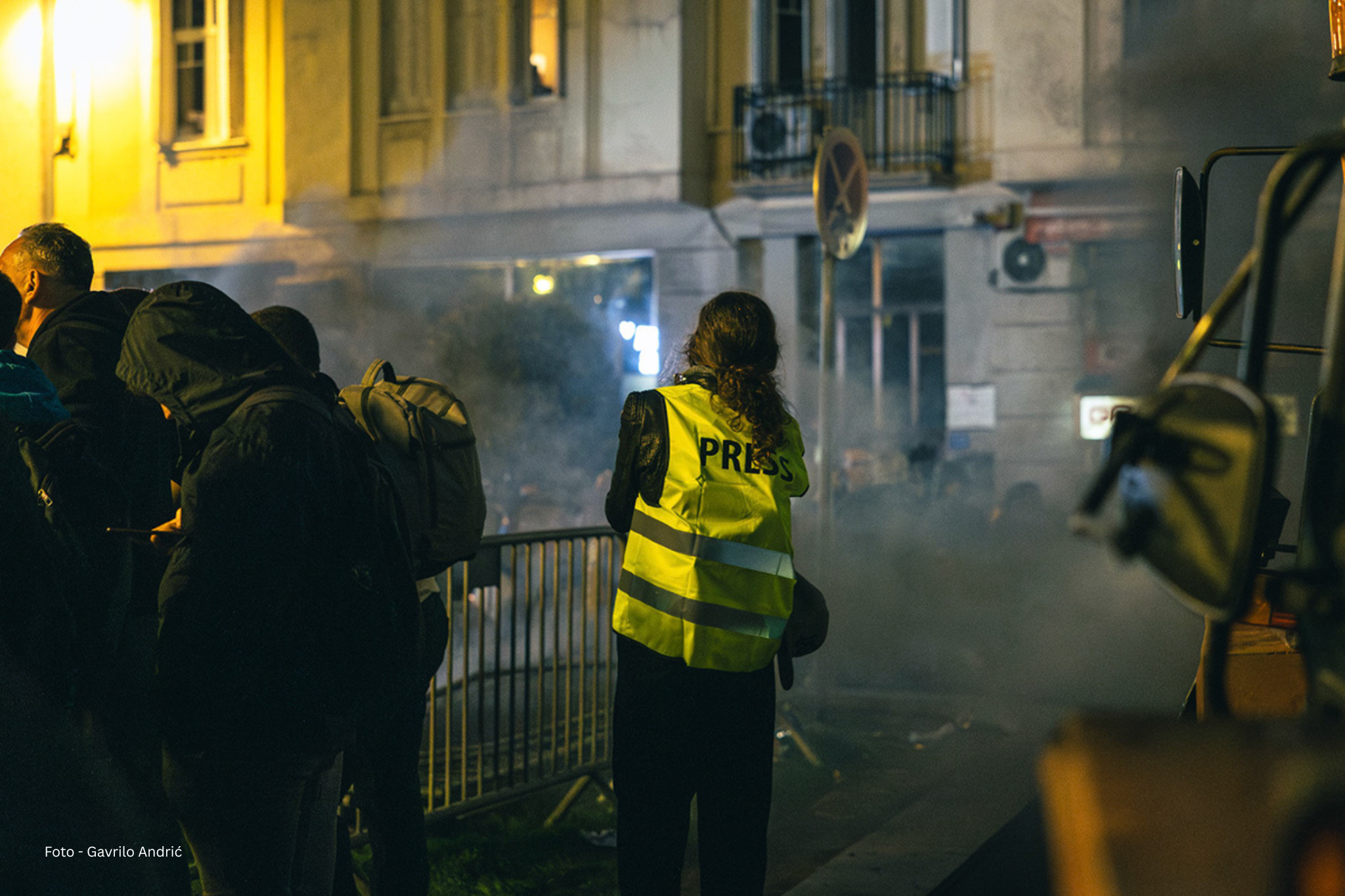
Although the era of Milošević is long gone, Matić still faces adversities and censorship while reporting from Serbia. Just last month, he was attacked while filming a public gathering in front of the National Assembly, when someone forcibly took his phone despite Matić identifying himself as a journalist.
He wants to emphasize that this was not an isolated incident. “What happened that day cannot be understood merely as an incident in which I was prevented from filming,” he said. “It is the culmination of a much longer process of public targeting and the creation of an atmosphere in which violence against me is effectively legitimized.”
Between 2011 and 2016, he was under 24-hour police protection, both in Serbia and during trips abroad. Recently, the current president, Aleksandar Vučić, publicly vilified Matić during a television appearance, suggesting that individuals convicted of crimes as a result of Matić's investigative journalism had suffered injustice. At the same time, a pro-government media organization published what Matić described as a lengthy propaganda article about him.
Matić is not the only journalist in Serbia who has become a target in this way. According to official records from the Supreme Public Prosecutor's Office, only 12 out of 271 recorded cases of threats and attacks on journalists in the past two and a half years have resulted in final court rulings.
Independent media are vital for holding authorities accountable, and being part of that will never be an easy profession. Matić has identified several economic, legal, and security challenges that such media face, including the threat of SLAPPs, along with smear campaigns, harassment on social media, and intimidating surveillance tactics.
The B92 Foundation has provided support to journalists outside Serbia in recent years, including correspondents in Ukraine and Gaza. Through his experiences, Matić understands the importance of press freedom on a global level—and the price that can come with it.
Source: Index on Censorship.
Author: Daisy Ruddock
Translation: ANEM with the help of VI
Related Articles

Journalistic associations provided support to the editorial team of Nova.rs: Ongoing communication and updates with international stakeholders agreed upon.

Coalition for Media Freedom: Stop Attacks and Harassment of Journalists During the Election Campaign


.png&w=3840&q=75)