
Ivana Bošković: "There are people here who depend on the SNS and who won't speak to me on the street because I am with Radio Free."
The latest OSCE research indicates that radio remains widely listened to. However, like many other media formats in Serbia, there are few radio stations that offer independent reporting. Nevertheless, they do exist, and one such station is located in Kraljevo.
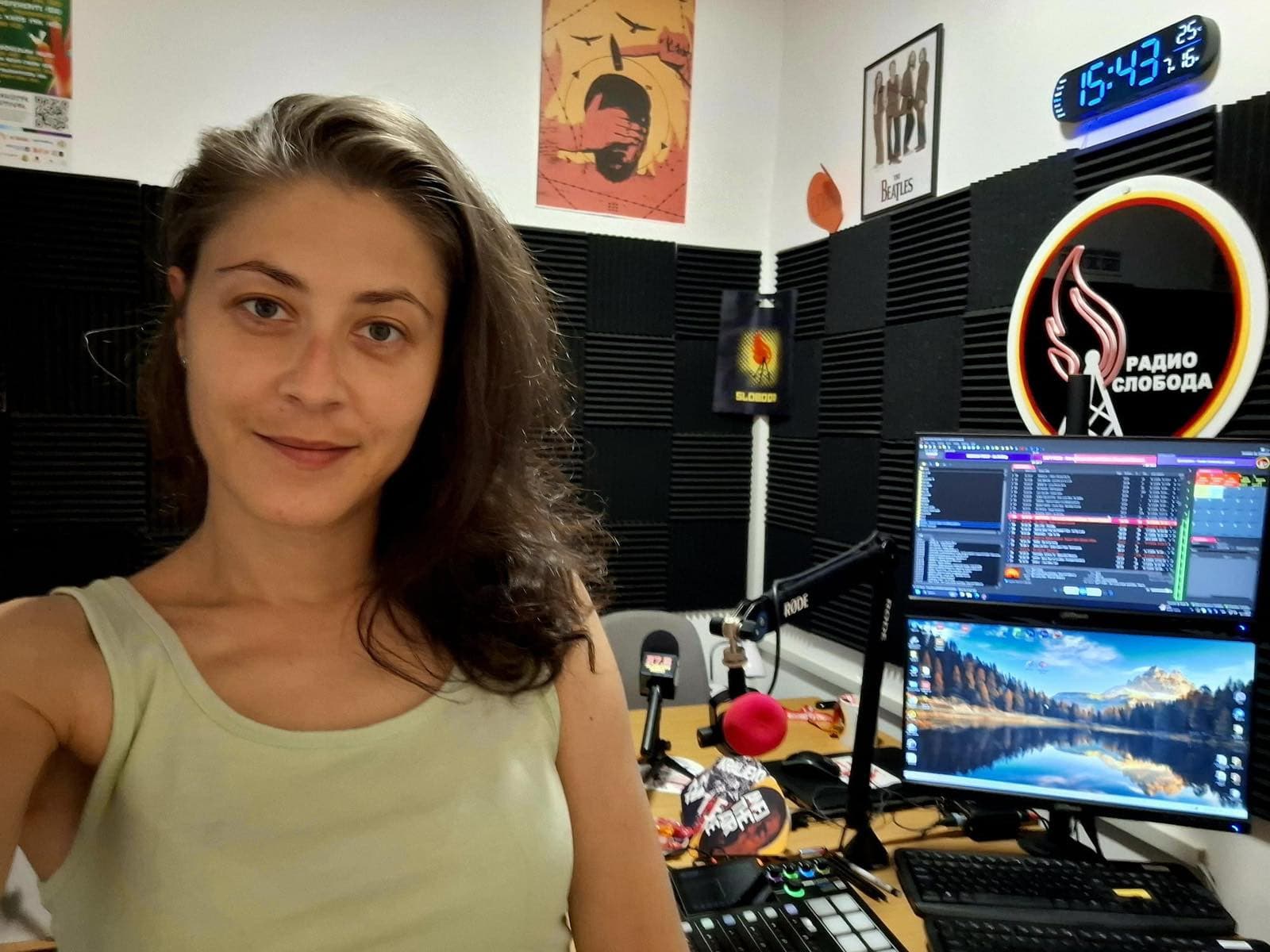
Ivana Bošković is the editor of the entertainment program at Radio Sloboda in Kraljevo. She explains that their radio station primarily stands out for its good music, as well as fast and accurate information. This radio station began broadcasting its program in 2024, a year that has significantly changed the reality in the country. We talked to Ivana about their journey from the first song played (it was Prodigy), to the present, and what it is like to work in a independent media outlet in Kraljevo.
Your radio was established in 2024. What was it like to start working in such a heated situation in the country?
In the first few months, we worked without salaries. You somehow believe in this great story and have great people around you, and then you easily give up even on going on vacation.
We started without money but with a strong desire, enthusiasm, and ambition.
Initially, it was difficult to reach an audience because the frequency 87.6 MHz, where Radio Sloboda now broadcasts, used to belong to a station that only played folk music. That radio had its own audience, and at one point, at midnight, Prodigy started playing right after some heavy folk songs. People who had previously listened to that radio were in shock.
What sets you apart from other media outlets? What are you most proud of in your work?
You know, there aren’t that many radio stations in Kraljevo. We are the only radio station in Kraljevo that truly provides some information.
We had M Radio, which was recently bought by Naxi, and now the Naxi program is broadcasted there. We still have Radio 996, which has been around for a long time, but there’s nothing special about it. They mostly play the same playlist for a couple of days, and that’s it.
Our situation is different; you will always hear something new here. Currently, we are on a break, but there is a program called Eho that deals with problems in the city, issues affecting young people, and problems with the infrastructure of our city.
At first, we expanded with the help of social media. I don’t know if we would have reached the audience we have, especially among young people, this quickly otherwise. Young people no longer trust the media, and I would say that everyone gets their information through social networks, which are somehow the key to our public recognition. We always have someone in Helsinki who listens to us, and they surely didn’t hear us on FM but saw us on Instagram, Facebook, or anywhere there’s a radio called Sloboda in Kraljevo, and then people start listening to it.
Somewhere, it is the music that has attracted our listeners. Sometimes they send us a message on the official phone at 9 PM: “Hey, this is great what you’re playing tonight!” So, music is something that has distinguished us from the mass of internet and radio stations and other stations that can be heard on FM, which mostly play folk music and newly composed songs, however you want to call it.
What challenges have you faced in your work so far?
The challenges are different for colleagues working in the field and for us who are in the studio. Colleagues who work in the field and report from protests and all outdoor events, while not affiliated with the main party in our country, often find it very difficult. Kraljevo isn’t that big, and everyone knows each other well here. My colleague Jovana has had unpleasant situations when she was recognized on the street. There were threats, insults, and really uncomfortable situations.
Those of us in the studio face different challenges, mainly related to information that we do not receive. In fact, we’ve never received information from official institutions; we always have to find ways to obtain that information through other channels. Very often, it’s our listeners or friends who have heard something somewhere that we might not have, or someone working somewhere lets us know: “Hey, have you heard this? Do you know about this?”
Radio Sloboda has been around for two and a half years, and in the beginning, it was very difficult because, for example, the City Administration didn’t even want to add us to their mailing list. It took a lot of time to get basic information about what was happening in our city’s Assembly – what they did with the budget and other basic things. It took a lot of time for someone to inform us about what was happening. Meanwhile, we report very objectively. We don’t leave anyone out; we talk about both sides, just as it is. However, the way it is doesn’t suit many people.
How would you describe what reporting looks like in a city like Kraljevo?
Last year, I went to report for the sports section on a portal. There was a handball match, and the national team was coming to Kraljevo. I was the only journalist there from a media outlet that wasn’t theirs.
There was a guy there whom I don’t know for just two months, but for at least 15-20 years. However, he didn’t have the freedom to come up to me and talk; he just waved and said: “Hi Ivka!”.
These are situations that happen here. Some people simply stop acknowledging you on the street. There are many people here who depend on the SNS and who are afraid to approach me on the street because I’m from Radio Sloboda, even though we’ve known each other our whole lives.
Fear has crept into the bones here. We had a moment when the fear was lifted from their side, like when Terzić was hit with eggs. Maybe even their people got scared or felt a glimmer of freedom, thinking he would step back and that some things in Kraljevo would get sorted out, but that didn’t happen.
It is up to us as individuals to choose whether we will accept their games or not. Personally, I won’t. Most of my colleagues and I, from this side, can walk freely through the city, as the old ladies would say, “with our noses in the clouds,” because there’s nothing anyone could pin on us.
To what extent does solidarity from colleagues in other independent media outlets matter to you in situations like the attack on your colleague who was assaulted in April 2026 in Gornji Milanovac?
It means a lot because information and support flow between us. We collaborate with media outlets outside Kraljevo. There’s always some collaboration; we reach out to each other if someone needs to pass something along.
______________________________________________________________________
Attack on Bojan Savković in Gornji Milanovac
A correspondent from Radio Sloboda was attacked on April 23, 2026, in Gornji Milanovac while reporting on the commemoration of the Municipality Day and the 211th anniversary of the Second Serbian Uprising. The physical attack occurred near the "Mija Aleksić" Cultural Center, where activities were organized for this event. As Savković noted at the time, Milan Tadić, a member of the Municipal Board of the Serbian Progressive Party in Gornji Milanovac, attempted to seize his mobile phone while he was recording attendees at the public gathering, according to ANEM. Savković recorded the entire incident.
______________________________________________________________________
Support means a lot in every sense during this time. We are witnessing how many attacks on journalists have occurred since the beginning of the year. Recently, that information circulated; if I'm not mistaken, the number is around 170. Literally every other day, there is a situation on the street where someone is verbally or physically attacked.
A common problem when discussing local media is financing. How challenging is this aspect for your media outlet? Do you receive any state funding, and if so, to what extent?
No one wants to advertise with us. We had a few people from the city who previously paid for, for example, a mask for New Year’s, and the guy called me to say: “You know, I can’t advertise with you anymore”. Meanwhile, it was a mask that cost about 6,000 dinars. It’s funny, but these are the situations where people are literally afraid to place any advertisement with us or do anything else.
When it comes to city projects, you are, of course, below the line. There’s no chance you’ll be approved. No matter what you’ve created and how great and phenomenal it is, you won’t get approved because it’s already known who will receive any money from the city budget. There was a project the city announced recently. We knew we wouldn’t get approved, even though the idea was great and not political, but more about culture.
However, until the authorities change, the principle of selecting people who get approved for those projects won’t change either.
Have you considered any form of donations from citizens, to call on the local community that listens to you for help?
In Kraljevo, we have a few children, little Balša and little Mija, who are fighting to survive. How can you, as a media outlet, ask your fellow citizens to make donations when you have two sick children in the city who need every dinar for operations, therapies, and everything else? It’s not that we are actively seeking donations from our fellow citizens in such a situation.
Instead, we look to incorporate donation boxes into our programs, through our portal, or any other way. When you see that some children who aren’t even 10 years old are fighting to survive, how can you take that and ask: “Hey, donate to us”?
Source: Zoomer
Related Articles
Journalistic associations provided support to the editorial team of Nova.rs: Ongoing communication and updates with international stakeholders agreed upon.

Coalition for Media Freedom: Stop Attacks and Harassment of Journalists During the Election Campaign
.png&w=3840&q=75)