
Report on the Protection of Freedom of Expression in the Judicial System of Serbia: Abuse, Impunity, Inadequate Institutional Response
The fourth report by the Slavko Ćuruvija Foundation on the protection of freedom of expression within the judicial system of Serbia records a continuous increase in the abuse of freedom of expression, a disregard for journalistic diligence, and a growing prevalence of hate speech in pro-government media, which are included in this analysis due to their frequent violations of professional standards. The analyzed media disputes indicate a rise in sensationalism, violations of honor and reputation, breaches of the presumption of innocence, as well as violations of the right to privacy.
The analysis of the practice of civil courts in media disputes covers the period from July 2024 to the end of 2025. It includes cases against media outlets that monitoring by the Press Council showed to most frequently violate the Ethical Code of Journalists of Serbia, namely: Alo, Informer, Kurir, Srpski telegraf, Republika.rs (the portal of Srpski telegraf), and Večernje novosti. In addition, the analysis also includes the daily newspaper Danas and the publication Nova, which the Press Council determined had the least deviations from the Code, as well as the investigative portal KRIK.
It is evident that the number of media disputes is increasing every year. During the observed period (one and a half years), a total of 24.80 cases were recorded in the registry "P3" maintained for this type of dispute, of which 396 were resolved by the end of 2025.
The analysis of legally concluded cases shows significant differences in the success of plaintiffs depending on the media against which the proceedings were conducted, i.e., differences can be observed between media outlets that the Press Council identifies as frequently violating the Ethical Code of Journalists and those with the least deviations from the Code.
In the analyzed cases against Informer, Kurir, Alo, Novosti, Srpski telegraf, and Republika, the claims were fully or partially accepted in 93.70% of the analyzed legally concluded cases. In contrast, cases against the media Danas, Nova, and KRIK recorded a significantly lower success rate for plaintiffs.
For the media Danas and KRIK, only a small number of cases were legally concluded during the observed period, and generally, fewer proceedings were initiated compared to other observed media outlets. In cases against Nova, the claim was partially accepted in 29.16% of the analyzed proceedings (or 41.17% of legally concluded cases).
In proceedings against the newspaper Danas, the claim was fully rejected in 57.14% of cases (four out of seven). In three cases (42.85%), the claim was partially accepted. In cases against KRIK, the claim was partially accepted in 50% of legally concluded cases (or in two out of four cases).
The analysis also looked at the amounts of damages claimed, as excessively high claims can indicate SLAPP lawsuits. It was noted that high damages claims (over one million dinars) are more common against media that rarely violate the Code and that report critically on the government. Considering the total number of proceedings against them, claims exceeding one million dinars are significantly more prevalent against media outlets Nova and KRIK.
One observed problem is the persistent repetition of the same violations by the same media to the detriment of the same plaintiffs, often opposition politicians. The analyzed court cases clearly indicate that certain opposition politicians have been subjected to continuous negative campaigns in pro-government media for years. Articles are published about the same individual with identical or similar content, without verifying the truthfulness of the claims. This issue is further deepened by low awarded damages, which are evidently not adjusted to the frequency and severity of violations to have a deterrent effect.
In proceedings against print media and portals, the average awarded compensation by the first-instance court amounts to 97,515 dinars. In legally concluded proceedings, the awarded amount averages 95,405 dinars. In many cases, amounts of 40,000 or 30,000 dinars were awarded, and in one case, a record low amount of 20,000 dinars was recorded.
Proceedings take a long time, even though they are considered urgent. The average duration of media disputes during this period is about two years. Lengthy proceedings result in compensation that is insufficient to prevent future abuses, and there is a question of the extent to which such low amounts provide adequate satisfaction for the violation of rights.
During the observed period, there were also cases where the plaintiffs were minors. Since such cases were not identified in previous reports, this indicates a further erosion of professional journalism standards. Judicial protection is neither sufficient nor effective enough to curb violations of rights protected in media disputes and to improve the media's reporting practices. Instead, the already poor state worsens.
Regarding protection against SLAPP lawsuits, considering that the European Union and the Council of Europe have adopted important standards in the last three years to combat SLAPP lawsuits, the main conclusion of the analysis is that their practical implementation is still lagging, and most countries have yet to align their legislation with the new regulations. Furthermore, Serbia still lacks an effective response to the problem of SLAPP lawsuits, despite direct warnings from the European Commission and the increasing number of cases involving the Slavko Ćuruvija Foundation, which seriously threaten the work of investigative media, journalists, and civil society organizations.
Finally, although there are numerous international standards and training for judicial function holders is conducted sporadically, the analysis emphasized that without clear legal solutions and genuine political and institutional will, the protection of freedom of expression from the abuse of judicial proceedings remains limited and insufficiently effective.
The analysis of criminal law protection for journalists covers the years 2024 and 2025, as well as the first three months of 2026. In 2025, a record high number of reported criminal offenses against journalists (134) was recorded, while a very small number of convictions were handed down – only three in cases initiated in 2025.
Additionally, very few cases from 2025 even reached court – only four. The report shows that certain editorial offices are frequent targets of violence, threats, intimidation, and interference in their work, and that the criminal complaints filed in this regard are not treated with special caution but are often dismissed lightly and routinely.
The safety of journalists is further jeopardized by daily verbal attacks on critical media from politicians of the ruling party and high state officials, sending the message that targeting journalists is socially acceptable. The lynch atmosphere created by the highest representatives of the government, on one hand, encourages violence against journalists, and on the other hand, discourages institutions from providing the necessary protection to journalists.
Crimes committed against journalists are often treated without regard for freedom of expression and the connection between the committed act and journalistic work. This practice deviates from the guidelines for prosecutors developed by UNESCO and the International Association of Prosecutors, which, among other things, call for conducting a contextual analysis of the connection between the alleged criminal act and the media activities of the victim, both past and present.
Considering the media environment when making decisions in cases involving crimes against journalists can lead to improvements in the media environment and the level of safety for journalists – through a more effective institutional response to cases of violence and threats faced by journalists. In addition to the general obligations that states have regarding the protection of freedom of expression, the practice of international courts and bodies for the protection of human rights indicates, among other things, the obligation to protect journalists reporting from protests that may become violent by police forces. This is another "test" on which the protection of journalists' safety in Serbia, especially in the last year and a half, has remained far below the level required by international human rights standards.
The report on the protection of freedom of expression in the judicial system of Serbia in the area of freedom of expression indicates that violence against journalists has intensified since the end of 2024, particularly in the context of reporting from protests that followed the collapse of the shelter at the recently renovated Novi Sad railway station.
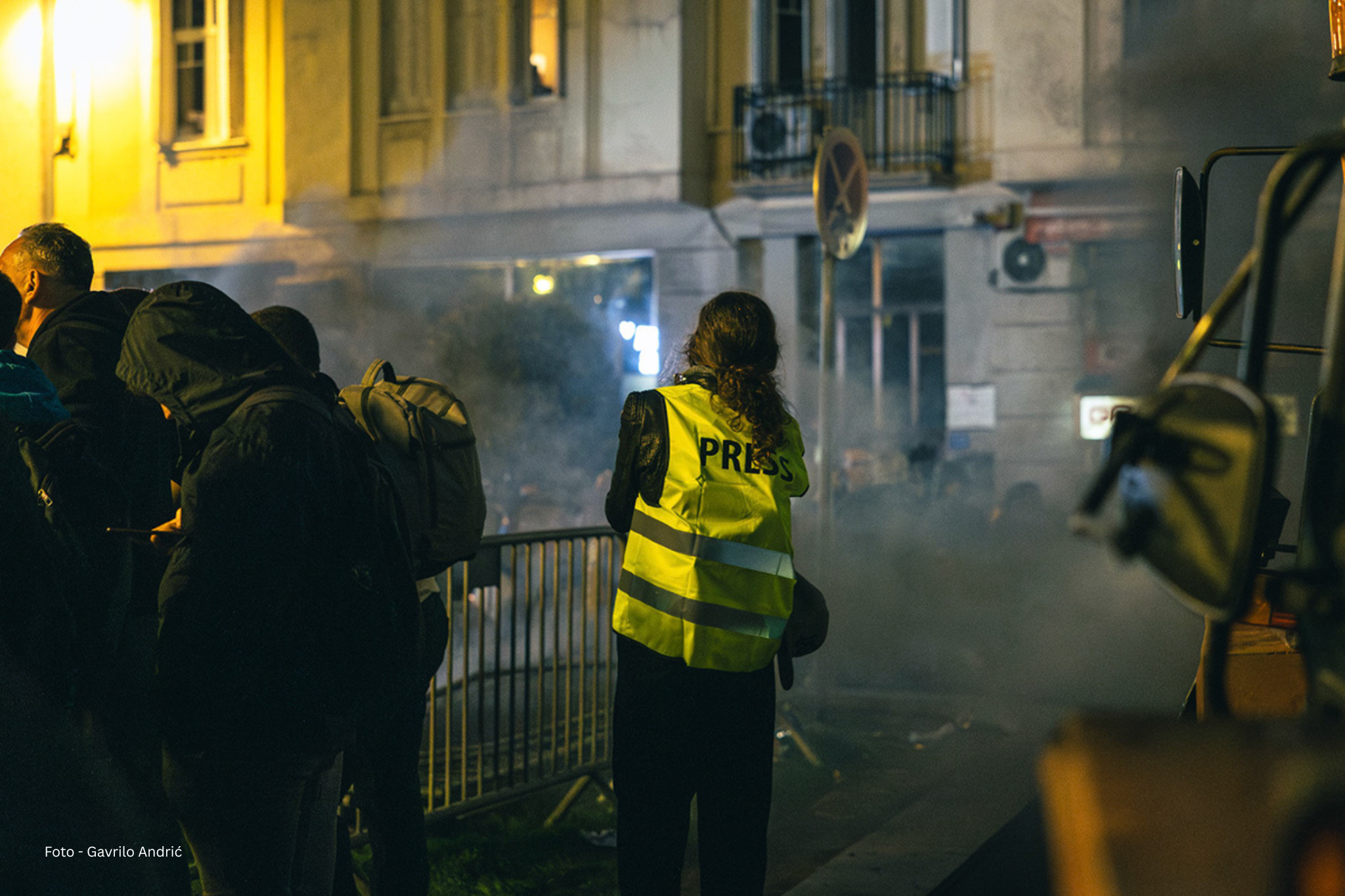
Police officers not only fail to provide adequate protection to journalists from violence during reporting at protests but often also attack journalists themselves or act as passive observers of the attacks.
Inadequate processing of attacks by the police severely undermines journalists' safety, as it sends a discouraging message to journalists while simultaneously signaling to police officers that unlawful conduct by the police goes without appropriate consequences. Both actions and inaction by the police further contribute to protests becoming dangerous places for conducting journalistic work, making journalism in Serbia a risky profession.
At the beginning of January 2026, the Supreme Court of Serbia issued a ruling determining that the acquittal in the case of the murder of journalist Slavko Ćuruvija was made with significant violations of procedural rules in favor of the defendants – former members of state security. However, due to procedural limitations in the Criminal Procedure Code, the Supreme Court could only acknowledge the significant violation of criminal procedure provisions without affecting the legal validity of the acquittal.
The Ćuruvija case was the only case of a journalist's murder that reached court and could have broken the decades-long chain of impunity. However, the conclusion of the nine-year process led, instead of access to justice, to only a legalistic conclusion of a state crime. Such an outcome is a clear and concerning indicator of the state of criminal law protection of freedom of expression in Serbia, which continues to erode in the shadow of impunity.
The extent of violence against journalists has become alarming, especially during the past year and a half and in the context of protests. The lack of an adequate institutional response can act as an encouragement to potential attackers on journalists and lead to further erosion of media freedom.
Considering criminal law protection for journalists over the past two years, it cannot be concluded that the competent institutions have sent a clear message that violence against journalists is unacceptable and that it will be appropriately sanctioned.
The erosion of media freedom culminated on the day of local elections, March 29, 2026, when journalists were beaten, attacked with axes, insulted, and obstructed in their work, their equipment was destroyed and seized. The violence that journalists experienced that day serves as a serious warning that the institutional response must be much more effective to prevent further escalation of violence and impunity for violence against journalists.
The full report "Report on the Protection of Freedom of Expression in the Judicial System of Serbia" from the Slavko Ćuruvija Foundation can be downloaded at this link.
Related Articles

Journalistic associations provided support to the editorial team of Nova.rs: Ongoing communication and updates with international stakeholders agreed upon.

Coalition for Media Freedom: Stop Attacks and Harassment of Journalists During the Election Campaign

.png&w=3840&q=75)