

How Correspondents from Southern Serbia Became Millionaires
Among correspondents in southern Serbia, there are millionaires, but not in terms of income, rather in the number of kilometers traveled. Aside from the established definitions of the profession from journalism textbooks, which describe a journalist as someone who regularly sends news and reports from cities or countries outside their home editorial office, current correspondents in the south have their own perspective on the profession – based on their personal experiences, they say that it is “nice to be in this field, but not advisable,” that it is a “pathological love,” that correspondents in the south are “first when it comes to work, but last when it comes to payment,” or that “the journalistic job is the hardest to do, but also the hardest to give up.”
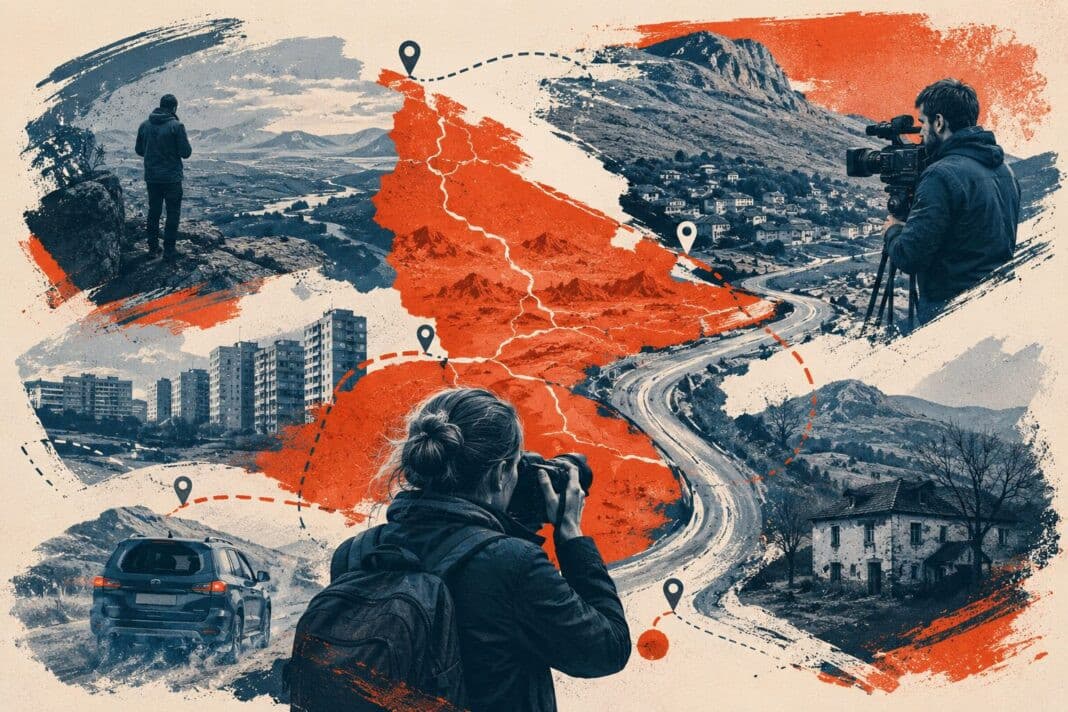
Dragan Pavić has not given up for 32 years. He has been in television for that long, with 20 years in correspondent roles. He points out that correspondents in the south, often with just one team, cover an area that the entire newsroom at headquarters would cover.
> "Moreover, in practice, they are simultaneously journalists, cameramen, editors, drivers, producers, or organizers. They are not IT experts, but they must know how to solve such problems," says Pavić.
His experience across numerous media outlets he has worked for allows him to secure complete equipment, but he also bears the costs of breakdowns.
Journalist Ivana Marković has a similar experience. However, hers is unique in that she can say she is part of a "correspondent family," as she has worked with her husband Dejan, who is a cameraman, for nine years.
> "I describe our job as a pathological love because the reality is that while we are attacked, called mercenaries, and insulted, we are actually working more for a higher cause. Earnings are decreasing if you are a professional journalist, as are the chances of getting a job. In this profession, the more you work, the more you earn. The situation in society is such that there are more topics to report on than ever, but fewer professional media that can hire and pay their correspondents," says Marković.
After 30 years of work, Zoran Kosanović claims to be a "happy correspondent."
> "I really have been lucky with the newsrooms I have worked for," states Kosanović.
He has worked for more than 10 newsrooms based in Belgrade or abroad. He started at Naša borba and ended at Al Jazeera Balkans (AJB). For now, he has not left by choice, nor has he gone into retirement as they say, but has been looking for a job for months since the AJB newsroom where he was employed was abruptly shut down. His employment contract and all rights guaranteed by law are part of the fortunate circumstances Kosanović refers to, particularly noting that everyone worked strictly professionally.
> "Unfortunately, there are fewer and fewer such newsrooms where it is possible to work professionally. They are closing under pressure. Colleagues who want to work are left with no options, no possibilities," emphasizes Kosanović.
Thus, a profession from which he says one could "live" has now become "survival," and many are forced to give up because they simply have nowhere to work. The only option left is propaganda, or the ever-increasing number of media that disseminate it.
The reduced market, as illustrated by Dragan Pavić's agency, notes that they once had contracts with five media outlets, but now they have only one, on which two members of the television crew earned 70 euros each last month.
> "The correspondent job as a hobby is not quite an accurate description because it is our not only profession but a way of life that involves a struggle for values that are hard to abandon. Then you give up on yourself. I say hobby because I don't know what other word to use when you do something and don't earn money; in fact, you spend to report on what you think is important and devise various other jobs to survive," says Pavić.
The interviewees for Slobodna reč consistently describe the same thing – reporting in the public interest and gladly share their stories that have influenced the broader public, solving specific problems. For instance, how a woman who was fired when she got cancer was reinstated after coverage by a correspondent; how families defrauded by investors finally received their apartments after 10 years; how, during the COVID epidemic, a series of fan gatherings or torchlight processions by members and officials of the Serbian Progressive Party (SNS) was interrupted during curfew immediately after live reporting from Niš.
Stories upon stories, news reports, and coverage pile up, but they are reluctant to discuss finances.
> "We are currently working for a higher goal," says journalist Ivana Marković.
Specific research on the economic position of correspondents is not available. The Association of Independent Electronic Media (ANEM) in its "Report on Media Reporting in Southern Serbia" highlighted financial instability and that the survival of local media is in question, while Slobodna reč, in an anonymous study "Standard and Position of Media Workers in the Pčinja District," found that only a third of them have employment contracts and employee status.
Correspondents consistently emphasize that along with the definition, it should be noted that the job is done 24 hours a day, with no breaks or sick leave.
> "I take medication and go to work," says Marković.
When asked whether the position of correspondents differs from other newsroom members, she replies:
> "On paper, no, but in practice, significantly. Correspondents do not have shifts or working hours. Time at home is not time off; it is working on topics, conversations with potential interlocutors, of whom there are fewer and fewer. Previously, you could call and schedule a statement or a guest. Now people are afraid to speak, and preparing a story takes hours. How can you work professionally without two sides, and other dilemmas also make our job harder? And on the ground, we have situations where we are in Niš today, Bujanovac tomorrow, for example. From Bujanovac, we have live segments from the morning show at 6 until the evening news. You can count the hours; we stopped long ago. We work even from a bench in the park, regardless of how warm or cold it is that day. Then, when you finally get home, which is our office, you just start working because editing the segment awaits you. And when you finish that, the preparation for tomorrow begins," explains Marković how correspondent reporting looks.
And so day after day in the media that has correspondents, which, as the interviewees point out, are becoming fewer and fewer. The disappearance of professional media on one side, the budget cuts in those that still operate, and facing pressures and challenges that are both economic and security-related.
That correspondents are the first on the list when it comes to budget cuts is evidenced by Dušan Pešić, a journalist from Vranje, who, along with colleague Vojkan Ristić, worked for Danas as a correspondent from that city. Like Kosanović, he did not stop of his own accord.
> "When it comes to the job itself and collaboration with fellow correspondents and editors – it’s a wonderful experience. Vukašin Obradović, one of the editors of the correspondent network, invited me to be part of the 'Danas na lokalu' project. With two editors, at the time I started working, there were a total of 25 of us, if I am not mistaken. So, 23 correspondents. And the network covered all of Serbia," recalls Pešić about 2022 and how he began his correspondent engagement, which lasted just over a year.
No other newsroom in Serbia had that number of correspondents, except for RTS, whose status as a national public service guarantees funding – paid for by all citizens of Serbia. Those guarantees do not exist in media like Danas.
Pešić recalls that he and his colleagues were given information from management that "there is no money" as a reason for not extending contracts and terminating correspondents.
> "There were several instances of layoffs. We just see that two, three, or four colleagues have lost their jobs. It mostly happened to those who had fixed-term contracts, and it was just a matter of waiting for them to expire. However, a colleague, for example, Vojkan from Vranje, who had worked at Danas for 23 years, also received a termination notice," says Pešić.
"Ivana, thank you for all your wonderful contributions so far, thank you for your engagement 24/7," was part of the sign-off from the studio after a live segment from Niš when correspondent Ivana Marković was working for television Prva and when in 2021, she literally realized live on air that she was losing her job.
Constantly caught between uncertainty and responsibility, yet ready to respond immediately to any emergency situation.
**Source: [Slobodna reč](https://slobodnarec.com/kako-su-dopisnici-sa-juga-srbije-postali-milioneri/)**
Related Articles
Journalistic associations provided support to the editorial team of Nova.rs: Ongoing communication and updates with international stakeholders agreed upon.

Coalition for Media Freedom: Stop Attacks and Harassment of Journalists During the Election Campaign


.png&w=3840&q=75)