

Local journalist: the last one to remember
There is a strange kind of people in Serbia...
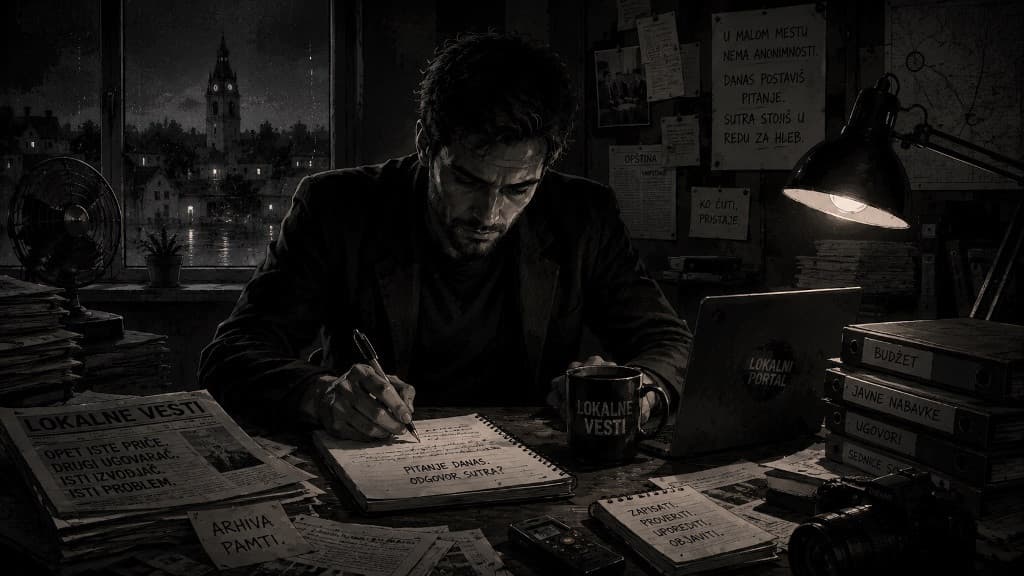
Written by: Tijana Janković, Editor Webinfo
You won’t often see them on national television, or at least rarely.
They don’t have offices, drivers, or PR departments.
They have a used car, a phone that rings even when it should be silent, and an archive that takes up more space than the living room.
But! They have been mentioned a lot lately.
Previously, they were almost invisible.
Now they are “important figures.”
To some. Although, maybe to everyone.
These are local journalists.
The state remembers them when it needs to publish an announcement.
Citizens expect that when a pipe bursts, the power goes out, or the doors of institutions close, the local journalist will do what the water company, municipality, inspection, and public enterprise have failed to do together.
Politicians when it’s time to disseminate a statement. Lawyers when they need to file a lawsuit.
But when it comes time to pay for their work, collective amnesia sets in. Because, for heaven’s sake, everyone thinks: “Aren’t journalists volunteers?”

After all, forgetting has always been cheaper than remembering.
But the local journalist is the last person in town who remembers something.
They remember that the same pothole on the road has been patched two or three times in two years.
They remember that the same contractor got the same job.
They remember that the same council member was against something until they became part of the government, and suddenly they were for the very same thing.
They remember who promised a kindergarten, who promised sewage, and who said that the work would be finished “by the end of the year.”
And the problem for the authorities is not (only) that the local journalist writes.
The problem is that they archive.
Because the internet remembers better than people do.
Big media shows up when something significant happens.
The local journalist was there when the residents first said that something was wrong.
Big media seeks scandal.
The local journalist knows that a scandal is made from a thousand small decisions that no one has read.
From one report.
One public procurement.
One competition.
One annex to a contract.
One meeting where everyone just raised their hands.
And the market, just like politics, does not reward memory.
For independent local media, the math is simple and harsh.
The more independent you are, the more financially insecure you become.
Because everyone wants someone to ask questions.
But no one wants to be asked.
Everyone just hopes someone else will pay for it.
And that’s why local journalists often do not live off media.
The media lives off them.
While other media pay salaries to their journalists, here the journalist finances the media with their other job.
They shoot an advertisement.
They do voice-overs.
They finish something completely different.
So they can afford fuel for the next investigative story.
For hosting.
For a camera...
For the right to ask the same question again.
Because the local journalist is the local memory.
When they disappear, it’s not just a few articles that vanish.
The answer to the question of who worked on the street that collapsed after the first winter is lost.
Who got the job.
How much they were paid.
Who voted for the decision.
And why the same pothole is being repaired again from the same budget.
But unlike numerous decisions, the local journalist cannot end up in the archive.
In a big city, you can change your newsroom.
You can change your street.
You can change your neighborhood.
You can disappear.
In a small town, you really can’t.
Every morning you pass by people you’ve written about or haven’t.
By the person to whom you promised you would return with an answer, or ignored.
By the worker who told you: “Don’t publish my name.”
By the sister who believed you, or didn’t.
By the director to whom you didn’t ask a question.
By the mayor to whom you did.
And that’s why local journalism is not a question of profession.
It’s a question of integrity.
Because in a small town, everyone knows each other.
Everyone knows who kept quiet.
Everyone knows who asked.
Everyone knows who looked away.
As well as who did not look away.
And the local journalist knows they will encounter the people they wrote about again tomorrow.
At the bakery.
At the market.
At the parent-teacher meeting.
That’s why local journalism doesn’t just require knowledge.
It requires backbone...
But, of course, there are also others.
There are local journalists who never have an uncomfortable question.
The doors open for them before they even knock.
Answers come to them before the questions.
Their phones are called by the authorities more often than by citizens.
Their job is not to ask.
Their job is to relay.
They do not verify.
They do not compare.
They do not dig through old files.
That’s why they last as long as the authorities do.
And when the authorities leave, they are the first to write how they criticized them for years.
Meanwhile, the local independent journalist lasts differently.
No party protects them.
The archive protects them.
And the archive is the most dangerous opposition.
It doesn’t vote.
It doesn’t speak.
It doesn’t cheer.
It just waits.
And one day it pulls out a paper that says that a promise remained just a promise.
That’s why in a small town, what you wrote is not the most important thing.
The most important thing is whether you will have the courage in ten years to stand behind the same sentence.
Because functions pass.
Terms pass.
Parties pass.
Statements pass.
And the people who were convinced they would last forever.
Only what you signed with your name remains.
Related Articles

Journalistic associations provided support to the editorial team of Nova.rs: Ongoing communication and updates with international stakeholders agreed upon.

Coalition for Media Freedom: Stop Attacks and Harassment of Journalists During the Election Campaign



.png&w=3840&q=75)