
MPM 2026: Serbia in the High-Risk Zone for Media Pluralism, Political Independence of the Media Most Threatened
Serbia is among the countries with the poorest results in the area of journalist protection, as shown by the Media Pluralism Monitor 2026 (MPM2026), which was published on June 29 by the Center for Media Pluralism and Media Freedom (CMPF). According to the report, the working conditions for journalists, including salaries and the social security system, are deteriorating across the entire European Union and candidate countries. Among the 31 countries analyzed, only six have a decent level of journalist protection: Luxembourg, Denmark, Estonia, Sweden, Finland, and Ireland, while Serbia is classified in the high-risk zone in the overall media pluralism assessment, with a score of 74 percent.
Serbia has been assessed in the MPM 2026 report as a country with high risk to media pluralism and media freedoms, with an overall risk rating of 74 percent. The report indicates a sharp deterioration in the media environment throughout 2025, marked by an increase in physical attacks on journalists, heightened institutional repression, and unlawful digital surveillance. Key issues highlighted include amendments to media laws without public debate, the absence of a functional REM, and increasing political pressures on the media.
Social media played a crucial role during the political crisis of 2025 as a space for disseminating uncensored information, while traditional media were subjected to increased political control. The report also notes that attempts by the authorities to weaken or eliminate the remaining critical media within the United Media group became evident following the publication of a leaked phone conversation, prompting international observers to warn that such escalation undermines Serbia's commitments in the European Union accession process.
According to the overview of results, the area of political independence received the lowest rating, with 81 percent risk, while market pluralism and social inclusiveness were rated at 74 percent risk each, and fundamental protection at 69 percent risk. This means that all four key areas monitored fall within the high-risk zone, with political influence on media assessed as the greatest threat.
Fundamental protection enters high-risk zone for the first time
In the section concerning fundamental protection, the report states that this area has entered the high-risk category for the first time since the MPM has been applied in Serbia, with an overall rating of 69 percent. Within this area, protection of freedom of expression was rated at 51 percent, protection of information integrity at 77 percent, protection of the right to information at 56 percent, journalistic profession, standards, and protection at 77 percent, and independence and effectiveness of national regulatory bodies at an alarming 82 percent risk.
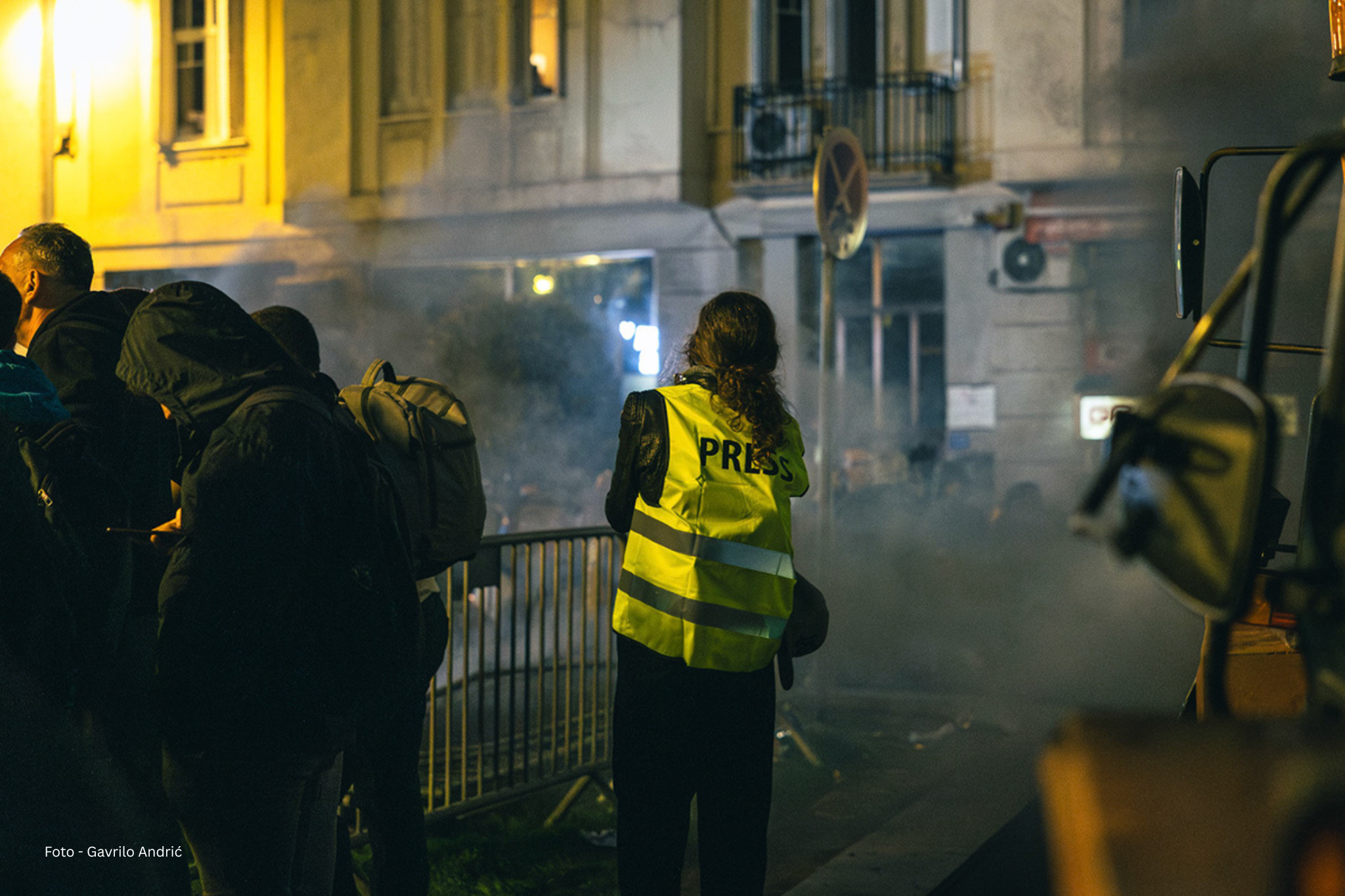
The report particularly emphasizes that 2025 was a year of violence against journalists. Citing Reporters Without Borders, it notes that since the beginning of the protests, there have been at least 98 physical attacks on journalists, while Mapping Media Freedom recorded nearly 200 incidents aimed at journalists throughout the year. In total, according to the report, 340 journalists and media outlets faced various forms of pressure, including physical attacks, attacks on property, and verbal threats.
Regarding legal pressure, it is noted that SLAPP lawsuits have become an increasingly serious obstacle to investigative journalism. According to the National Working Group on SLAPP, since 2020, 48 abusive lawsuits against journalists and media actors have been initiated, with KRIK alone handling 14 such cases. The report warns that Serbia still lacks specific anti-SLAPP mechanisms aligned with international standards for freedom of expression.
The document also records serious problems in the area of digital rights and surveillance, including pressures on journalists to disclose sources, confiscation of devices, and the use of surveillance tools. The report states that Amnesty International has confirmed the use of spyware tools such as Pegasus, Predator, and NoviSpy, as well as forensic tools like Cellebrite, noting that the legal framework is insufficiently precise and leaves ample room for political abuse.
In the chapter on the right to access information, it is stated that practices have further deteriorated, and “administrative silence” has become widespread. Authorities, as noted, often ignore requests for information access, prolong procedures, or claim not to possess the requested documents. The controversial draft amendments to the Law on Free Access to Information of Public Importance, which faced criticism from civil society, were withdrawn from parliamentary procedure in March 2025.
The position of REM, the regulatory authority for electronic media, has also been sharply criticized. The report notes that the procedures for electing members of the REM Council during 2024 and 2025 were marked by serious irregularities, political influence, and legal violations, leaving the electronic media sector without a functional regulator for over a year. In December 2025, four independent members of the Council resigned, leaving REM without a quorum and unable to perform its duties.
Market pluralism under pressure from ownership concentration and state influence
In the area of market pluralism, Serbia received a rating of 74 percent risk, while pluralism in digital markets was rated at a staggering 97 percent, the most severe rating in this area. Media ownership transparency was rated at 60 percent, plurality of media providers at 64 percent, media sustainability at 67 percent, and editorial independence from commercial and ownership influence at 82 percent risk.
The report warns that there is still no complete transparency of media ownership in Serbia. Although registers exist, they do not provide reliable data on actual owners, and many online media operate outside the formal system. It is also stated that cross-ownership concentration is very high, with the four largest media owners controlling nearly 80 percent of the total media market.
The role of Telekom Srbija has been particularly highlighted, as its influence has further grown. The report notes that Telekom has acquired smaller cable and internet operators, as well as television channels in recent years, and as of December 31, 2025, it became the majority owner of Mondo INC, thereby taking control of Kurir, its portal, and television. The authors warn that such concentration, along with non-transparent financial flows, further strengthens political influence over the media market.
Regarding the financial sustainability of the media, the report states that the total net advertising market in 2024 was estimated at 274 million euros, of which 135 million went to television, 75 million to digital media, and 35 million to external advertising, while the remainder was divided among radio and print. Digital advertising increased by 24 percent compared to 2023, but it is noted that the majority of that revenue goes to global platforms rather than domestic digital media.
The report also notes that state aid and project co-funding for media remain highly biased. Pro-government and tabloid media are cited as the main beneficiaries of public funds, while media reporting on student protests have been left without support. Additionally, local governments often bypass the legally prescribed system of project co-funding and revert to public procurement and direct contracting, further jeopardizing local media.
Political pressures undermine media independence and public services
In the section on political independence, which received the lowest rating, it is stated that this area records 81 percent risk, while some indicators have entered the category of very high risk. Political independence of the media was rated at 97 percent, editorial autonomy at 90 percent, integrity of political information during elections at 65 percent, state regulation of resources and support for the media sector at 66 percent, and independence of public services at 85 percent risk.
The report assesses that the key problem lies in the deeply rooted clientelist ties between media owners and political authorities, which operate at local, national, and even international levels. An example of the increasing political pressure on critical media is noted, with television stations N1 and Nova S being removed from satellite services in April 2025, followed by reports of attempts by the authorities to influence the management of the United Media group.
As an illustration of the erosion of editorial autonomy, the case of Euronews Serbia is detailed, where a change in leadership led to a shift toward a pro-government editorial line, increased control over guests, and layoffs of employees during 2025. The second part of the report states that journalists in Serbia practically have no effective mechanisms for protection against pressures from owners and management, and that editorial decisions are often adjusted to the business and political interests of the owners.
The evaluation of the work of public services RTS and RTV is particularly concerning. The report notes that, despite legal obligations, both public services continued to favor representatives of the government, while voices of the opposition and participants in protests were inadequately represented. As an illustration, it is noted that on December 28, 2025, RTS dedicated 23.5 minutes to the President of Serbia, while a student initiative received only one minute, without direct statements. It is also mentioned that opposition parties receive only 1 to 2 percent of political space on RTS.
The report recalls that RTS and RTV were also targets of student blockades during 2025, who accused the public services of biased reporting and failing to fulfill the public interest. At the same time, the funding of public services is assessed as problematic: although legal amendments specified the subscription model, it is assessed that they did not bring about substantial changes, while RTV remains dependent on budget support, receiving an additional 900 million dinars from the budget for 2026.
Inclusion in the media: limited access, media deserts, and gender imbalance
In the area of social inclusiveness, Serbia was also rated at 74 percent risk. Individual indicators show that universal and inclusive access to media was rated at 74 percent, cultural and linguistic diversity in media at 80 percent, local/regional and community media at 67 percent, gender equality in media at 76 percent, and media literacy at 72 percent risk.
The report states that access to media content for persons with disabilities remains limited, that commercial media hardly offer tailored content, while REM does not conduct consistent oversight in this area. It is also assessed that Serbia has a formally developed framework for prohibiting hate speech, but its implementation is weak, particularly on the internet and social media, where threats, insults, and hate speech are widespread.
Regarding local media, the summary of the report states that the issue of “news deserts” is worsening in Serbia, that the quality and diversity of local information are declining, and that many local media are under direct or indirect control of local authorities. It is added that, ahead of the local elections in 2026, supporters and members of the SNS purchased financially weakened local media, after which their editorial policies were aligned with political interests.
In the section on gender equality, the report presents a range of specific data. On the governing bodies of RTS and RTV, out of a total of 18 members, only 3 are women, although women make up 52.7 percent of employees in public services. In the largest private television companies, women hold only 16.7 percent of top management positions, while in the eight media outlets with the largest audience share in Serbia, only 20 percent of the main editorial positions are held by women.
The report also shows that women continue to be seriously undervalued as subjects and sources in news. Although they constitute 70 percent of reporters in traditional media, they appear as subjects in only 24 percent of stories, and as experts or commentators in just 12 percent of cases. In digital media, women make up 76 percent of reporters, but are subjects in only 36 percent of stories. They are least represented in political (17 percent) and economic (21 percent) topics, while being more visible in science and health (67 percent) and entertainment and culture (79 percent).
Finally, in the section on media literacy, the report assesses that it remains underdeveloped in Serbia and is generally treated as an optional rather than mandatory component of education. Although 78.84 percent of the population has above-average basic information and data skills, no systemic media literacy activities aimed at vulnerable groups were identified in 2025, nor did audiovisual media and video platforms show significant engagement in this area.
Source: NUNS
Related Articles

Journalistic associations provided support to the editorial team of Nova.rs: Ongoing communication and updates with international stakeholders agreed upon.

Coalition for Media Freedom: Stop Attacks and Harassment of Journalists During the Election Campaign

.png&w=3840&q=75)