
At the IFJ Congress in Paris, a resolution was adopted regarding the escalation of attacks and the deterioration of media freedoms in Serbia.
At the World Congress of the International Federation of Journalists (IFJ), held in Paris from May 4 to 7 to mark the centenary of this organization, a resolution was adopted today, submitted by the Independent Journalists' Association of Serbia (NUNS), which warns of the escalation of attacks on journalists, the imprisonment of media, and the continued decline of media freedoms in Serbia. This year's congress gathers nearly 300 representatives of journalist unions and associations from around the world, taking place in a year when the IFJ celebrates 100 years of existence.
.jpg&w=3840&q=75)
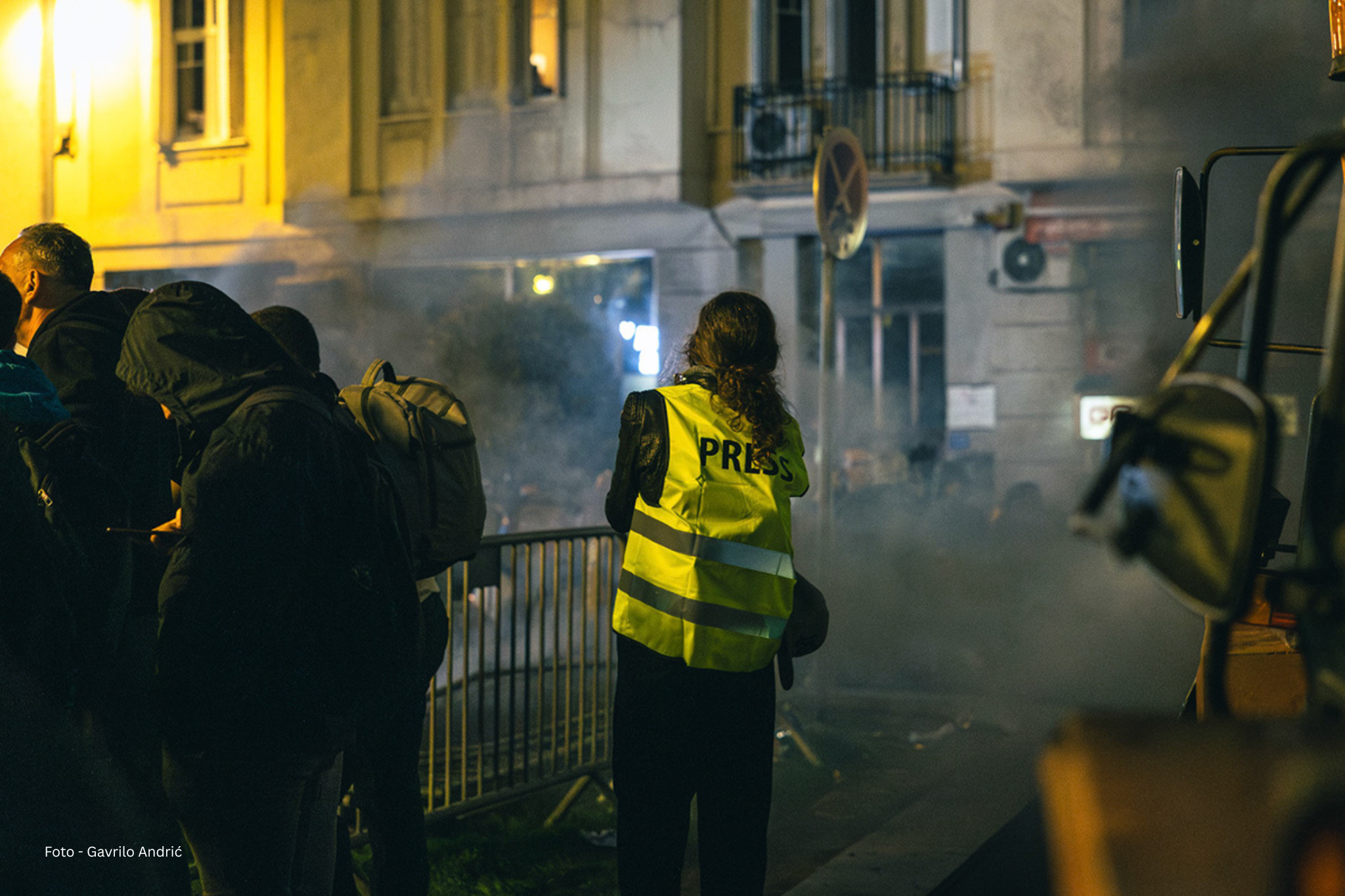
The resolution "On the Escalation of Attacks, Ensnaring of Media, and the Regression of Media Freedoms in Serbia," submitted by NUNS to the Congress, states that attacks, threats, and pressures on journalists and media workers in Serbia have continued to rise, and that verbal attacks from high-ranking state officials and representatives of the government have become systematic.
Addressing the Congress delegates on behalf of NUNS, General Secretary Tamara Filipović Stevanović urged participants to support the resolution, emphasizing that the situation in Serbia is alarming and that the adoption of this document represents an important message of international solidarity with independent journalism. In her address, she highlighted that attacks and threats against journalists, smear campaigns originating from public officials, police inaction and abuses, work pressures, SLAPP lawsuits, and threats to media pluralism create an atmosphere of fear and impunity.
With the adopted resolution, the IFJ condemned in the strongest terms the increasing attacks, threats, and discrediting campaigns against journalists and media in Serbia, as well as the growing involvement or passivity of state institutions that contribute to a climate of fear and impunity. At the same time, the authorities in Serbia were called upon to urgently, independently, and effectively investigate all attacks and threats against journalists and media outlets, and to ensure that the police protect journalists on duty.
The resolution also calls on the Government of Serbia to cease smear campaigns and verbal attacks by public officials on journalists, to publicly condemn hate speech and threats, and to ensure that state-owned companies are not used as tools for political and economic pressure on independent media. The European Union, the Council of Europe, the OSCE, the United Nations, and other international partners are urged to utilize all available mechanisms to insist that Serbia meets its obligations regarding media freedoms, journalist safety, labor rights, and media pluralism.
This year's congress carries additional weight as it is also the electoral congress of the IFJ. Elections for the presidential and vice-presidential positions have been conducted so far. Zuliana Lainez from Peru was elected as President, and the following individuals were elected as Vice Presidents: Jennifer Moreau from Canada, Zied Dabbar from Tunisia, and for Senior Vice President, Nasser Abu Bakr from Palestine. Elections for the executive board are ongoing.
The adoption of this resolution thus represents an important political signal not only in this anniversary year but also at a moment when decisions are being made regarding the new leadership of the organization and its bodies for the 2026–2029 mandate. Consequently, the issue of journalist safety and media freedoms in Serbia has been included among the topics that will remain high on the agenda of the largest global organization of journalists in the forthcoming period.
The full text of the resolution can be found at this link.
Note: The text of the resolution was submitted to the IFJ in early December of last year when the deadline for document submission for this year's congress was set.
Source: NUNS
Related Articles

Journalistic associations provided support to the editorial team of Nova.rs: Ongoing communication and updates with international stakeholders agreed upon.

Coalition for Media Freedom: Stop Attacks and Harassment of Journalists During the Election Campaign


.png&w=3840&q=75)