
Neither budget funds nor advertisers: How do those who criticize local authorities survive?
After more than a decade of project co-financing for media, it has become evident that it does not serve to support the public interest, but rather to reward those in favor. While local media aligned with the authorities are counting millions from city, state, and provincial funds, those known for their critical voice have two approaches to project co-financing: either they apply expecting not to receive any money, or they completely boycott the competitions to avoid giving them legitimacy.
Local media in Serbia have two paths: either they will support the authorities, quietly or loudly, and rely on money from public budgets and advertisers, or they will write critically about the problems in their communities, expecting to work without salaries, with debts, turning to foreign donors, or finding some other way to survive.
Project co-financing should serve to support reporting in the public interest and thereby indirectly help local media to survive and develop, but a decade of this model has countless times confirmed that its sole purpose is the distribution of our money to the favored.
Cenzolovka spoke with those who are considered undesirable.
“Let it be recorded”: The Case of In Media
One of them is In Media from Inđija. The editor-in-chief of this portal, Verica Marinčić, emphasizes that after years of pause, the editorial team decided to apply this year for the municipal competition for co-financing media projects.
The idea of the project was to create performances on the theme of digital violence against journalists and to show citizens the effect of online threats that journalists receive.
“On the street, actors would recite the insults we constantly receive, so citizens could see what it looks like when it is communicated live. In addition, there were plans for panels with colleagues and the production of a brochure. We wanted to create a ‘street of shame’ in the city, where people could read what we read about ourselves online. People would see what it means to digitally oppress someone, especially someone who works in the public interest for your benefit,” explains Verica Marinčić.
She mentions that in an unofficial conversation, some employees in the Inđija municipality praised the project, saying they were thrilled, “but that they hope we are aware that we won't succeed in this competition.”
And that was indeed the case – the project from this editorial team was later rated the lowest and they did not receive funding, but as Marinčić says, that was expected.
“We knew it would turn out this way not only because it was us, but also because of the project’s theme, which does not align with the authorities. We are the only media outlet from Inđija that applied and did not receive funding. We decided to apply because there will come a time when all decisions will be reconsidered, including these. That’s why we wanted it to be recorded and to have evidence that we participated,” explains Marinčić.
When asked how much her editorial team depends on project co-financing, Marinčić answers ― completely.
WASTED MONEY
“Instead of contributing to a more diverse and higher-quality media environment, the analysis of the competition of the Ministry of Information and Telecommunications (MIT) for 2026 shows that this mechanism is increasingly being used to reinforce existing political and economic power relations in the media market,” states the Analysis of the Project Financing Competition of the Ministry of Information and Telecommunications for 2026, conducted by the Coalition for Media Freedom.
The analysis shows that public funds “are significantly concentrated among a limited number of interrelated media owners, that organizations close to the authorities have a privileged position in the distribution of funds, while independent professional associations and local media find themselves in an increasingly unfavorable position.”
“Perhaps only about 15 to 17 percent of our annual revenue comes from donations, advertisements, and online sales. All the rest comes from European projects. We have a problem reaching those who would purchase our advertising space. One entrepreneur only wants to give us money, and he does this every year, but he doesn’t want anything in return, he doesn’t want advertising,” explains Marinčić.
Due to this financial situation, In Media has no funds to hire young journalists or to cover more complex topics. According to the editor of this media outlet, although her generation worked for free at the beginning of their careers, she believes it is not right and does not want to not pay for someone’s work and effort.
Glas Šumadije: Reducing the Team
The fact that it does not receive funding from domestic competitions also prevents Glas Šumadije from hiring new people. Editor Jovanka Nikolić states that due to financial reasons, the number of team members had to be reduced.
“This year we participated in the city media competition, but not in the republic one, because we had a bad experience in the last two years. The portals that we know were established literally just a few days or months before the competition passed, so we didn’t want to waste resources. This is the second year in a row that we have not passed the city competition,” explains Jovanka Nikolić.
She recalls the situation with Radio-Television Kragujevac (RTK), which has not yet been privatized and which, as she says, receives about 80 million from the city budget annually through subsidies.
“We sought data on where the money for RTK is allocated from the budget and found that it primarily comes from the position for communal services. And we, who are regularly contacted by citizens showing that we are very important to them, did not pass the city competition. Neither did other local portals that critically relate to the city authorities,” explains the editor of Glas Šumadije.
Despite this, Nikolić believes that Glas Šumadije should participate in the city competition because “this editorial team performs the function of a public service for Šumadija, and it involves public money.”
FOR PROJECTS ON CORRUPTION AND PROBLEMS IN ŠUMADIJA - ZERO DINARS
“In Šumadija, 80 media projects were supported in the competitions for co-financing media content in 2026, with a total of 71,700,000 dinars. Every third funded project deals with cultural and historical heritage, almost a quarter with tourism, but none have been identified as addressing corruption, public spending, or the control of institutional work,” states the analysis of the competition in Šumadija by the Association of Independent Local Media, Lokal Pres.
It is emphasized that this way “the model of project co-financing, which is currently crucial for the financial sustainability of local media, has completely displaced investigative and critical journalism from local media and communities.”
Eighty percent of Glas Šumadije's revenue depends on project co-financing, while only 20 percent comes from marketing, according to Jovanka Nikolić. As in the case of In Media, there is a fear of advertising in a media outlet that does not align with the authorities.
“Our marketing director often tells us how she has a big problem with advertisements when it comes to Kragujevac. Very often, we are offered some compensations for advertising, such as the use of a swimming pool, but we do not have larger earnings from marketing,” explains the editor of Glas Šumadije.
Therefore, this editorial team is also turning to foreign donors.
“In the imprint, we have a list of all our donors. We do not have citizen reactions, nor any problems because of that. I believe that citizens should know who and what enables our survival, in addition to our own work,” says Jovanka Nikolić.
Južne vesti: “We are in crisis like everyone else”
Unlike editorial teams like Glas Šumadije and In Media, which apply out of principle and spite expecting a negative outcome, there are also local media outlets that do not want to waste time and energy on this process – also out of principle or spite.
Južne vesti is one of the editorial teams that do not respond to competitions because, according to the words of the editor-in-chief Milana Zirojevića, they do not want to legitimize the process of project co-financing.
“For many years, we have not participated in either city or municipal competitions. The majority of the money in competitions is distributed to regime propaganda media, and if any honest media manages to get funding, it is merely ‘pocket change’ to justify the process and give the authorities an argument for objectivity,” states Zirojević. “We are aware that there has been a radicalization of propaganda, that it is spreading through the networks of existing or newly established local media, and that it is a preparation for elections. Thus, citizens' money, instead of going to the public interest, is going into the pre-election campaign of the Serbian Progressive Party.”
For Južne vesti, revenue from marketing is also not at a commendable level.
“Južne vesti is part of the umbrella IT company ‘Simplicity’, so that company ‘pulls’ our entire operation. However, as is known, flowers are not blooming in the IT sector in Serbia either. From marketing, we do not have the revenue that the most read and influential media south of Belgrade should have, primarily because the market does not exist and also due to entrepreneurs' fears that by advertising in Južne vesti, they will provoke the regime. We do not have any fixed advertisements from public enterprises; they advertise in regime media, but that is not about marketing, rather a scheme for financing propaganda,” says the editor of Južne vesti, adding that there are fewer and fewer international projects.
“International projects occupy a small percentage in our overall financing. Simply, we are in a state of crisis, like the entire society, but we will not give up,” says Milan Zirojević.
If a media outlet is critical, it is certain that it will remain without funding in project co-financing competitions. This raises the question ― should such media continue to apply, or should they not waste their time?
Marija Obrenović from the Association of Local Independent Media Lokal Pres believes that one should always apply.
“There should be some written record. It is true that it consumes your time, it is true that it is a futile effort, but if we agree to work largely on a voluntary basis, one more volunteer task doesn’t change much,” she concludes.
Source: Cenzolovka
Related Articles
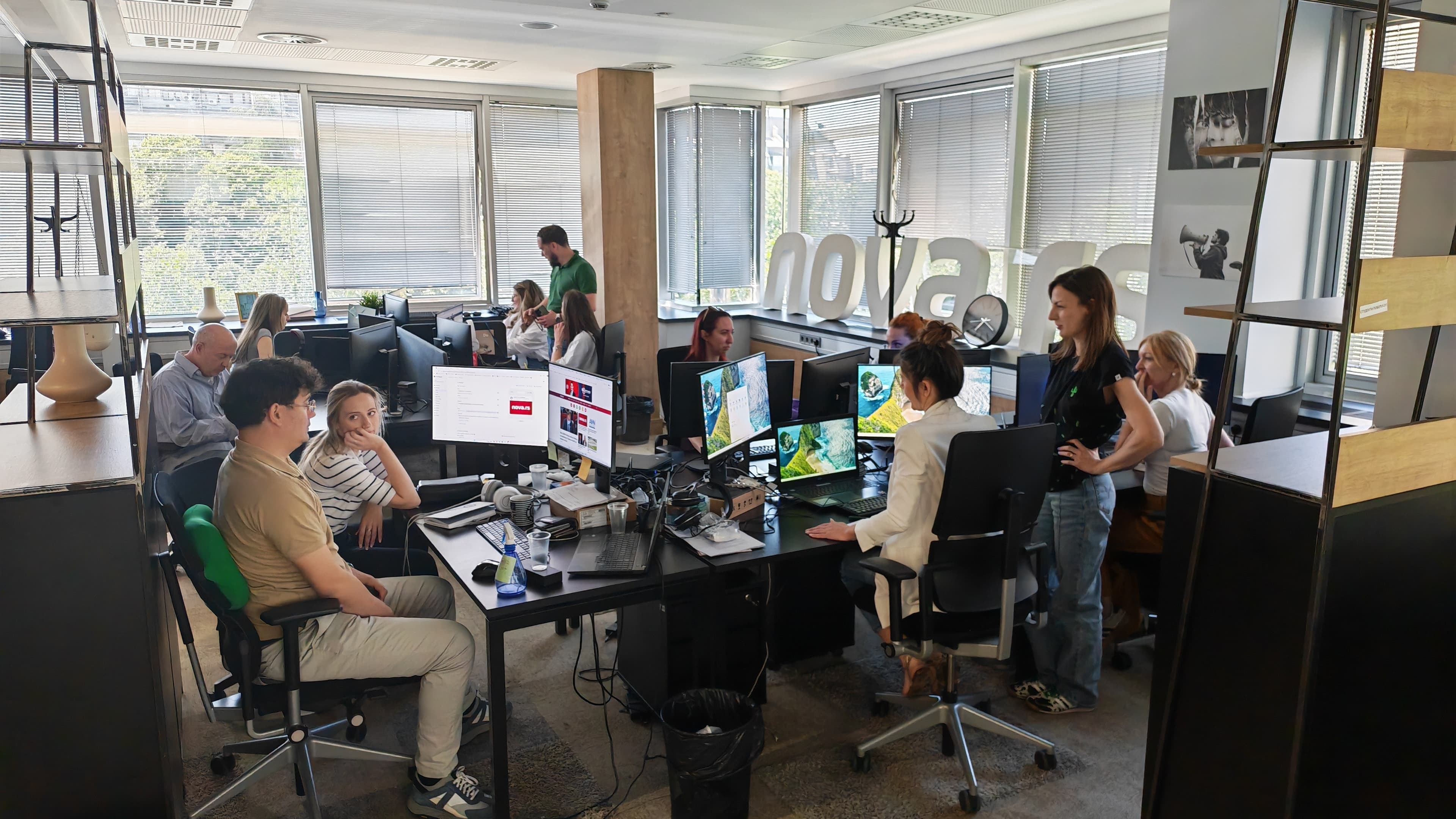
ANEM joins the protest of journalists from Nova.rs.

General Secretary of EFJ: Brutal takeover of the portal Nova.rs, a propagandist imposed as editor in an atmosphere of terror.

.png&w=3840&q=75)