
SĆF monitoring: 135 verbal attacks on journalists and media in May 2026.
In May 2026, the Slavko Ćuruvija Foundation recorded at least 135 verbal attacks from state officials and party functionaries of the Serbian Progressive Party (SNS) against journalists and media outlets, delivered via social media, in media appearances, and during sessions of the National Assembly.
Student and civic protests, the murder in Senjak that raised questions about the connections between police structures and criminal groups, reporting on the Serbian Orthodox Church and the Patriarch, and the visit of the President of Serbia to China – are just some of the triggers for the attacks.
For the first time in ten months, since the SĆF began this monitoring, the highest number of attacks was recorded in statements by the President of Serbia, Aleksandar Vučić (27), although he had previously regularly been at the top of this list.
Following him are:
- Member of Parliament from the SNS Nebojša Bakarec (25)
- Member of Parliament and Chairman of the SNS Parliamentary Group Milenko Jovanov (17)
- Speaker of the National Assembly Ana Brnabić (13)
- President of the SNS and advisor to the President of Serbia Miloš Vučević (9)
- Minister for Public Investments Darko Glišić (7)
- Member of Parliament from the SNS Vladimir Đukanović (6)
Attacks on journalists and media also involved another 19 officials, including the Ministers of Information Boris Bratina, Culture Nikola Selaković, Finance Siniša Mali, European Integration Nemanja Starović, Minister of Labor, Employment, Veterans and Social Affairs Milica Đurđević Stamenkovski, Vice President of the Provincial Government Sandra Božić, Mayor of Novi Sad Žarko Mićin, Director of the Government Office for Kosovo and Metohija Petar Petković, as well as Members of Parliament and members of the SNS Presidency. The Municipal Board of the SNS in Voždovac, the Ministry of Internal Affairs, and the Higher Public Prosecutor's Office in Belgrade also contributed.
This month, the highest number of attacks was directed at the editorial offices of N1, Nova S, Danas, and Radar. The officials also targeted Radio-Television of Serbia, the portals Autonomija, Srbin info, and 021, the News Agency Beta, and investigative editorial offices KRIK and CINS.
The current protests of students and citizens continue to be one of the key triggers for the attacks: Miloš Vučević stated that "the media platforms owned by Dragan Šolak" are "the key drumbeaters of everything that is being done," while Darko Glišić claimed that "these propaganda outlets sow discord among people, poison and awaken the worst possible emotions" and that "blockade media have the power to wash a person's brain."
Officials do not only portray critical media as "propaganda services" and "megaphones" for these protests, but also attribute an active role to them, accusing them of foreign financing and alleging that their aim is to harm the state. Siniša Mali, for instance, referred to N1 and Nova S as "a means for destroying Serbia in the hands of some Šolak, some powerful individuals, some foreign services, all those who do not wish well for our Serbia."
Student protests and the commemoration of Montenegro’s Independence Day were the cause for at least 15 cases where "Montenegrin," "Podgorica," "Milogorski," "Sarajevo," "Priština," "Croatian," and "Ustasha" media were attacked. Serbian officials presented these media as "the vanguards" or "media-political platforms for implementing a color revolution," whose interest is the "overthrow" of Serbia and President Aleksandar Vučić from power.
Media reporting on the "Senjak case" – the murder of A.N. which is publicly linked to criminal groups, and the arrest of then-head of the Belgrade police Veselin Milić on suspicion of participating in the cover-up of the crime – triggered a series of negative reactions from officials and institutions.
The news that, after Milić's arrest, Minister of Internal Affairs Ivica Dačić ended up in the hospital was not appropriately denied by the Ministry of Internal Affairs, which instead accused certain editorial offices of "shameful, reckless, and extremely unprofessional dissemination of disinformation," which "undermines stability and causes unrest among citizens."
Subsequent reporting on this murder was evaluated by the Ministry of Internal Affairs as an attempt to discredit the work of state bodies and criminalize the entire security system of Serbia. The Higher Public Prosecutor's Office labeled media reports as "spreading vague and unverified information," aimed at obstructing the investigation.
Such reactions cannot be viewed outside the broader context: pro-regime media have for years, without consequences, published details from investigations, court proceedings, and police actions, while their cameras are often present at the sites where police and prosecutors operate. One example is the reporting by Informer following the death of student Milica Živković at the Faculty of Philosophy in Belgrade, when it published photographs of the deceased student from the scene, covered the raid on the Rectorate and faculty, disclosed details about what was allegedly found, and even details from the autopsy report.
Therefore, the selective calling to account of the media for reporting on the murder in Senjak is an obvious continuation of pressure on critical editorial offices: it does not remain at warnings about professional standards, but represents gross accusations against the media coming from state bodies, despite the fact that they should not interfere in their work in any way.
Some of the attacks recorded in May were based on accusations that certain media not only do not advocate for the values that preserve the Serbian national identity and are in the interest of Serbian society, but also persistently work against them.
Dissatisfied with the reporting on Patriarch Porfirije, Nebojša Bakarec accused Nova S of, "like Ustashas," satanizing, criminalizing, and dehumanizing the Serbian Orthodox Church and Patriarch Porfirije, as well as conducting a "campaign for the destruction or abolition of the SPC."
Nikola Selaković stated that N1 and Nova, as "the media arm of the pressure group on Serbian institutions," are attempting to "subject institutions that have preserved the spiritual, cultural, and national identity of the Serbian people for centuries to empty criticism."
In a similar pattern, politicians commented on the reporting of the President of Serbia's visit to China. Contributions from certain editorial offices regarding this were not presented as legitimate criticism, but rather as proof that these media do not care about investments, the international position, and state interests of Serbia.
The information that "tycoon media" described the visit as "reality TV," Vučić commented:
"If they have something more important, if they think it's more important to throw containers in the streets, to attack the police (...) If that is more important than bringing investments, than friendship with such a people (...) let them continue reporting on that."
Member of Parliament Biljana Pantić Pilja sarcastically commented on the reporting of "blockade media" regarding the visit to China, pointing out that "they did not write about the investments and the agreements that were signed, because everything that is good for our country is not good for them," and asking journalists: "People, are you normal?"
Source: Slavko Ćuruvija Foundation
Related Articles
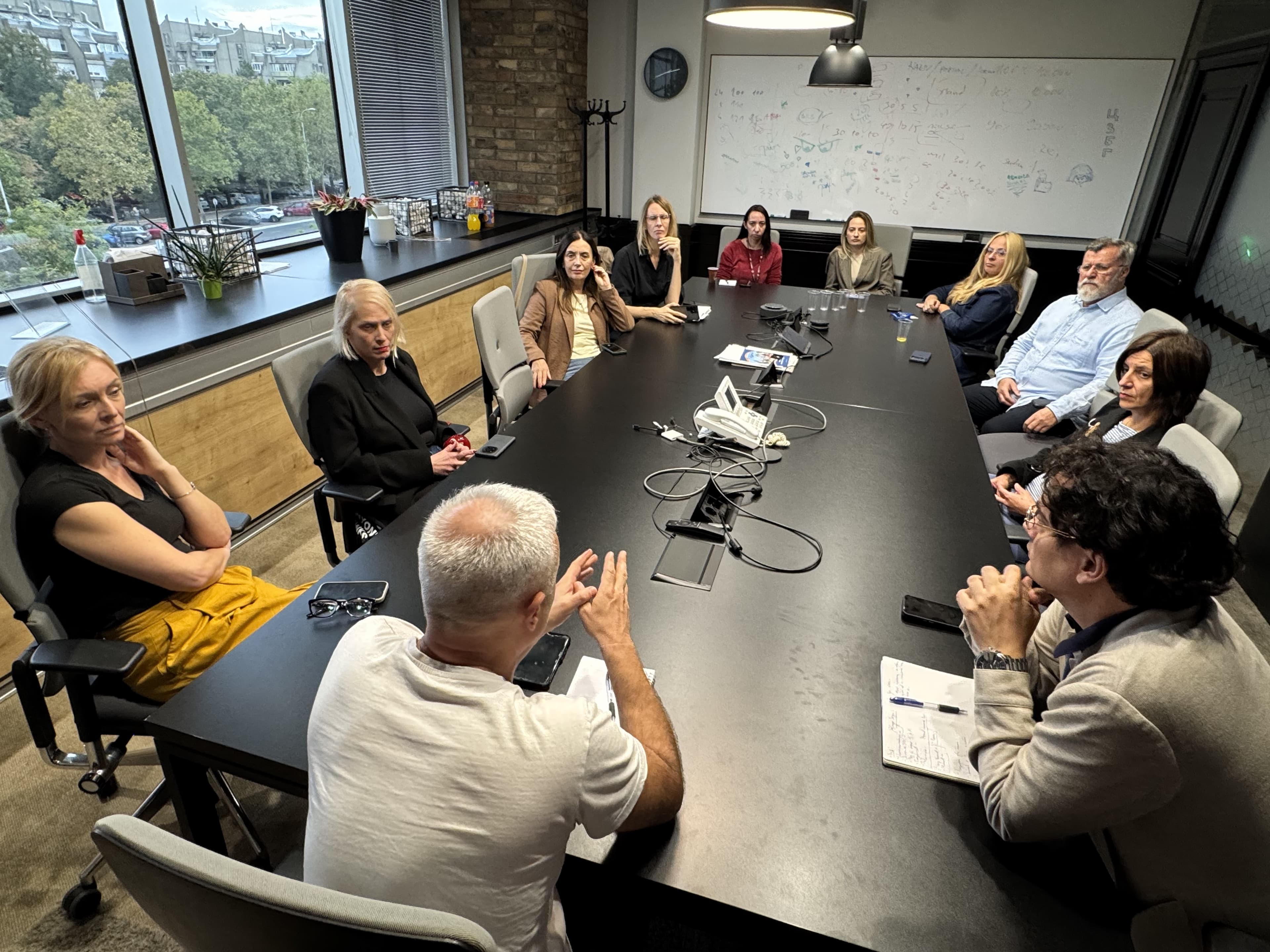
Journalistic associations provided support to the editorial team of Nova.rs: Ongoing communication and updates with international stakeholders agreed upon.

Coalition for Media Freedom: Stop Attacks and Harassment of Journalists During the Election Campaign

.png&w=3840&q=75)