
SĆF: In January, there were twice as many attacks on media by state officials compared to December.
During January 2026, the Slavko Ćuruvija Foundation recorded at least 160 verbal attacks on critically oriented media and journalists, carried out by the highest state and party officials who did not "rest" even during the New Year and Christmas holidays. This is, in fact, double the number recorded in December, when they noted 79 attacks.

In the discrediting and labeling of journalists and media, at least 27 officials participated in January, with the most active being SNS member of parliament Nebojša Bakarec (37), SNS member of parliament Milenko Jovanov (22), President of Serbia Aleksandar Vučić (19), SNS member of parliament Vladimir Đukanović (19), President of the National Assembly Ana Brnabić (17), SNS member of parliament and Chairman of the Justice Committee Uglješa Mrdić (9), and SNS President Miloš Vučević (8).
The attacks also involved: Minister of Information Boris Bratina, Minister of Culture Nikola Selaković, Minister for Public Investments Darko Glišić, Minister for European Integration Nemanja Starović, Vice President of the National Assembly Marina Raguš, SNS members of parliament Dragan Nikolić, Marjan Rističević, Marko Atlagić, Milica Nikolić, Aleksandar Mirković, Nataša Jovanović, Uglješa Grgur, Đorđe Komlenski, SPS member of parliament Dušan Bajatović, State Secretary in the Ministry for Family Care Đorđe Dabić, member of the Assembly of Vojvodina Aleksandar Đurđev, Vice President of the Assembly of Vojvodina Nemanja Zavišić, Vice President of the Government of Vojvodina Sandra Božić, former Minister for Family Care Darija Kisić Tepavčević, as well as a member of the Board of Directors of the Oil Industry of Serbia Dragutin Matanović.
The targets were predominantly the editorial teams of TV N1 and TV Nova S, and somewhat less frequently the newspapers Danas, Radar, and Vreme, as well as the public media service RTS and KTV Zrenjanin. In addition to already normalized labels such as “Šolak’s,” “blockading,” and “tycoon” media, more severe insults were recorded: member of parliament Milenko Jovanov spoke in the Assembly about “Šolak’s garbage,” members of parliament Dušan Bajatović and Dragan Nikolić referred to “media poisoners,” Nebojša Bakarec wrote on social media about “failed Ustaše media,” and Vladimir Đukanović labeled RTS as a “detestable” media outlet where “miserable” people and “communists” work. For N1 and Nova, epithets such as “Goebbels-like” and “anti-Serbian” were used, and journalists from these editorial teams were targeted as “tycoon lackeys,” “liars,” and “purveyors of evil.”
Individual journalists who already face serious pressures and threats due to their work were also targeted, raising concerns for their safety from the media community on multiple occasions.
Member of parliament Uglješa Mrdić wrote about journalist Vuk Cvijić as a “deep throat, megaphone for the services, and drug addict,” Milenko Jovanov referred to journalist Slobodan Georgijev as “Šolak’s Piculobranitelj,” and the targets also included Mijat Lakićević, the author of the Peščanik portal, and journalists Srđan Škoro, Marina Fratucan, and Dinko Gruhonjić, as well as Aleksandar Dikić and Nemanja Šarović from KTV Zrenjanin. Nebojša Bakarec referred to some of them as “horsemen of the apocalypse.”
In the majority of cases, officials discredited media and journalists by belittling their professionalism, independence, and honesty, but they continued to criminalize entire editorial teams in their statements throughout January. Independent media were accused, without any evidence, of calling for Vučić's assassination, of being “media sponsors of crime and violence,” and of wanting to “hang, ride, and kill” political opponents.
Although attacks on the media were daily and concerned various topics, the most intense campaigns of targeting were conducted regarding the most significant political events in January—the visit of the European Parliament mission to Serbia and the adoption of a set of judicial laws. Reporting on the mission of the European parliamentarians provoked comments that “Šolak’s media” stood with “Ustaša Picula” and the delegation, and against the interests of their own state.
When it comes to the “Ustaša-ization” of independent media, it is interesting to note that member of parliament Nebojša Bakarec shared a deepfake video on social media X in which the founder of the Ustaša movement, Ante Pavelić, takes a selfie with N1 journalist Žaklina Tatalović during student protests.
Similar discrediting could also be heard during the public discussion about the controversial set of judicial laws, which was criticized by both domestic and international expert communities, as well as the media. In an attempt to convince the electorate that the so-called Mrdić laws would ensure greater independence for prosecutors, members of the ruling coalition claimed that “renegade parts of the judiciary” (i.e., politically undesirable prosecutors) deliver information and indictments to the media, and that in collaboration with the media, they attempt to carry out a colored revolution and portray Vučić as a criminal.
Perhaps the most bizarre reason for the criminalization of the media was the airing of an episode of the TV series "Radio Mileva" on Radio-Television of Serbia in mid-January. In one of the scenes, the residents of a building discuss how to prevent its demolition, and the heroine suggests “revolution, demonstrations, blockades of schools, faculties, kindergartens, the internet, portals, media, television.” This fictional scenario was the basis for a real campaign led by pro-government tabloids, spearheaded by Informer, against the public service, claiming that RTS “destroys the state” and broadcasts “blockading messages and policies.” The campaign was also joined by the Ministry of Information, led by Boris Bratina, which announced that the public service had been “abused,” and that this scene from the series could be interpreted as an indirect call for blockades and the overthrow of the constitutional order.
**Source: Slavko Ćuruvija Foundation**
Related Articles
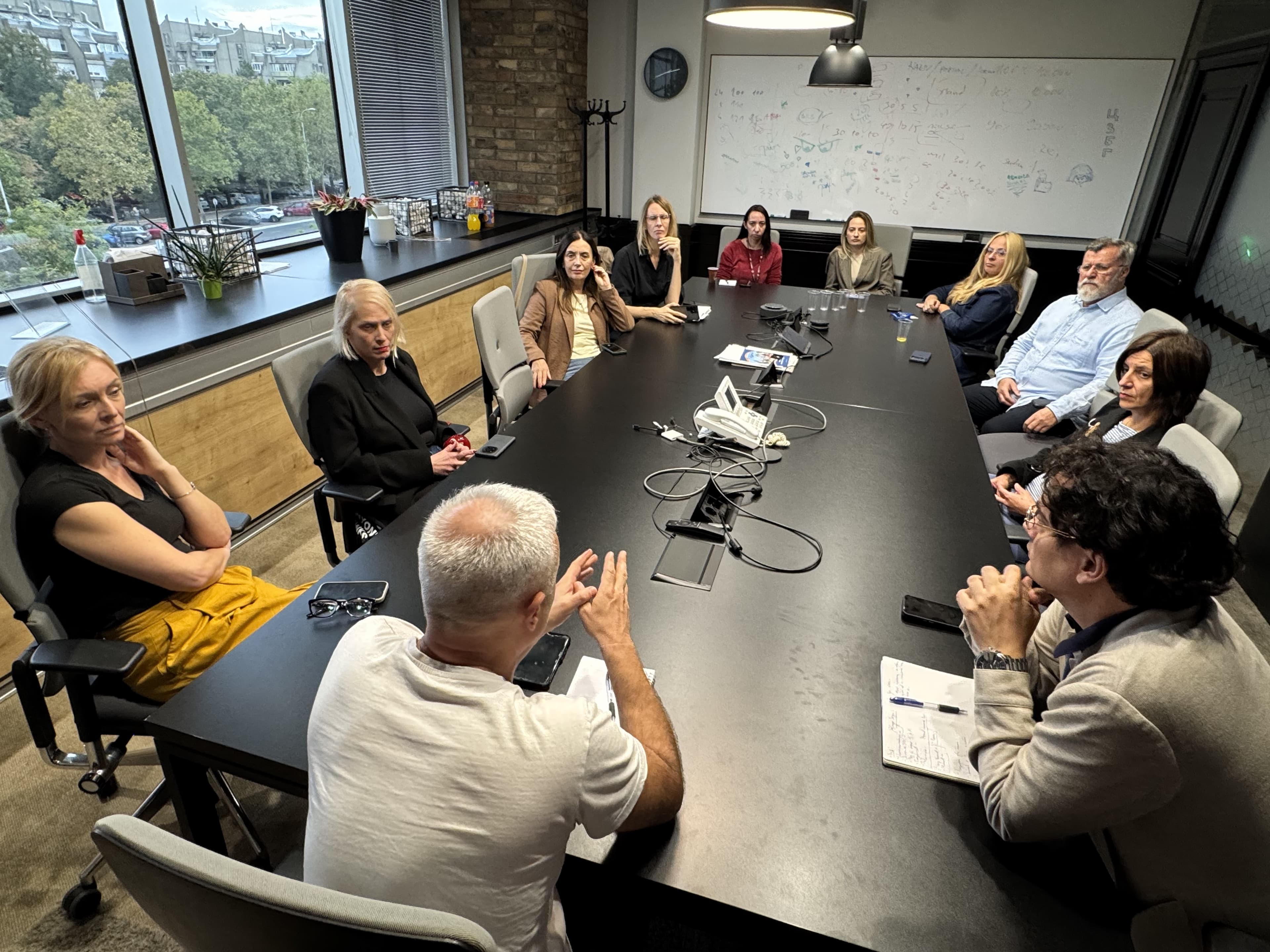
Journalistic associations provided support to the editorial team of Nova.rs: Ongoing communication and updates with international stakeholders agreed upon.

Coalition for Media Freedom: Stop Attacks and Harassment of Journalists During the Election Campaign
.png&w=3840&q=75)