
The fees for public service remain 349 dinars.
The Ministry of Information and Telecommunications has rejected the proposal from the boards of directors of Radio Television of Serbia and Radio Television of Vojvodina to adjust the fee for public media services in line with inflation, which, according to the unions, could further jeopardize the financial stability of RTV and the position of its employees.

“The Ministry of Information and Telecommunications does not agree with your proposal, given that the adjustment of the fee amount is provided by law as an option, and we believe that at this moment it is not necessary to adjust the fee for the public media service to the inflation rate in the Republic of Serbia, i.e., to increase the fee amount to 387.32 dinars,” the Ministry stated in response to the proposal recently submitted by the boards of Radio-Television of Serbia and Radio-Television of Vojvodina, which NUNS has reviewed.
As the Ministry further clarified, the Law on Public Media Services (LPMS) states: “The fee amount may be adjusted once a year, based on the inflation rate in the Republic of Serbia, according to officially published data from the authority responsible for statistical matters, and it cannot be lower than 0.6% of the minimum wage in the Republic of Serbia established for that year.”
Thus, the key word in Article 37, paragraph 2 of the LPMS, is “may,” and in accordance with that possibility, the decision was made not to approve the increase of the fee from the current 349 dinars to 387.32 dinars.
On the other hand, the unions warn that this decision will have serious consequences for the functioning of RTV and the material position of its employees.
Darko Šper from the Independent Trade Union of RTV told NUNS that both boards made this decision back in November 2025, in accordance with the new Law on Public Media Services, and informed the Ministry, which responded very quickly.
According to him, an increase in the fee for RTV alone would mean a significant revenue boost.
“Regarding RTV, this would mean a monthly increase in revenue from fees of just over twenty million dinars. Even without that money, we have reached a situation where we do not have funds to increase salaries, as is the case throughout Serbia, specifically by five percent,” said Šper.
He warns that the situation among employees is already alarming.
“At RTV, nearly 500 out of 1,200 people received the minimum wage for the last salary. Some positions that require a college degree are already receiving the minimum wage. It has reached a point where employees with a first level of education are being equated with the salaries of those who have sixth and seventh levels,” emphasizes Šper.
He adds that any potential approval of the fee increase would at least partially improve the situation.
“The unions at RTV are already in negotiations with the employer to increase employee earnings, and in the event that those funds are approved, only a small number of people would remain on the minimum wage, but we do not have the money for that,” he emphasizes.
Šper reminds that the minimum wage has been increased multiple times in the previous period, while the revenues of public services have not kept pace with that growth, and there has been no increase in either subscriptions or budget allocations intended for public media services.
According to him, maintaining the fee at its current level could have broader consequences for programming production.
“If the subscription remains at 349 dinars, RTV may find itself unable to purchase anything from independent production, as there will be no funds available, and we will end up in a situation, after the next increase in the minimum wage, where a much larger percentage of people will be on the minimum wage,” warned Šper.
Source: NUNS
Related Articles
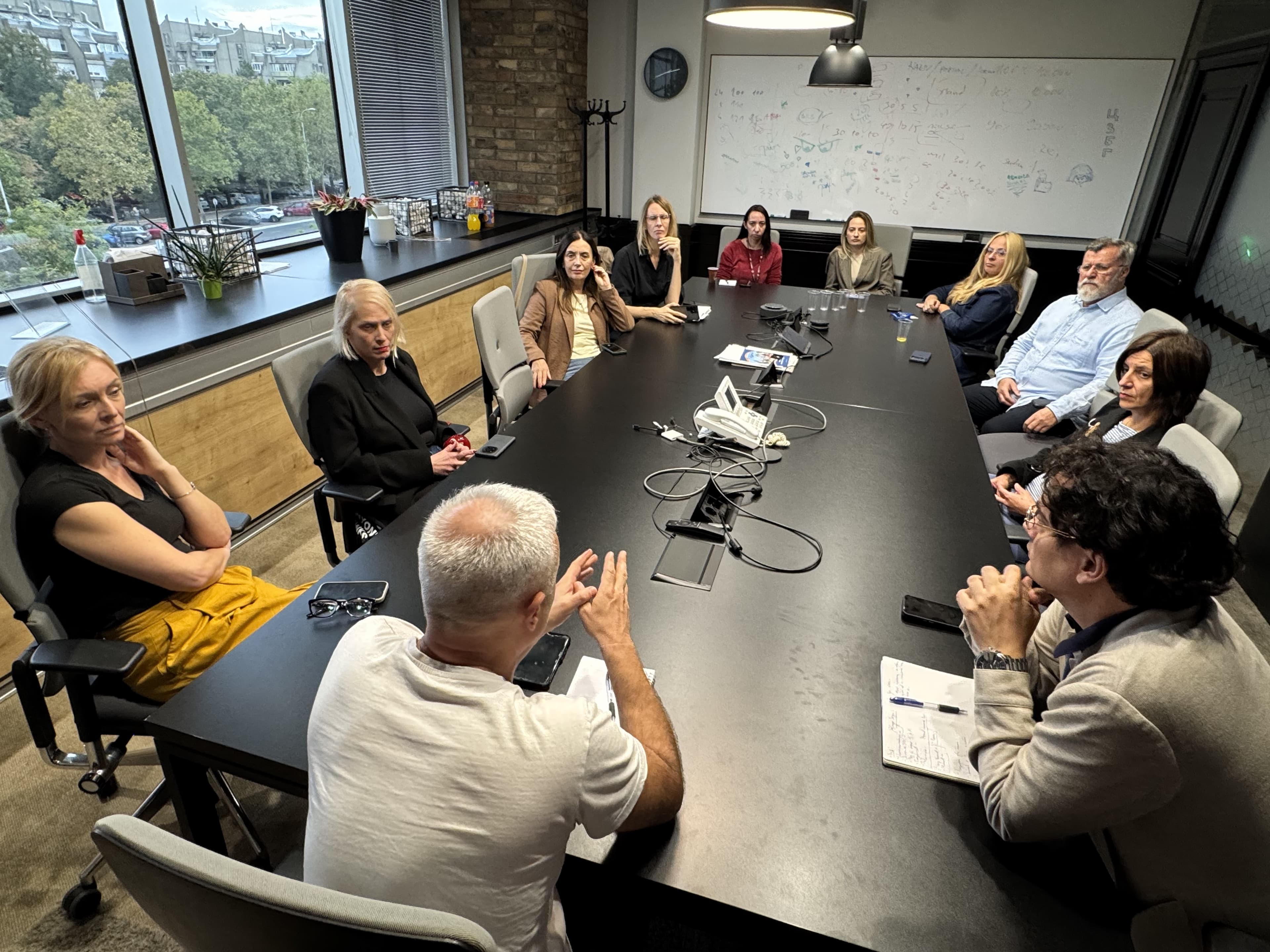
Journalistic associations provided support to the editorial team of Nova.rs: Ongoing communication and updates with international stakeholders agreed upon.

Coalition for Media Freedom: Stop Attacks and Harassment of Journalists During the Election Campaign

.png&w=3840&q=75)