

Veran Matić: Today, hate speech comes from the top of the government, and the response to it is solidarity and empathy.
“That hatred is now directed against one’s own people, against those who think differently,” warned the president of ANEM, Veran Matić, assessing that hate speech in Serbia today “comes directly from the top of the government.” He stated that society is facing an atmosphere of fear, targeting, and violence, while he sees the only response as “love, empathy, and solidarity,” which, according to him, were demonstrated by the student protests.
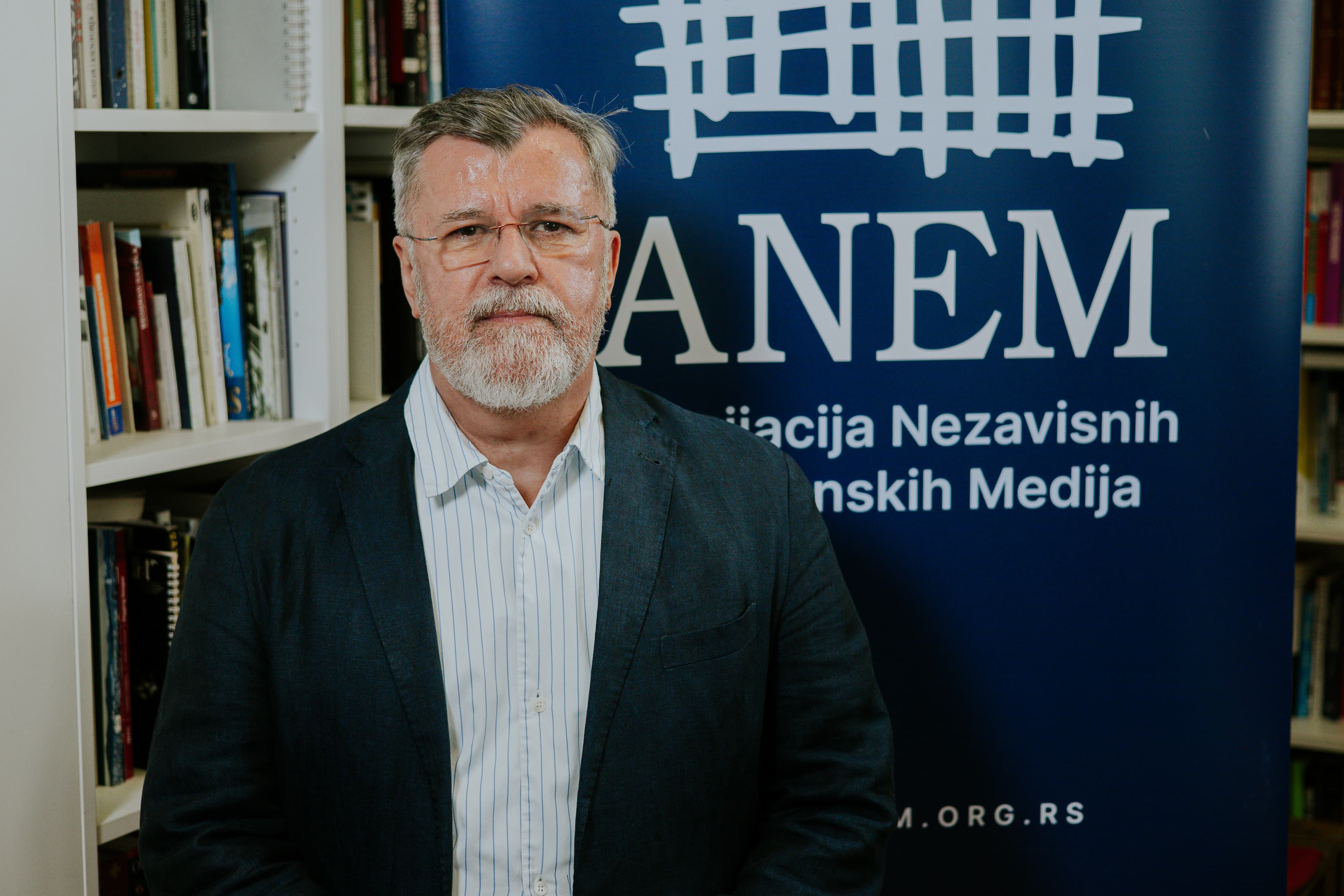
The president of ANEM and long-time journalist Veran Matić assessed that hate speech in Serbia and the former Yugoslavia has been systematically constructed since the late 1980s, and that today it comes directly "from the top of the government," warning that society is sinking into a "darkness that Europe no longer recognizes."
Speaking about the roots of hate speech, Matić noted that negative stereotypes and hostilities among nations and political groups existed before, but their escalation began with the development of totalitarian politics in Serbia in the late 1980s and early 1990s.
"Hate speech is a product of hatred that was produced in our regions, particularly intensively at the end of the 1980s and the beginning of the 1990s. The escalation of hatred begins with the development of totalitarian politics in Serbia, based, on one hand, on the narrative of the endangered status of one’s own nation, and on the other, on the creation of hatred towards others," said Matić.
According to him, the media during the 1990s became a tool for spreading such narratives.
"Through hate speech, this was multiplied through the media that were then functionalized. Thus, the wars in the former Yugoslavia began," he stated.
Matić recalled that the wars of the 1990s were accompanied by "horrific crimes," especially against civilians, women, and children, assessing that hate speech was a "major generator of brutality."
"For several years, hate speech and the lies that accompany it generated those horrific crimes," he said.
He added that after the wars, there was no real readiness in society to confront the past, nor were serious mechanisms established to sanction hate speech.
"There was no absolute interest in seriously confronting the past, nor in creating legal and other mechanisms for hate speech to be sanctioned," said Matić.
He believes that hate speech has only "moved from topic to topic" over time.
"When it became forbidden to speak about Albanians as 'Shiptars' or about Croats as 'Ustashas,' hatred found a new target. Thus, homosexuals suffered, and the Pride in 2001 was horrifically bloody," he recalled.
Matić assesses that society today is facing the consequences of all the "lost wars," and that hatred is now directed towards its own people and political dissenters.
"We now have a war that has returned to where it started – in Serbia. That hatred is now directed against its own people, against those who are not part of the ruling political structure, against those who think differently," he said.
He particularly warned of what he describes as the connection between politics, violence, and criminal structures.
"In order for that hatred to be effective, criminals are engaged, killers are engaged, and now the worst part of society is working to prolong the political life of this government," Matić stated.
He added that various segments of society are involved in such an atmosphere, including part of the Serbian Orthodox Church, which he considers particularly dangerous due to the multi-religious character of the region.
"The most drastic thing at this moment is that this hatred is commanded from the top of the government, directly from President Aleksandar Vučić, his 'clones,' Ana Brnabić, ministers, and members of the ruling party. The largest amount of hatred today comes precisely from the parliament," he assessed.
Speaking about the current social atmosphere, Matić said that citizens today live with a sense of fear and the possibility of being attacked due to political targeting.
"When you have a fear that you will be attacked because you are targeted precisely from there, then that is a terrifying piece of data. The world is now beginning to perceive the reality and brutality of that regime," he said.
As a counterpoint to such an atmosphere, Matić sees student protests and the values they promote.
"The most subversive part, the one that this regime fears the most, is precisely love, empathy, and solidarity that have been expressed during the student protests over the past year and a half," he stated.
According to him, proponents of hate "do not know how to fight against that except through bare violence."
"I hope that together we will find a way to oppose this and protect the lives of all who are targets and endangered, and that love, solidarity, empathy, and youth will prevail," said Matić.
He particularly emphasized the importance of the role of journalists in such a social atmosphere.
"The journalistic mission and hypersensitivity to hate speech are particularly important. It must always be marked and criticized so that it is not normalized, as it seems to be today," concluded Veran Matić.
**Source: [Kossev](https://kossev.info/veran-matic-govor-mrznje-danas-dolazi-iz-vrha-vlasti-a-odgovor-na-njega-su-solidarnost-i-empatija/)**
Related Articles

Journalistic associations provided support to the editorial team of Nova.rs: Ongoing communication and updates with international stakeholders agreed upon.

Coalition for Media Freedom: Stop Attacks and Harassment of Journalists During the Election Campaign


.png&w=3840&q=75)