
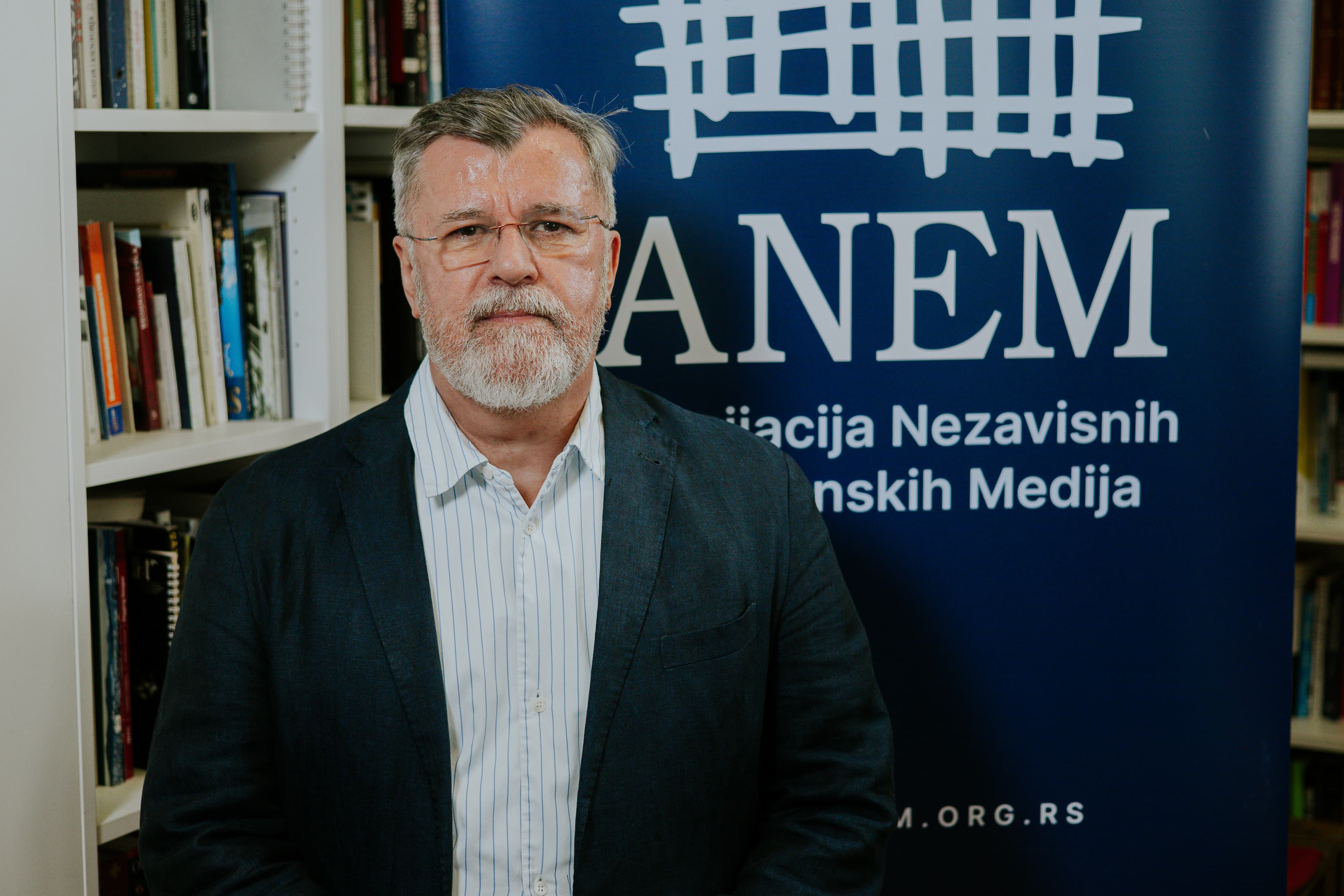
Veran Matić: "The public interest replaced by funding a propaganda network."
Since the beginning of the year, at least 88 new media outlets have been registered in Serbia, while around 1.7 billion dinars have been allocated through 140 completed competitions for project co-financing of media content. Analyses by the Association of Independent Electronic Media (ANEM) indicate that a significant portion of the funds has ended up with a few large media groups and their affiliated companies, while at the same time, the network of new local portals is expanding rapidly. Veran Matić, the President of ANEM's Board of Directors, assesses in an interview with Mašina that the project co-financing system is no longer fulfilling its original purpose and warns that professional local media are lacking the resources necessary for survival.
The first six months of 2026 were marked by two trends that, according to assessments from experts, are changing the media landscape in Serbia. On one hand, at least 88 new public outlets have been registered in the Media Registry of the Business Registers Agency, almost exclusively internet portals. On the other hand, approximately 1.7 billion dinars have been distributed from national, provincial, and local budgets for the 140 completed competitions for project co-financing of media content.
ANEM's analyses show that the largest portion of the funds goes to a limited number of media groups that increase their presence in competitions year after year, while new portals are simultaneously being established, often associated with already existing publishers.
The highest amounts of funding in the completed competitions so far have been awarded to Zona plus from Niš, VTV from Subotica, RTV Pančevo, Kopernikus Cable Network, RTV Vranje, INI media, and Novosadska TV. Observed by ownership structure, the largest individual amount went to the tabloid publisher group Alo and Informer and their affiliated companies, which collectively received over 154 million dinars.
At the same time, companies associated with Radoica Milosavljević received more than 120 million dinars, while significant funds were also awarded to the groups of Vladan Stefanović, Goran Lalić, Tatjana Cuk, and Slavko Stijaković.
For Veran Matić, such data is not just statistics.
“What we can notice today is that project co-financing is no longer a mechanism for achieving the public interest or for financing content important for local communities. It is an organized system through which funds intended for the public interest are redirected towards media content that spreads lies, targets political opponents of the government, and professional media, while simultaneously promoting the ruling structure,” says Matić.
According to him, abuses are not new, but he believes that 2026 is a turning point.
“This is a process that has been ongoing for years, but is now reaching its peak. It is evident that a decision has been made to completely suppress professional media and even eliminate those local media that have so far managed to survive thanks to modest funds from competitions.”
From Pluralism to Concentration
Project co-financing was introduced with the idea of encouraging the production of media content of public interest and enabling the sustainability of local and professional journalism. Matić recalls that the initial model was aligned with European standards and that the first commissions consisted of experts from various fields.
“I was a member of some of the first commissions. They included representatives from different areas of society, people who understood media, human and minority rights, and the needs of local communities. Such a composition allowed for genuine discussions about the public interest,” he says.
Today, however, he believes that the problem is no longer in the legal framework itself.
“Laws are not the key problem. The problem is the political decision to completely abuse the existing system. For years, conditions have been created for this method of scoring and for commissions that will make pre-determined decisions,” says Matić.
As a result, the number of professional local media that manage to obtain funding decreases year after year, while the largest portion of the budget goes to media that already have strong financial and political support.
“Even that small percentage of funds that independent local media used to be able to obtain practically no longer exists. For many of them, even relatively small amounts represented the difference between survival and closure.”
88 New Media in Six Months
Alongside the distribution of budget funds, the number of registered media is also increasing. Since the beginning of the year, at least 88 new public outlets have been registered, of which as many as 82 are internet portals. Five printed media and only one radio station have been registered, while no new television stations have been entered into the Registry.
Among the new publishers, Zapple Media Group stands out, having established 12 local portals in just a few months and already managed to secure more than 16 million dinars in competitions, including almost five million from the Ministry of Information and Telecommunications.
At the same time, Best Media Team, a company connected with the publishers of tabloids Alo and Informer, continued to acquire local media and register new portals through affiliated enterprises.
New portals have also been registered by publishers who already own a large number of media outlets, including Slavko Stijaković, Radoica Milosavljević, Vladan Stefanović, and Vesti sa severa.
At first glance, such growth could indicate a development of media pluralism. However, Matić believes the reality is different.
“The establishment of new media largely serves to strengthen the government. Serbia now has over 2,300 registered media outlets, and there is no serious business logic that would justify such a number of media in a country of this size,” he emphasizes.
In his estimation, the vast majority of registered media operate as a pro-government network, while there are only around a hundred professional media working in the public interest.
“It is not enough to have a vast majority in the media space. The goal is to have a whole network of loyalist portals that will publish identical texts, the same message, or the same targeting at the same time. This is precisely the purpose of a large portion of the newly established media.”
Targeting Has Become Part of the Media Strategy
Speaking about the role of newly established portals, Matić notes that they are often not used for producing original local content, but for coordinated dissemination of identical texts and campaigns against individuals.
He mentions that he himself has been a target of such a campaign.
“Unfortunately, I experienced the first wave of media establishment close to the Center for Social Stability. The propaganda film targeting me appeared practically at the same moment on more than twenty newly established or acquired portals. Those contents still remain on those sites and evidently have no other purpose than targeting.”
He adds that, in his assessment, such a model is not applied only to him.
“On that list were numerous journalists, activists, and other dissenters. Today, we see daily that many people are exposed to very serious campaigns that cause some to even leave the country to protect themselves and their families.”
Matić believes that the trend of establishing new media will continue, especially ahead of politically significant events.
“I am sure that the number of newly established media will continue to grow. This has nothing to do with business logic, but with the need to have as many channels as possible through which identical messages will be conveyed at a given moment,” says Matić.
Why ANEM Created a Competition Database
One of the reasons for the conversation was ANEM's new database of competition results for project co-financing of media. This is a unique database that consolidates data on the distribution of funds across Serbia, created because official data are not easily accessible or systematized.
According to Matić, the very lack of transparency represents one of the biggest problems.
“This government is the least transparent since 2000 when it comes to the field of information. Even in the 1990s, there was more transparency in the work of the then Ministry of Information, although it was extremely repressive. Today, data that show how public funds are spent are concealed.”
ANEM, he says, has systematically monitored competitions, commission decisions, and distribution of funds for almost a year and a half to create an overview that did not previously exist.
“Many told us that it was a futile task because it was known in advance how the competitions would end. However, it was important for us to document everything and to create a cross-section of a year that would show how the system functions.”
Such a database, he adds, allows for the first time to see in one place where budget money intended for public information goes and what patterns repeat year after year.
Local Governments as Part of the Same Pattern, Professional Media Left Without Space to Survive
Commenting on the distribution of funds at the local level, Matić believes that the decisions made by commissions are not isolated cases, but part of a broader pattern.
“I think it all boils down to a political decision. Local officials are tasked with ensuring that a certain portion of the funds ends up with certain media, and they carry this out. When you look at the results of competitions across Serbia, you can see that the same patterns repeat almost everywhere.”
According to him, that is precisely why it was important to consolidate data from all competitions.
“Only when all results are placed in one place does it become clear that these are not individual decisions but rather a system,” he emphasizes.
Matić warns that the greatest price of such a system is paid by local professional media.
As he says, many of them operate with small newsrooms and modest budgets, so funds from competitions often represented the only way to continue operating.
“For many local media, even relatively small amounts were a guarantee that they would be able to survive. Now it is evident that a decision has been made for them to disappear as well,” says Matić.
At the same time, he adds, money intended for the public interest ends up with media houses that already possess significant resources or expand their network of new portals.
Instead of Public Interest, We Have Conformity
At the end of the conversation, Matić assesses that the original idea of project co-financing was to encourage diversity in media content, the development of local journalism, media literacy, and the production of programs significant for various social groups.
Instead, he believes, the system has lost its fundamental purpose.
“Project co-financing could have been a mechanism for the development of media pluralism, tolerance, respect for human and minority rights, and quality local information. Instead, we have received conformity and a centralized propaganda system.”
The data that ANEM has collected over the past year and a half, he concludes, represent a detailed overview of how the distribution of public funds intended for media functions today.
“Our goal was to document the situation and make it visible. Only when all data are placed in one place can it be seen how the system, which was supposed to serve the public interest, has changed its function over the years,” concludes Matić.
Source: Mašina
Related Articles

Journalistic associations provided support to the editorial team of Nova.rs: Ongoing communication and updates with international stakeholders agreed upon.

Coalition for Media Freedom: Stop Attacks and Harassment of Journalists During the Election Campaign


.png&w=3840&q=75)