
In six months, there have been 834 verbal attacks by officials on journalists and the media.
From August 1, 2025, to January 31 of this year, the Slavko Ćuruvija Foundation recorded at least 834 verbal attacks by high-ranking state officials on critically oriented journalists and media in Serbia. This involved at least 64 officials who insulted, discredited, and accused journalists and media outlets without evidence on a daily basis. The most frequent attacker is Nebojša Bakarec, who verbally assaulted the media and journalists at least 214 times, accounting for a quarter of the total number. Following him are SNS member Vladimir Đukanović, President Aleksandar Vučić, SNS member Milenko Jovanov, Speaker Ana Brnabić, and SNS President Miloš Vučević. The primary targets are often "Šolak's media," particularly N1 and Nova S.

There is practically no government authority whose representatives have not been involved in targeting journalists: from SNS (Serbian Progressive Party) members of parliament, who absolutely lead in attacks during parliamentary discussions and on their social media accounts, to the leadership of the parliament and ministers in the government, all the way to the President of the Republic. In these attacks, at least 64 officials participated over the past six months.
Insects, liars, drug addicts, subhumans, terrorists, fascists, Nazis, traitors, lunatics – these are just some of the epithets that state officials have used to describe journalists.
The dominant narratives in verbal attacks focused on discrediting the media and journalists regarding their professionalism, independence, and ethics, as well as dehumanization, insults, labeling journalists as traitors and mercenaries, and even comparisons to fascists.
Particularly dangerous narratives over the past six months have concerned the criminalization of media and journalists, within which officials accused certain editorial offices of inciting the most serious crimes, of a violent overthrow of the government and bloodshed in the streets, and even of preparing the media ground for the assassination of Vučić. Alongside the spread of such accusations, there have also been calls for the prosecution to take action against them.
The absolute champion in the number of attacks, Nebojša Bakarec, has insulted, accused, and discredited the media at least 214 times. He referred to N1 and Nova S as “miserable,” “malefactors,” “paupers,” “anti-Serbian poisoners,” “Nazis,” “media garbage,” the newspaper Danas as “toilet paper,” and journalists from RTS as “stenches.” He did not choose his words or emojis, and he repeated his insults on Instagram, Twitter, in columns for Informer, in articles on his website, and during TV appearances.
In September, Bakarec even accused employees of N1 of attempted murder. “TV N1 has started killing! A vehicle from TV N1 deliberately hit a police officer on a motorcycle,” Bakarec wrote.
However, it turned out that the driver of this television station had knocked over a police officer on a motorcycle while making a U-turn on the street, as shown by footage from street cameras. The editorial office expressed regret over the incident in a statement and wished the police officer a speedy recovery.
Following him is Vladimir Đukanović with 114 verbal attacks over the past six months, using similar vocabulary, albeit slightly more polite. What could be heard from him?
“Šolak's media poisoners,” “KRIK, the transmitter of texts from Western agencies,” “the vile communist RTS.” The editor of Danas is referred to as “unfortunate Draža Petrović, once a fiery Chetnik, and now an ANTIFA novice,” journalist N1 Ana Novaković is called a “fake journalist,” and one article by Snežana Čongradin in Danas was deemed by Đukanović in October as something “that should be analyzed by a psychiatrist.” He suggested that the journalist should be hospitalized in a psychiatric ward.
Although insults were the most common, somewhat less frequent but potentially more dangerous were accusations that critically oriented media are actually branches of foreign services and are working to overthrow the government. Such criminalization has come on several occasions from the most powerful people in the state – from President Aleksandar Vučić and Parliament Speaker Ana Brnabić. The two of them verbally attacked the media a total of 178 times, averaging almost every day.
Aleksandar Vučić targeted the media and journalists at least 105 times in his statements and appearances, on Instagram or at press conferences. Although his language is formally much milder, the messages are similar. Vučić's language is more cynical; he often speaks of “certain media”; “Šolak's” “liberal-anarchist,” “fake,” “occupying,” “criminal” media.
From the position of de facto the greatest power in the state, the president has repeatedly accused the media of undermining the constitutional order.
“N1 and Nova S have an agenda to destroy the state,” Vučić stated, and on another occasion, in September, even called on the prosecution to take action against the undesirable, threatening that otherwise, the authorities would deal with the judiciary.
“I have a question for our prosecutors – how long will they pretend to be naive and not see what certain media platforms are doing that directly call for lynching and a confrontation with state authorities? I must say that I am waiting for a reaction from the prosecution. If there is none, we will have to take more serious measures at the state level regarding the prosecution and the judiciary,” Vučić said.
Similar statements were made by Parliament Speaker Ana Brnabić, who accused “blockaders” and “Šolak's blockading media” of “riots and broken heads” at protests. In October, she referred to them as “extremists” advocating for a violent overthrow of the government and, following Vučić's example, called on the prosecution to react.
“They advocate for calls to violence on the streets solely because it is in the business interest of the man who pays them – Dragan Šolak,” said the Parliament Speaker. “After such blatant calls for violence and the violent overthrow of the constitutional order, where is the prosecution, where are the institutions?”
Hand in hand with such epithets, other state officials have issued accusations that critically oriented media are actually working as branches of foreign services, poisoning citizens with lies, and working to overthrow the government.
Researchers from the Foundation recorded at least 97 attacks that came from SNS member of parliament Milenko Jovanov, at least 73 attacks from Parliament Speaker Ana Brnabić, and the leader of SNS Miloš Vučević attacked the media 51 times. At least 64 officials participated in these attacks.
N1 has been directly targeted at least 220 times, and Nova and Nova S at least 130 times, making them media outlets that are attacked almost daily. In addition to these constant targets, there are also frequent ones: Danas, Radar, Vreme, and RTS, while other media outlets are attacked sporadically: KRIK, CINS, KTV Zrenjanin, etc.
It is not only the media under attack but also individual journalists, and the name of N1 journalist Žaklina Tatalović has often been dragged through the mud by officials, primarily on their social media, discrediting her work. Insults have also been directed at Dinko Gruhonjić, journalist Sanja Eker, and Slobodan Georgiev. We have recorded at least forty targeted journalists and media workers, the vast majority of whom work in the editorial offices of N1, Nova, Nova S, Danas, Radar, and Vreme: Ana Novaković, Danica Vučenić, Draža Petrović, Filip Švarm, Igor Božić, Jelena Obućina, Marina Fratucan, Mladen Savatović, Nikola Radišić, Zoran Kesić, Vuk Cvijić, Željko Veljković and others.
It should be noted that the number of 834 verbal attacks represents a minimum we have reached by applying a predefined methodology limited by existing resources. The total number of all attacks far exceeds this figure. The monitoring covered a limited sample of media and actors: official accounts on networks and appearances of officials who stood out for frequently targeting journalists, parliamentary sessions, and the tabloid portals Informer, Alo, and Telegraf.
Source: Slavko Ćuruvija Fondacija
Related Articles
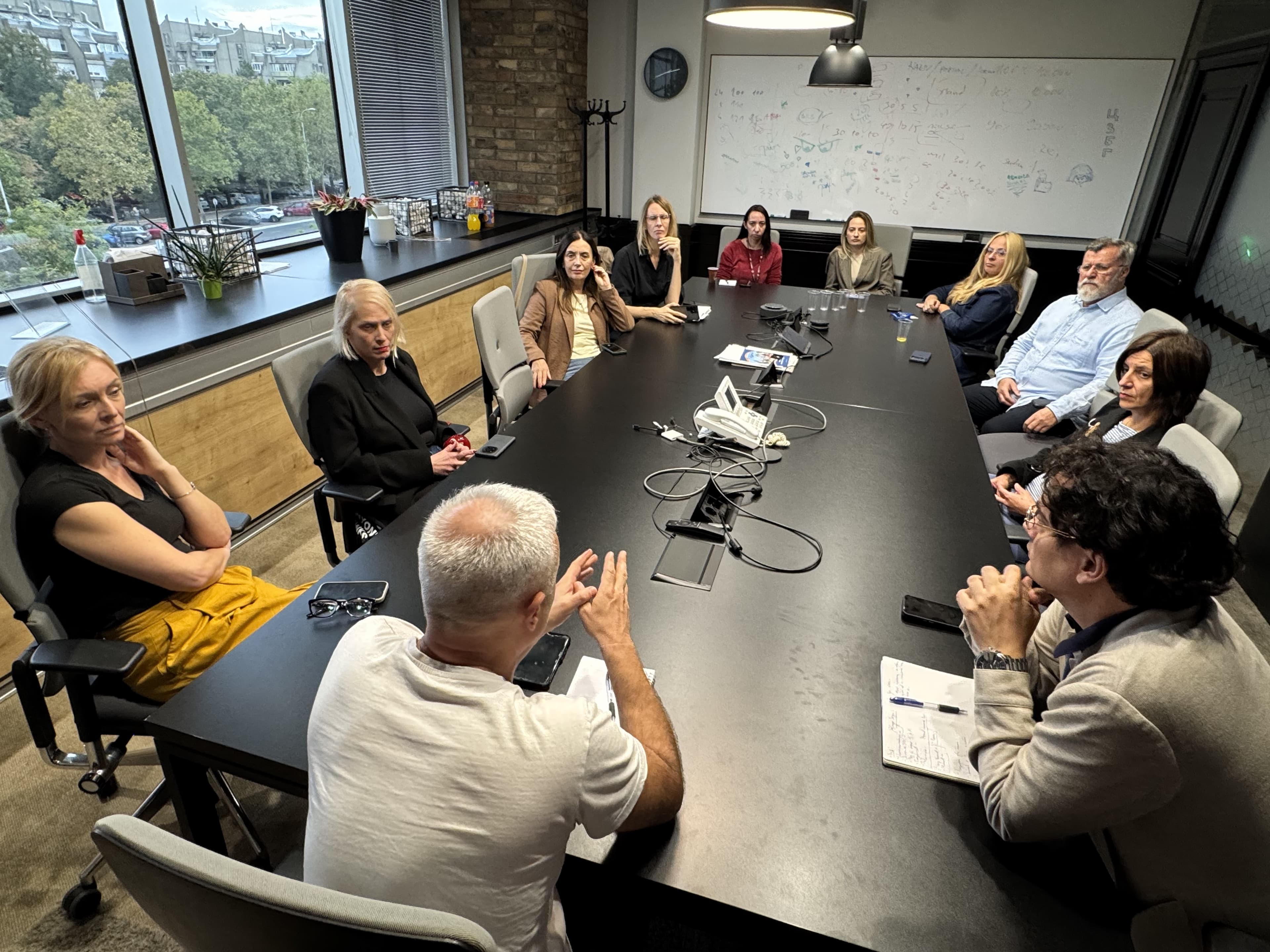
Journalistic associations provided support to the editorial team of Nova.rs: Ongoing communication and updates with international stakeholders agreed upon.

Coalition for Media Freedom: Stop Attacks and Harassment of Journalists During the Election Campaign
.png&w=3840&q=75)