

The Danas journalist Uglješa Bokić was questioned by the police: “I perceive this call from the prosecution as pressure on myself and independent journalism.”
Journalist of Danas, Uglješa Bokić, was interrogated today at the police station in the Novi Naselje area of Novi Sad at the request of the Basic Public Prosecutor's Office. In his statement to the police, he did not wish to disclose his sources. The prosecutor ordered the interrogation due to the publication of portions of a police official report on the Danas portal, related to the arrest of Novi Sad lawyer Nemanja Aleksić in early April of this year.
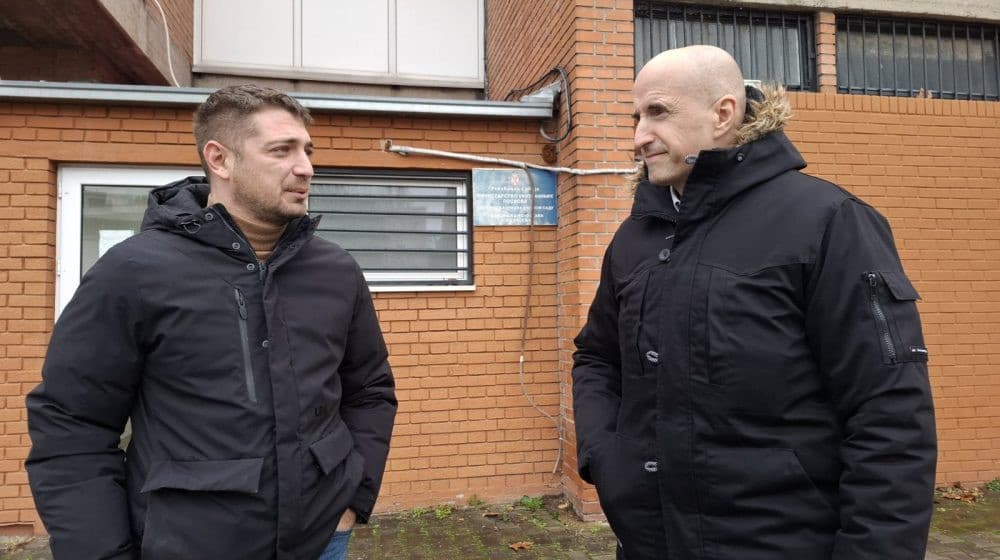
The prosecutor's office has instructed the police to question Bokić regarding the circumstances of the criminal complaint filed personally by attorney Aleksić against an unknown person for the criminal offense of Violation of Procedural Secrecy.
His criminal complaint has been accepted, and the prosecutor's office has initiated a preliminary investigation.
The editorial team of Danas learned from a source in the prosecutor's office that the police have been instructed to ask Bokić who provided him with the official note, when it was delivered, whether he still possesses the note, and to instruct him to surrender it to the police if it is still in his possession.
After the questioning, Bokić stated that this summons from the prosecutor's office has only one goal – to pressure independent journalists.
– The police asked me where I got the note, or how I obtained it. I stated that I do not wish to answer those questions because, according to the Law on Public Information and Media and the Code of Journalists of Serbia, I am not obligated to disclose my sources. I added that I perceive this action by the prosecutor's office as pressure on myself and independent journalism, since it has not been practice until now to summon journalists to inquire who provided them with certain information – said Bokić.
He notes that the story regarding the arrest of the Novi Sad attorney was not nearly as interesting or “sensitive” compared to many others he has recently published in Danas. Recently, he disclosed a story about whom the BIA was monitoring, along with a strictly confidential document, yet he points out that nobody called him to ask where he got that paper.
– I have no logical explanation for why this story, in particular, but when it comes to the complainant, which is attorney Aleksić in this case, I can't be surprised by anything. I cannot even believe that the prosecutor could propose such evidence-gathering action, if it can even be called that. I believe this is some kind of external pressure on her to ensure that this is done at all costs. If the motive is something else, to intimidate me, that is sheer nonsense. I am really not impressed that someone is calling me for talks at the police station. I have worked here and I am not afraid of the police – Bokić continued.
He emphasizes that everyone in the police was correct towards him. Incidentally, Bokić, as a former police officer, spent seven years precisely at the station in Novi Naselje where he was questioned today.
– I want to emphasize that this was not done at the initiative of the police but exclusively of the prosecutor's office. It was a bit strange to sit in the office where I spent so many years, but now from the other side. My sources, both current and future, can be absolutely assured that there is no possibility that I will ever disclose their identities, even in such cases when the prosecutor's office and police request it from me – he stated.
Goran Stupar, Bokić's attorney, believes that the authorities are trying to sever the connection between individuals and the public, which is represented only by the remaining free media.
– In this way, journalists are trying to be intimidated so that the authorities can learn which individuals have the courage to provide information to the media. This is a textbook example of intimidating journalists with a dual purpose. The first is to deter journalists from their intention to do their job, and on the other hand, to ensure that individuals who possess information of public interest keep it to themselves. We demand that state authorities do not interfere with independent journalists doing their jobs as permitted by law – Stupar said.
He notes that the prosecutor's office will obviously not obtain any information based on the questioning of Bokić.
– Let the prosecutor's office do its job in accordance with the law; if they obtain information on how Bokić acquired that data, let them take the necessary measures – concluded the attorney.
Let us recall that the Appellate Court in Novi Sad suspended the proceedings against Nemanja Aleksić in September, who was charged by the Basic Prosecutor's Office in that city for attacking and obstructing two traffic police officers in the performance of their duties, as well as threatening the safety of a driver in Veternik, whom he threatened with a golf club after a traffic dispute.
Following that incident, he was taken to the police station, where he was detained for up to 48 hours. While in police custody, he was tested with a rapid drug test, which showed a positive result for amphetamines, after which he was placed in custody for 30 days. Today, he received this official note from a source in the Novi Sad prosecutor's office, after which an article about it was published, authored by Uglješa Bokić.
However, a later drug test from a blood sample showed otherwise, indicating that attorney Aleksić was negative, which Danas also first reported.
In the summons for questioning that was served to Bokić, it was specified that he would be forcibly brought in if he did not respond to the questioning.
The editorial team of Danas considers this action by the prosecutor's office to be an unacceptable pressure on our journalist and the editorial staff, as well as on free journalism, especially since, according to the Law on Public Information and the Code of Journalists of Serbia, a journalist is not obligated to disclose their sources. The court can only order this in cases where the information pertains to a criminal offense punishable by a prison sentence of five years or more.
Source: Danas
Related Articles

Journalistic associations provided support to the editorial team of Nova.rs: Ongoing communication and updates with international stakeholders agreed upon.

Coalition for Media Freedom: Stop Attacks and Harassment of Journalists During the Election Campaign

.png&w=3840&q=75)