

How the mechanism that was supposed to prevent attacks on journalists has collapsed.
“How did the system collapse? I believe that this question best illustrates where Serbia stands today regarding the safety of journalists. What we are witnessing are not isolated incidents. This is not a temporary deterioration of the situation. It is a collapse of the mechanisms that are supposed to prevent attacks, protect journalists, investigate threats, and ensure accountability,” emphasized Tamara Filipović Stevanović, the General Secretary of the Independent Association of Journalists of Serbia (NUNS), at the two-day OSCE conference “Strengthening Journalism as a Public Good.” According to her, what we are witnessing are not isolated incidents and it is not a temporary deterioration of the situation.
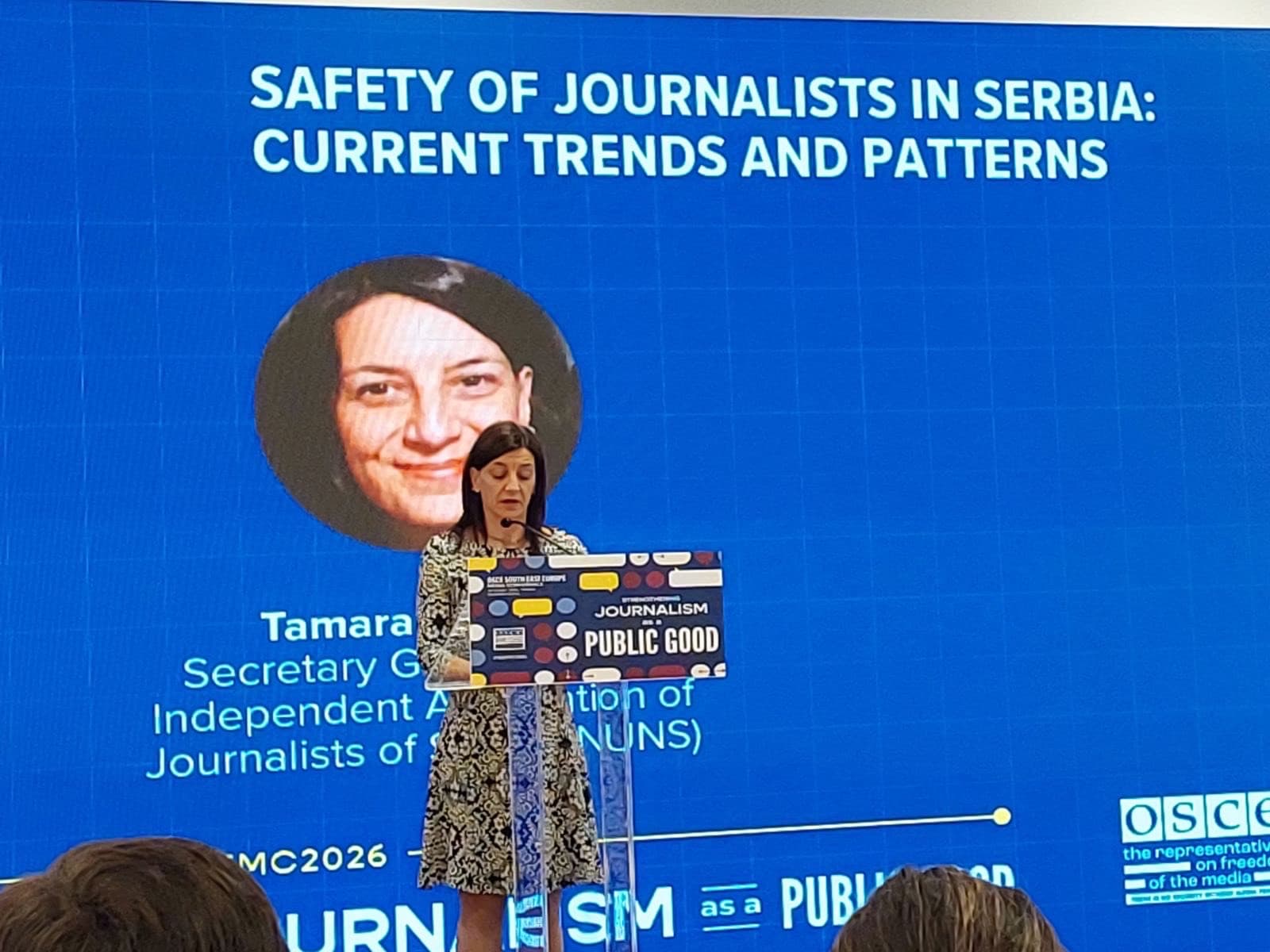
According to her, Serbia has officially earned the title of the most unsafe country for journalists in the Balkans. According to the latest Journalist Security Index for 2025, the country received a score of only 2.24 on a scale from 1 to 7 (where 1 signifies the worst scenario in which journalists are harmed or go missing). Serbia has thus permanently positioned itself in an extremely negative domain, and concerning trends have continued into the current year.
She presented data collected by NUNS within the SafeJournalists regional network, which testify to a geometric progression of threats to safety. With 131 recorded cases in 2024, the number of incidents skyrocketed to as many as 313 in 2025 – including 113 physical attacks and 124 death threats. To further confirm the alarming situation, data shows that in just the first four months of 2026, 118 incidents have already been registered, among which are 38 actual attacks.
According to her, several patterns lie behind these numbers.
First, violence has escalated and become more physical, direct, and public. A particularly concerning moment occurred on the day of local elections at the end of March this year.
“On that day, the level of violence against journalists was unprecedented. Yet, nearly two months later, in the six most severe cases of physical attacks on journalists – including attacks that, according to the testimonies of the journalists who survived them, can be described as attempted murder – the perpetrators have still not been identified,” emphasized the Secretary General of NUNS, adding that hope cannot replace accountability.
“When attacks of this severity remain unresolved for weeks and months, the message sent to journalists is devastating.”
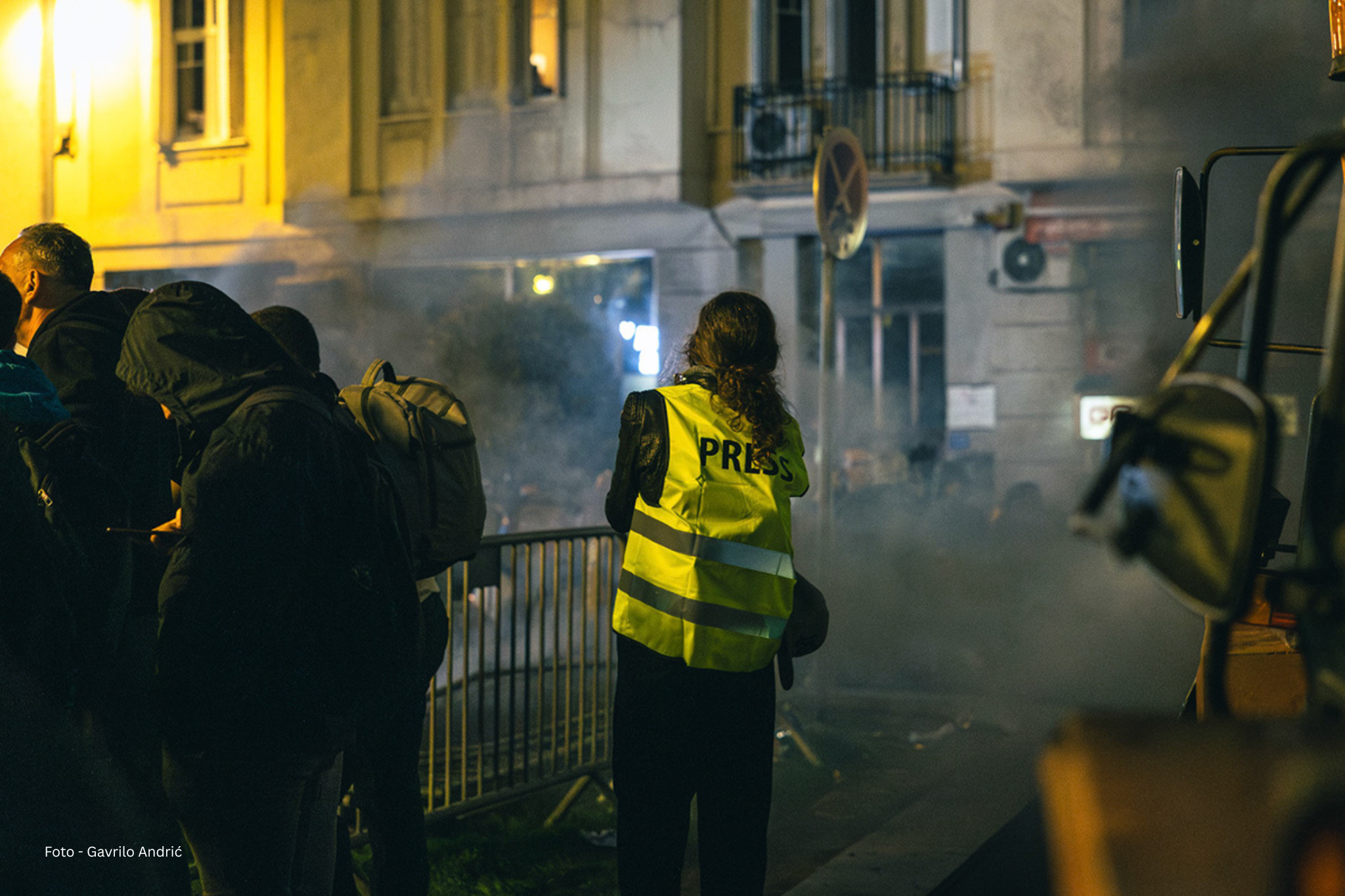
Second, the police have increasingly become a source of danger for journalists, rather than a source of protection. According to her, there is no longer talk of a passive lack of response but of situations where police officers witness attacks and do not intervene, as well as cases where the police themselves use force against journalists reporting from protests and public events. According to data from the prosecution, there were 64 cases related to the safety of journalists in 2024, and in 34 cases, the police did not act upon the prosecutor’s orders. In 2025, the prosecution recorded 140 cases, and in 50 of them, the police did not follow the prosecutors' instructions. Therefore, we clearly state: the police have become one of the key sources of risk for journalists in Serbia.
Third, attacks do not begin on the street. They start in speech. Serbia is witnessing a mass expansion of smear campaigns, discreditation, and dehumanizing rhetoric aimed at critical journalists and media outlets. These campaigns are not limited to tabloids or marginal actors but are amplified on national television and by the highest state officials.
Fourth, legal pressures remain a serious tool for silencing journalists. SLAPP lawsuits continue to be used as a form of intimidation and exhaustion.
She specifically pointed to a new danger, the existence of spyware. One device compromise has already been confirmed, along with at least three unsuccessful attempts to attack the phones of journalists. Criminal charges have been filed, but there is still no resolution.
“Impunity is, in fact, the key word. Last year, despite the highest number of recorded cases since the beginning of systematic monitoring, only three convictions were handed down for attacks on journalists. At the same time, many cases remained in the evidence-gathering stage, while around 30 criminal charges were dismissed. When journalists see that attackers are not punished, that threats are normalized, and that institutions respond slowly or selectively, the result is predictable: fear, self-censorship, and deep distrust in the system.”
She pointed out that the impunity for the murders of journalists in Serbia is absolute. “In three murders and one attempted murder of journalists over the last three decades, no one has been justly punished. This is not just a failure of justice towards the victims and their families; it is a message to every journalist working today that even the gravest crimes can go unpunished.”
So, when we ask how the system has collapsed, the answer is as follows:
- It collapsed when public officials began to target journalists instead of protecting them.
- It collapsed when the police began to pose a threat instead of a guarantee of safety.
- It collapsed when prosecutors opened cases, but justice did not follow.
- It collapsed when smear campaigns became normalized.
- And it collapsed when impunity became expected.
“Therefore, the safety of journalists in Serbia is not a narrow professional issue. It is a democratic indicator. It shows whether institutions still function in the public interest. It indicates whether the rule of law exists in practice.
According to her, we no longer need declarative promises of support but action and urgent identification and prosecution of those who attack journalists. Clear institutional accountability for police inaction and police violence. Stronger protection against online threats, spyware, and abuse of lawsuits. And an end to the public stigmatization of journalists by holders of power.”
She emphasized that journalists in Serbia continue to work professionally, courageously, and with exceptional quality.
“Journalists in Serbia continue to do their job. But they do so in an environment where the cost of reporting is becoming dangerously high. And no democratic society can afford to accept this as normal.
Source: NUNS
Related Articles

Journalistic associations provided support to the editorial team of Nova.rs: Ongoing communication and updates with international stakeholders agreed upon.

Coalition for Media Freedom: Stop Attacks and Harassment of Journalists During the Election Campaign


.png&w=3840&q=75)