
Council of Europe Platform: Serbia one of the main hotspots for attacks on media freedom
In the past year, Serbia has emerged as one of the main focal points for attacks on media freedom in Europe, according to the annual report of partner organizations of the Council of Europe Platform for the Protection of Journalism and the Safety of Journalists.

According to reports, the number of attacks on journalists rose sharply during the year 2025, as the media environment became increasingly hostile towards journalists, particularly following the collapse of the roof at the railway station in Novi Sad, which sparked protests against corruption across the country.
The report titled "At a Turning Point: Media Freedom 2025" assesses that the situation for independent journalists reporting on protests and from the front lines of demonstrations has deteriorated.
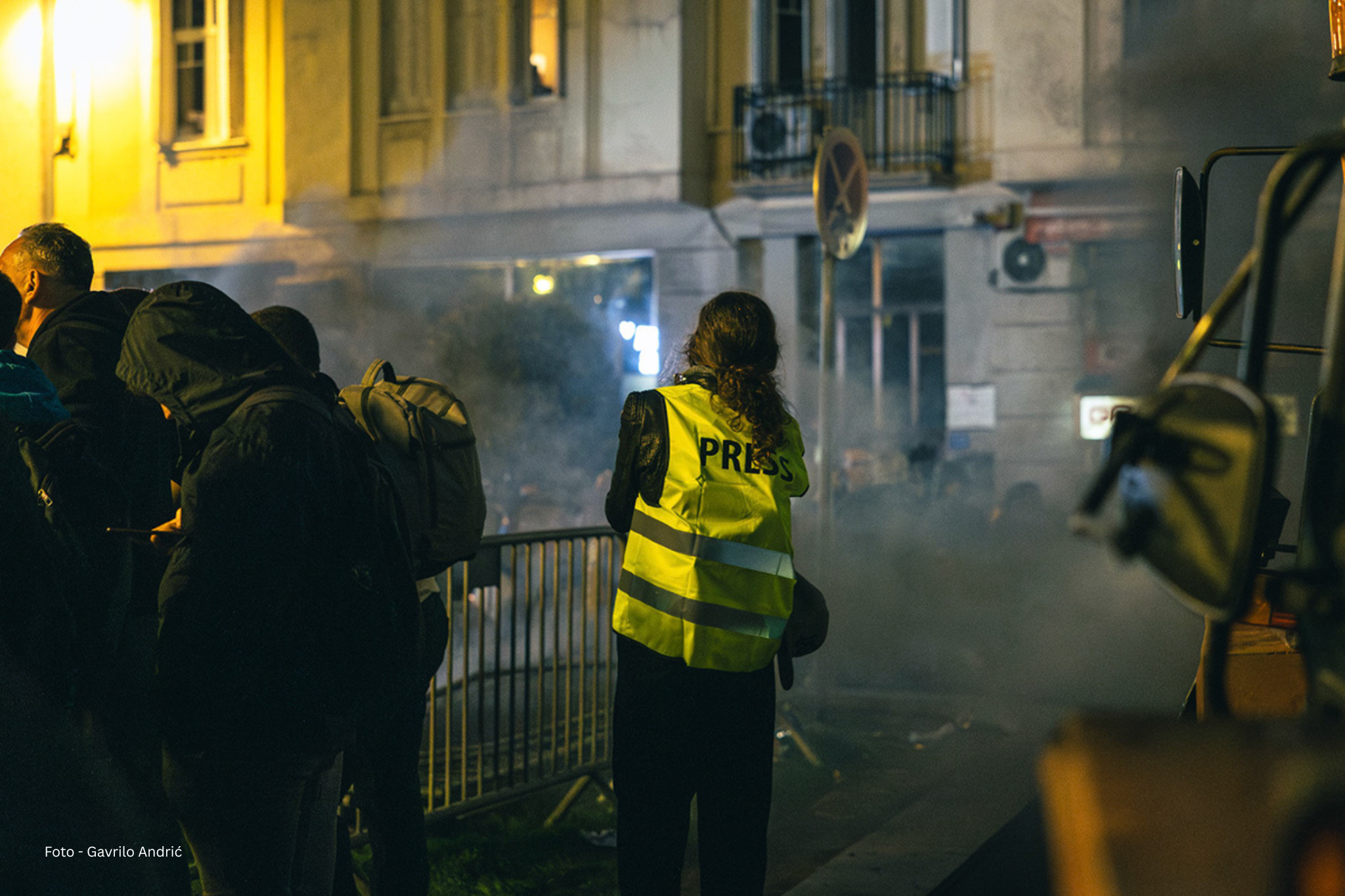
“The excessive use of force by law enforcement posed an additional serious risk to journalist safety, with police officers responding either by inaction or by directly confronting journalists with violence and arbitrary arrests,” the report states.
The protest held in Belgrade on June 28, where numerous journalists were injured, is particularly highlighted and described as “especially violent.” It is also noted that in Novi Sad, there have been multiple recorded instances of interference with journalists, including arrests and the confiscation of equipment.
The annual report from partner organizations of the Council of Europe Platform for the Promotion of Journalism and the Safety of Journalists states that the statements of high-ranking officials, including President Aleksandar Vučić, “contributed to fostering hostility towards independent voices by portraying them as ‘enemies’ of the state.”
Hostility Particularly Directed at N1
It adds that this “hostility” was particularly directed at “the main remaining independent television station N1” in several ways, from the public support Vučić provided to the smear campaign led by a pro-government tabloid against N1 journalists, to the public humiliation of N1 journalist Mladen Savatović, who received new threats in the days that followed.
The report notes that in July of last year, after President Vučić labeled N1 as “pure terrorism,” the newsroom received a letter threatening an attack “in the style of Charlie Hebdo,” alongside other death threats received daily via the internet.
It is assessed that this fits into a pattern of discrediting journalists and inciting hostility towards the media, with local journalists increasingly becoming targets of attacks. “Employees of N1, Nova, Danas, Radar, and Insider TV journalist Brankica Stanković were also targeted with threats of an attack ‘in the style of Charlie Hebdo’ from various perpetrators. Media professionals like Nenad Kulačin, Marko Vidojković, or Dinko Gruhonjić were targeted along with their families, facing smear campaigns and hate campaigns, while perpetrators are rarely brought to justice,” the report states.
It adds that the illegal use of advanced surveillance spyware continues to raise significant concerns for journalists and their sources, especially following recent cases of its installation on journalists' phones and other devices in 2025.
Targets of Smear Campaigns and Journalistic Associations
The report states that journalistic associations have also been targets of smear campaigns.
“The newly established Association of Journalists of Serbia (ANS) spread false narratives, labeling the Independent Association of Journalists of Serbia (NUNS) as an organization that ‘supports the organizers of unrest.’ The smear campaign, which was subsequently publicly supported by President Vučić, stemmed from NUNS providing protective equipment to journalists covering the protests,” the report states, adding that NUNS was also targeted by the pro-government tabloid Informer TV, which attempted to discredit the association by publishing confidential financial information.
The media monitoring for 2025 by the Center for Media Pluralism and Freedom (MPM), which maps risks to media pluralism and journalist safety across Europe, identified a high level of risk (68%) in Serbia, due to the concentration of the media market under increasing state and party control, the report notes. It also mentions that the appointment process for the Council of the Regulatory Body for Electronic Media (REM) was once again conducted in a flawed manner, lacking transparency and independence.
“In April, the main independent television channels, N1 and Nova TV, were removed from satellite television distribution, leaving viewers with no choice but to follow these channels online. In July, investigations by OCCRP and KRIK revealed politically motivated plans to undermine their independence. N1 and Nova were targets of attacks from multiple high-ranking officials due to alleged actions against the state,” the report states.
It further adds that this includes the Minister of Information and Telecommunications Boris Bratina, who stated that N1 and Nova “should not exist in our ether.”
The report mentions that even RTS, which has been criticized for its reporting on the protests, has not been spared from political interference, and that media professionals across various media outlets, such as Euronews Serbia, ELLE Serbia, Večernje novosti, and Politika, “were fired or forced to resign due to their opposition to censorship and defense of ethical journalism.”
Serbia Among Countries with Highest Number of SLAPP Lawsuits
Serbia remains one of the countries in Europe with the highest number of SLAPP lawsuits against the media, the report states, adding that the greatest burden is borne by investigative media dealing with crime and corruption.
The report references a solidarity mission conducted by the Consortium of European Organizations for the Protection of Media Freedom (MFRR) last April in Belgrade and Novi Sad, where they described the media situation as “emergency” and “marked by threats to journalist safety, the use of spyware, media captivity, and SLAPP lawsuits.” “In its report, MFRR called on authorities to end public attacks on journalists, halt illegal police actions and unlawful surveillance, investigate both recent and historical attacks, and ensure independent media and public broadcasting regulation. It also urged the European Union to publicly condemn attacks, smear campaigns, political interference in the media, and the use of spyware, as well as to consistently pressure Serbian authorities regarding the status of investigations into attacks on journalists,” concludes the annual report from partner organizations of the Council of Europe Platform for the Promotion of Journalism and the Safety of Journalists on Serbia, which was presented today in Brussels.
Serbia is highlighted in the report titled "At a Turning Point: Media Freedom 2025," alongside Azerbaijan, Bulgaria, Georgia, Hungary, Slovakia, and Turkey, and it cites other specific examples of pressure and attacks on journalists in Serbia, such as the attack by supporters of the ruling party on BIRN journalist Saša Dragojla, or the assault by police on several journalists covering the Vidovdan protest, despite their identification as media representatives.
The report also recalls the case of journalists from POP TV, RTL, and Slobodna Dalmacija, who were detained at the Serbian border before being banned from entering the country, noting that countries like Serbia and Georgia “are increasingly taking steps to prevent international journalists from reporting on protests.”
Female Journalists Frequent Targets of Online Abuse
In the section concerning threats to female journalists online, who are reported to be frequent targets of online abuse and the publication of personal data, the report recalls the case of Kristina Demeter Filipčev, editor and journalist of the Bečejski mozaik portal, who was subjected to insults and threats of rape after posting about a moment of silence for the victims of the tragedy in Novi Sad. It is also noted that the Supreme Public Prosecutor's Office of Serbia announced that it has initiated a pre-investigation procedure to identify the perpetrators.
The report also documents specific attempts to spy on journalists, such as the case of two journalists from BIRN, Bogdana (pseudonym) and Jelena Veljković, who were targeted in attempts to attack them with the Pegasus spyware via suspicious Viber messages while investigating foreign investments and alleged corruption in Serbia, warning that this indicates “a troubling weakening of democratic protection mechanisms.”
Source: N1
Related Articles

Journalistic associations provided support to the editorial team of Nova.rs: Ongoing communication and updates with international stakeholders agreed upon.

Coalition for Media Freedom: Stop Attacks and Harassment of Journalists During the Election Campaign

.png&w=3840&q=75)