
Press Advisory: 25 Portals Violated the Code with Articles about Veran Matic
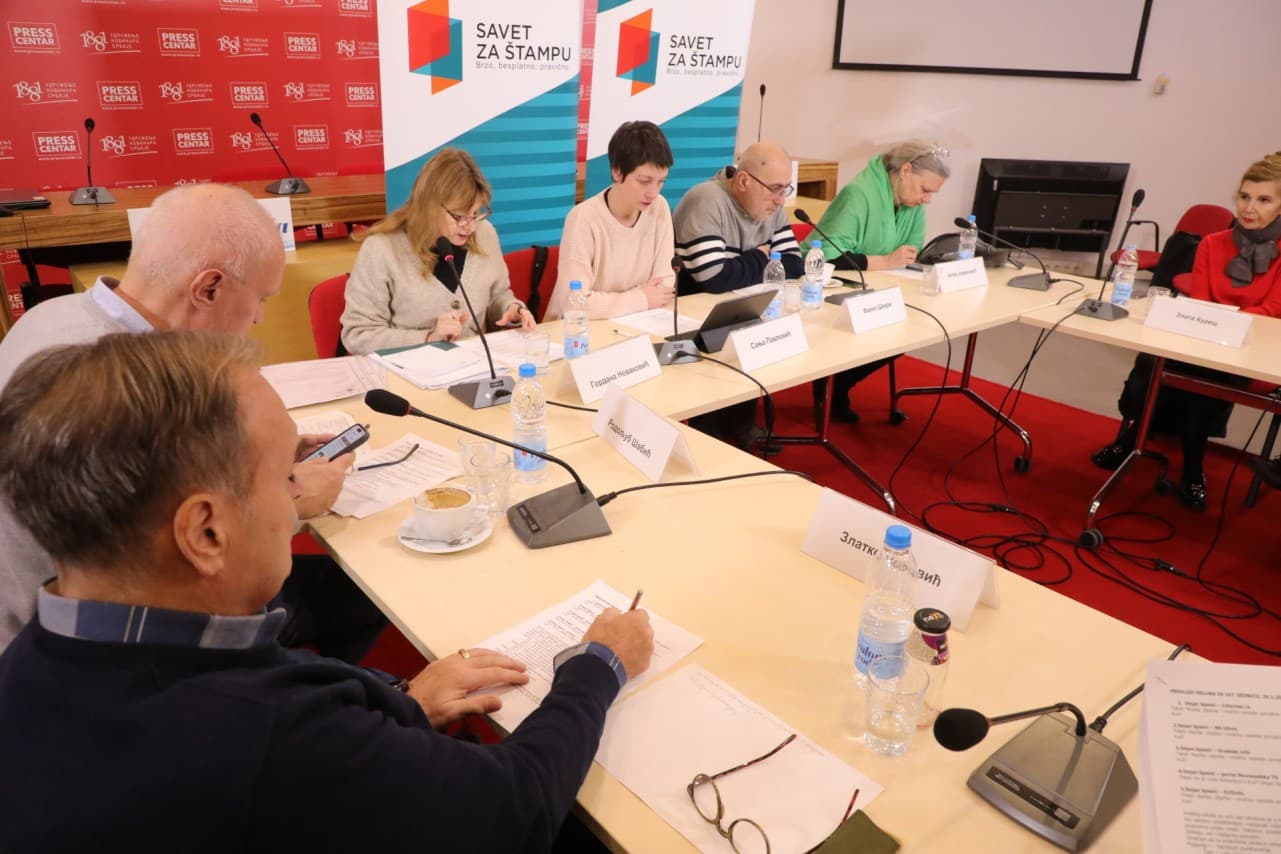
The Appeals Commission of the Press Council unanimously concluded at yesterday's meeting that 25 portals violated the Code of Journalists of Serbia with their articles about Veran Matić, the president of the Management Board of the Association of Independent Electronic Media (ANEM), specifically excerpts from the video segment produced by the Center for Social Stability that was aired on B92, Prva, Informer, and Documentary TV.
It has been assessed that multiple points of the journalistic code have been violated by these texts, which pertain to the media outlets Informer.rs, Srbija Danas, Alo.rs, Palanačke vesti, Glas Aranđelovca, Stara Pazova uživo, Nova Pazova uživo, Srbija na istoku, Podunavlje uživo, Knjaževačka hronika, Vojvodina uživo, Lučani uživo, NS uživo, RTV Pančevo, Novosadska TV, 24 sedam, Dnevnik.rs, 025.rs, Gradske info, Dunavtelevizija.rs, RTV Bap, 025info.rs, Drina Info, Moja Bačka Topola, and 024info.rs. Sremske vesti removed the text from its portal prior to the session, which is why the Commission did not discuss that media outlet.
In the complaint filed by Veran Matić, it is stated that these texts contain a series of falsehoods, that the facts are distorted and placed in a negative context, and that unfounded accusations have been made, with no opportunity for the “other side” to be heard, thereby damaging his reputation without any basis and jeopardizing his safety, considering that all the texts refer to him as a foreign mercenary, traitor, and similar.
Members of the Complaints Commission of the Press Council assessed in the session that these texts are part of an organized campaign against Veran Matić and that it is hypocritical for some of these media outlets to offer to publish a denial and “peacefully resolve the dispute” after the complaint was filed.
Commission member Jelka Jovanović emphasized that there is an evident intent by the regime and its followers to target Veran Matić in the most brutal manner, endangering his safety. “This has nothing to do with professional texts. It is pure, raw political propaganda in the worst sense,” Jovanović stated.
Jelena Petković noted that the documentary “Zlo doba 2,” which is the impetus for these texts, directly threatens the safety of Veran Matić and that this work by the Center for Social Stability is chilling and dangerous.
“Matić is blamed for everything you can think of that is worst about someone; all of that is attributed to him. These texts are actually part of that campaign; they are an extended arm for those who have not seen the film, which is an absolute violation of the entire code and has nothing to do with journalism,” Petković emphasized.
Filip Švarm, regarding the justification of certain media for relaying someone else's text, reminded that there is no journalistic reason to relay the same text unless it is part of a campaign. He added that all media bear responsibility, as by relaying the same content, they have participated in the campaign.
Olivera Milošević also stated that this is a form of organized campaign with a perfidious goal, which is the obvious validation of readership, due to uncertainty over whether sufficient effects have been achieved by the film.
The Commission assessed that all these texts violated points 1, 2, and 3 of Chapter I, which state that journalists are obliged to present accurate and verified information, to report impartially, and to communicate in an appropriate context, that they must make a clear distinction between the facts they report and comments, assumptions, and speculations, and that the publication of unfounded accusations, slander, and rumors, as well as content whose author is unknown, is incompatible with journalism.
Additionally, point 2 of Chapter II was violated, which states that the economic and political interests of publishers must not influence editorial policy in a way that results in inaccurate, biased, and incomplete information.
Furthermore, points 2 and 3 of Chapter III were violated, which pertain to journalists cultivating the culture and ethics of public discourse, not using hate speech, aggressive rhetoric, or rhetoric that may incite discrimination or aggressive behavior, and that journalists are primarily responsible to the public and must not subordinate that responsibility to the interests of others: publishers, corporations, governments, and other state bodies. It was assessed that point 4 of this chapter, which states that editors are responsible for the entire content of the media, was also violated.
Within Chapter V, point 3 was violated, which states that journalists must respect the principle of not causing harm to the reputation and dignity of individuals and must not participate in spreading falsehoods or in the continuous malicious undermining of the reputations of the individuals they report on.
And finally, point 3 of Chapter VIII was violated, which stipulates that journalists are obliged to consult as many sources as possible, as none of these media called to hear the other side of the story.
Recording of the meeting of the Appeals Commission of the Press Council; Source: Press Council / YouTube
Related Articles

Journalistic associations provided support to the editorial team of Nova.rs: Ongoing communication and updates with international stakeholders agreed upon.

Coalition for Media Freedom: Stop Attacks and Harassment of Journalists During the Election Campaign

.png&w=3840&q=75)