

Warning from the mission of international journalism organizations: The safety of journalists in Serbia has shifted from bad to "explosive."
Representatives of partner organizations of the Rapid Response Mechanism in the field of media freedom and the Council of Europe Platform for the Promotion of the Protection of Journalism and the Safety of Journalists today warned, in front of the location where Slavko Ćuruvija was murdered, that the situation regarding the safety of journalists in Serbia is "explosive."
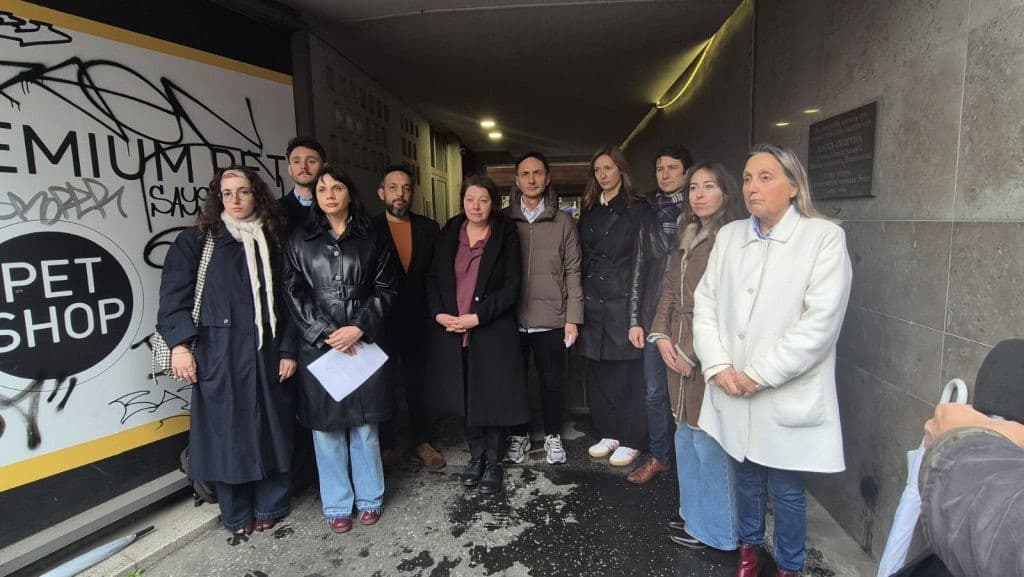
Eight partner organizations of the MFRR and the Council of Europe Platform, currently on a mission to assess the state of media freedom in Serbia, met yesterday with journalists, media representatives, journalism and media associations, unions, civil society organizations, police, as well as with the President of the National Assembly of Serbia, Ana Brnabić.
Magnisalis: Journalists in Serbia are being dehumanized and criminalized
Kamil Magnisalis from the European Federation of Journalists (EFJ) stated that the situation regarding the safety of journalists was bad last year, and now it is – explosive.
On the Mapping Media Freedom platform, she reminded, more than 208 cases of media freedom violations were recorded last year, which is more than double compared to 2024, and this year, although it has just begun, is even worse.
“These are not just numbers. They represent the reality in which journalists in Serbia are dehumanized, criminalized, and constantly threatened, including with death. They are increasingly attacked by the police and work in a hostile environment perpetuated by state officials and politicians through smear campaigns,” she said.
Smear campaigns have been, as Magnisalis emphasized, one of the key issues that representatives of this mission raised in discussions with Ana Brnabić, along with the message that the use of dangerous rhetoric against media professionals must cease.
“An official condemnation of all forms of attacks on journalists is crucial to prevent further escalation of violence before another journalist is killed,” she stated.
Brnabić, according to Magnisalis, indicated that Serbia would respond more frequently to warnings from the Council of Europe platform.
Salaj: The situation regarding media freedom in Serbia is at a historic low
Pavol Salaj from Reporters Without Borders stated that a significant signal from Brnabić, as well as from all government representatives, would be a public condemnation of all attacks on journalists.
He noted that the situation regarding media freedom in Serbia is at a historic low, and that all “red lines” have been crossed.
Salaj mentioned that the delegation symbolically gathered today at the site of Slavko Ćuruvija's murder, as not only has this case not received justice, but journalists who reported on the trial for this murder are now being prosecuted.
"I believe this is the original sin when we talk about cases of endangering journalists because the culture of impunity originates from here," Salaj said.
Čereševa: We are shocked by the Ministry of Internal Affairs' reaction to the data on attacks
Marija Čereševa from the Association of European Journalists stated that the delegation, after the meeting with representatives of the Ministry of Internal Affairs and the police, was disturbed by the lack of understanding of the seriousness of the problem and the police's failures in protecting journalists, as well as the absence of investigations into attacks on them.
“Even when specific and documented examples were discussed regarding cases where the police attacked journalists on duty, the relevant authorities stated that they had made no progress in resolving these cases,” she added.
She emphasized that there is no information about any case in which a police officer was held accountable for attacks or for failure to act in cases of attacks on journalists.
“This problem is further exacerbated by the fact that the police are increasingly unresponsive to requests from the prosecution, despite the importance of these cases. Due to the very small number of resolved incidents, more and more journalists are choosing not to report cases to the authorities – which clearly indicates a significant lack of trust in institutions,” she added.
Čereševa also pointed to new forms of endangering media freedom, such as the use of spyware against journalists, as well as cyberattacks on media websites and social media accounts.
Vajsman: Establishment of the REM Council is a priority
Džemi Vajsman from the International Press Institute (IPI) stated that one of the priorities is the urgent establishment of the REM Council, which should operate in accordance with professional and ethical standards.
Nik Williams from Index on Censorship highlighted the growing problem of SLAPP lawsuits, noting that the European Coalition Against SLAPPs recorded 16 such cases in 2024, which is the third highest number in Europe.
Brnabić, as Williams added, has shown interest in this topic and announced that she would address this problem in more detail.
Atila Mong presented demands: Introduce penalties for police violence
Representative of the Committee to Protect Journalists (CPJ) Atila Mong presented a series of demands from the mission, emphasizing the need to ensure justice in the case of Slavko Ćuruvija's murder.
He added that all forms of hostile rhetoric, harassment, and intimidation of journalists must be immediately stopped.
He also stressed that the police and other law enforcement agencies must be instructed to protect, not attack journalists, with the introduction of disciplinary sanctions for violations of internal rules and strengthening cooperation in prosecuting police violence, as well as adequate training for police officers.
He added that the use of spyware against journalists must be halted and all allegations of its prior use must be thoroughly investigated.
Mong stated that existing national mechanisms should be empowered and further developed, including the Permanent Working Group for Journalist Safety, which brings together the judiciary, police, and journalists to enhance the protection of journalists.
He added that timely appointments of members of the Regulatory Body for Electronic Media (REM) must be ensured, along with a fair, independent, and transparent process.
He also mentioned that the role of the Public Service Viewer Protector must be fully functional and independent, with enhanced direct communication with the audience.
Finally, he added that mechanisms to protect journalists from SLAPP lawsuits must be introduced.
The delegation consists of representatives from Article 19 Europe, the European Center for Press and Media Freedom (ECPMF), the European Federation of Journalists (EFJ), Reporters Without Borders (RSF), the International Press Institute (IPI), the Committee to Protect Journalists (CPJ), Osservatorio Balcani Caucaso Transeuropa (OBCT), the Association of European Journalists (AEJ), Index on Censorship, and the European Broadcasting Union (EBU).
Source: UNS
Related Articles

Journalistic associations provided support to the editorial team of Nova.rs: Ongoing communication and updates with international stakeholders agreed upon.

Coalition for Media Freedom: Stop Attacks and Harassment of Journalists During the Election Campaign


.png&w=3840&q=75)