
Due to salaries lower than 500 euros, journalists in the south are taking on multiple jobs.
Nearly 70 percent of media workers in the Pčinja District are taking on additional jobs to secure a monthly income sufficient for living, according to a study on the standards and situation of colleagues conducted in February this year by the portal Slobodna reč. During the research, attempts were noted to discourage journalists from speaking publicly about working conditions and the state of local media. One-third of currently employed colleagues earn less than the alarming amount of 60,000 dinars.
.jpg&w=3840&q=75)
Data obtained from the aforementioned survey shows that 30 percent of media workers in the Pčinja District have earnings below 60,000 dinars, while nearly 70 percent are in circumstances that require them to take on additional work. At the same time, close to 90 percent of respondents openly state that they are not adequately compensated.
The economic dependence of the media, as one of the most prominent issues, as indicated by the interlocutors of Slobodne reči, is conditioned by the socio-political situation in the local community where "everything revolves around politics." Additionally, high levels of media unfreedom, the overall position, and safety of media workers are accompanying factors of such a situation, which is why an increasing number of professionals are moving to "other waters."
This is confirmed by the results of our research — over 60 percent of respondents are considering leaving the profession, with nearly 40 percent thinking about it occasionally, while a quarter is doing so seriously.
The reasons are also supported by previous research. The "Report on Media Reporting in Southern Serbia," published in June 2025 by the Association of Independent Electronic Media (ANEM) and the Center for the Development of Local Media, highlighted financial instability and raised questions about the survival of local media, along with a decreasing number of resources for training young staff. Meanwhile, the research "Social Position of Employees in the Media in Vranje," conducted by Slobodna reč in 2021, already recorded low wages, insecurity, and an uncertain future as key problems.
Salaries are half of the national average
An anonymous survey titled "Standards and Position of Media Workers in the Pčinja District" conducted by our portal took the form of an online questionnaire, and the data obtained testify to the standard of a total of 20 media workers in the Pčinja District, half of whom are from Vranje.
The survey examined the level of labor law security, economic security, gender and professional inequality, as well as the predictions of media workers regarding the sustainability of the profession.
The largest percentage of respondents (56 percent) is engaged in online portals, an equal percentage (31 percent) is engaged in television and social media, while 19 percent of respondents are currently not employed in any media outlet, with 6.3 percent working in radio and print media.
About 14 percent of female and male journalists work without any contract or are paid through a third party.
Only a third of respondents (around 33 percent) have so-called "permanent" employment contracts (for an indefinite period), while slightly less than 20 percent have fixed-term contracts, meaning that half of media employees have employment contracts with all paid taxes and contributions.
The percentage of those who have their own entrepreneurial agencies through which they charge services to media outlets is close to 20 percent, as is the percentage of those with service contracts.
The majority of media workers in the Pčinja District have net earnings below 60,000 dinars, which is half of the national average, which was 118,429 dinars in February. Another third have no income at all, and only 12.5 percent of respondents earn more than 75,000 dinars.
This means that most media workers in the Pčinja District cannot cover the costs of the average consumer basket, which was 109,449.45 dinars for August of the previous year (the last officially publicly available data on purchasing power).
A third of respondents still work in insecure jobs — with service contracts or without any contracts — which is a slight increase compared to 2021. The majority believe that they would not be creditworthy in a bank.
The results also show that regardless of the level of economic security, as much as 75 percent regularly work on weekends, while 25 percent do so occasionally, and that of the total number, nearly 70 percent of workers do not receive bonuses or rewards from their employers for their work.
Over 60 percent of respondents believe that their female colleagues in the professional environment are subjected to additional pressures or inadequate treatment compared to their male colleagues.
The same percentage anonymously reports that they have personally been exposed to such pressures. Nearly 40 percent experience this frequently (12.5%) or occasionally (25%).
Local journalists increasingly endangered
Assessing the level of labor law security in local communities, including the Pčinja District, Marija Babić, a lawyer from the Independent Journalists' Association of Serbia (NUNS), notes that there is "great exhaustion among media workers locally," and that this is a result of a broader picture, namely "a difficult financial situation."
She states that there is a specific impression among local journalists that they are constantly working and that they are in those media 24 hours a day, seven days a week.
"The situation is so bad that even those who work in these media do not think about their rights regarding overtime, rest, shifts – they don't even consider it," says Babić.
When asked which rights are most often endangered locally, Babić mentions the frequent signing of "insecure contracts" and work outside of employment relationships, reminding that there are also many abuses by employers.
"What is a problem for us is that this is often abused, and when you sign a copyright contract – you are given a specific task, and you need to complete that task within the timeframe specified. This means you do not need to have working hours. You do not need to come to the office. However, in our case, there is some kind of – I can freely say abuse, and you have people who work in certain media, who come to work, who have working hours but do not have rights like other employees when it comes to the Employment Contract," emphasizes our interlocutor.
Babić concludes that the previous year was record-breaking, both regarding the endangered labor rights status of journalists and the number of recorded physical attacks and threats against journalists.
A significant number of employment contracts were terminated, and freelance contracts were not renewed for certain individuals who had been working under the same conditions for years, simply because in some cases they protested in their media regarding professional standards and refused to work below them, concludes Marija Babić.
Being both employer and employee
From a personal and professional perspective, Ljiljana Pavlović, founder and editor-in-chief of the portal Vesnik017, reflects on how the poor situation locally arose due to media privatization, economic insecurity, and a low level of media freedom, emphasizing that "everything revolves around politics."
"I am currently not working for another employer. I am both my own employer and employee, which means that if I earn – that's good, and I am to be credited, if I don't – again, it is my fault. But on the other hand, I emphasize that in small communities, if you engage in this job and you are not a member of the ruling party or coalition – you struggle to survive," emphasizes Pavlović.
Commenting on the situation in the Municipality of Vladičin Han and the media she founded, Pavlović states that after receiving non-refundable funds for starting the media from the National Employment Service (NSZ) – she often "paid taxes and contributions out of her own pocket."
Pavlović testifies that the "passage" of local media in national competitions is complicated by market conditions and competition, emphasizing that for this reason, it is significant for media to be supported by local governments through competitive co-financing. However, the support that local media expect, she adds, depends on the personal choice of authorities that favor the compliant.
When it comes to commercial financing, media in Vladičin Han, like most local media – have few choices left, as local advertisers either "do not need" advertising or seek advertising space outside the area in which they operate.
"The same situation existed when the economy was part of social capital; it is the same now when it is in private hands. This means that maybe someone entering a business will pay for your advertisement – that's short-term and eventually, only those who believe that independent media are needed in society."
Touching on her experiences as a media worker, she says that "it has never been easy to earn in this profession" and that with a permanent job at a local radio station, she worked part-time for nearly two decades.
However, she evaluates "this time" as "the hardest," at least for those media that strive to report objectively. She admits that she often fails to secure interviewees for objective reporting and that communication with "responsible parties" is often reduced to written requests and invoking the Freedom of Information Law.
"Even when it comes to some positive topics – people are simply afraid to be featured in the pages of Vesnik. I believe that there is no freedom of reporting. Compared to that earlier period, although there have always been people calling and asking what you wrote, there has never been as much unfreedom as now," explains Pavlović.
Although on the brink of survival, the love for journalism and the investigative instinct still persist in the Pčinja District, as best evidenced by the example of Pavlović, who began to consider establishing her own media business after losing her job.
"After a while, you get tired of working for ridiculous fees a few months a year for someone else and spending the remaining six months working for free just to get those six months where someone pays you. Secondly, I lost my job at an age when you are not welcome by employers, especially private ones, and since you have not engaged in anything but writing, you are no longer at an age where you can physically endure all kinds of jobs," testifies Pavlović.
The survival of employees in the media in the Pčinja District is not determined by their standards and position but exclusively by personal enthusiasm driven by "family support" and "a few people who are there to provide professional assistance," as shown by the experiences of our colleagues.
Source: Slobodna reč
Related Articles
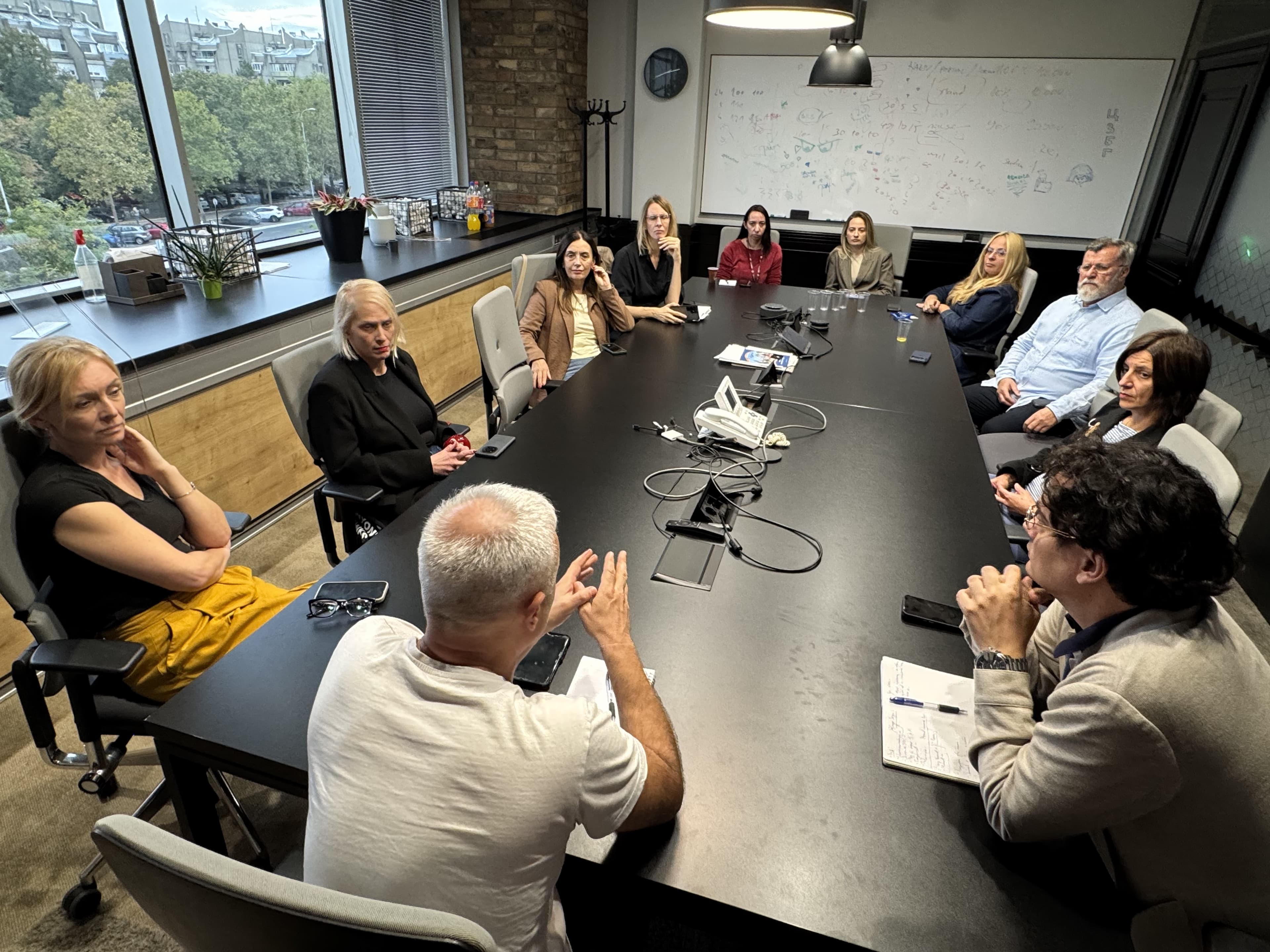
Journalistic associations provided support to the editorial team of Nova.rs: Ongoing communication and updates with international stakeholders agreed upon.

Coalition for Media Freedom: Stop Attacks and Harassment of Journalists During the Election Campaign


.png&w=3840&q=75)